A brand sourcing a dark-faced paddle can approve a striking rendering and still receive a sample whose edge color, handle proportions, or overall feel differs from its brief. In this Black Kevlar project, the visible gradient edge is as much a specification item as the named face and core.
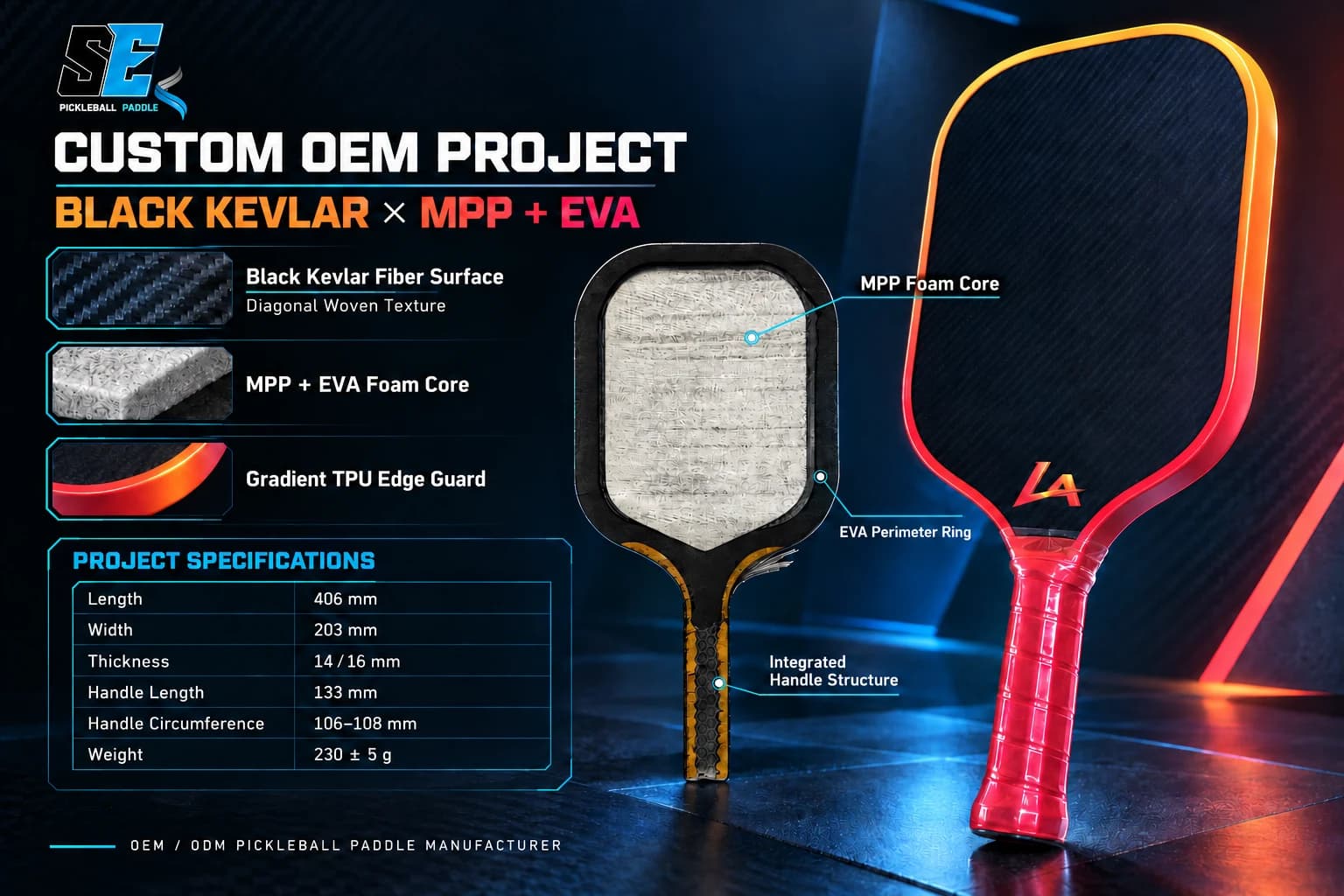
Specify the paddle as one connected build: Black Kevlar face, MPP + EVA core, gradient edge, outline, thickness option, handle dimensions, target weight, and a physical finish reference. Use the configuration graphic for the recorded specification and the project close-up for the face and edge actually visible. Then review a sample against one agreed checklist before approving a production version.
Below, we separate what the project records from what its photograph shows, then turn both into a practical brief for a custom paddle supplier. The aim is to help a buyer ask precise questions without treating a material name or a marketing image as a measured result.
What was specified in this Black Kevlar paddle build?
Imagine a buyer forwarding only a photo of a black paddle and writing, “Make this, but with our colors.” That request leaves the face, core, profile, handle, and edge treatment open to interpretation.
The recorded configuration pairs a Black Kevlar face with an MPP + EVA core and a gradient edge. Its overview lists a 406 × 203 mm outline, 14 mm or 16 mm thickness options, a 133 mm handle, a 106–108 mm grip circumference, and 230 ± 5 g as the listed weight. These are specification values to confirm for the chosen sample, rather than measurements taken from the photo.
The face label deserves its own line in a purchase brief. The material owner describes Kevlar as a para-aramid fiber1; that background helps explain the material category but does not identify the precise fiber grade, weave, resin, or layup used in this paddle. If those details matter to your brand, request the supplier's project-specific material description or agreed material evidence. A product nickname alone is too broad for repeat ordering.
The MPP + EVA wording is the project's recorded core specification. It does not describe a visible cross-section in the supplied finished-paddle photograph. Treat the exact core construction, thickness choice, and any proposed substitutions as separate approval fields. Likewise, “gradient edge” should have a reference for its start and end colors, transition direction, and how the color meets the face and handle. A screenshot may communicate the direction, but a signed-off sample communicates the finish more reliably.
| Item | Recorded here | Buyer decision before sampling |
|---|---|---|
| Face | Black Kevlar | Confirm the exact face description and desired visible texture. |
| Core | MPP + EVA | Confirm the construction and what documentation the supplier can provide. |
| Thickness | 14 mm and 16 mm options | Select one sample option or request a controlled comparison. |
| Outline | 406 × 203 mm | Approve the drawing and measurement points. |
| Handle | 133 mm; grip circumference 106–108 mm | Agree how the finished wrapped grip will be measured. |
| Weight | 230 ± 5 g listed | Agree the target and whether the measurement includes final grip and artwork. |
| Edge | Gradient finish | Provide a color reference and approval photo of the final transition. |
For a broader view of available outlines and materials, compare the custom pickleball paddle options with this particular configuration. The catalog establishes choices; this case shows how one combination was described.
What do the project photographs actually show?
A buyer may receive a configuration graphic, a close-up, and several workshop images in one message. Those images answer different questions and should have different captions.
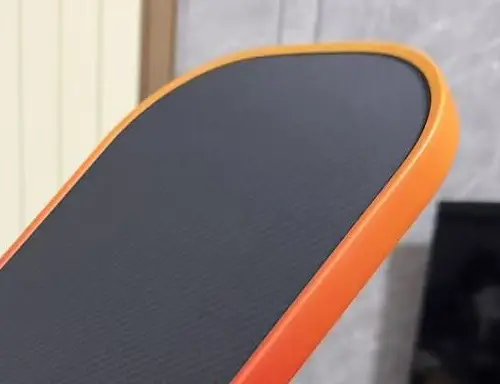
The project close-up shows a dark, finely textured finished face beside an orange edge whose color changes along the border. It is useful for discussing appearance, edge continuity, and the relationship between the face and edge. The graphic records the named materials and dimensions; the close-up does not expose or measure the core.
Read the close-up at three levels. First, look at the visible surface: the dark face has a small-scale texture, which should be compared with the texture wanted in your artwork and finish brief. Second, follow the edge: its orange tone varies, so a buyer should define where the transition begins and how uniform it must look from one paddle to the next. Third, look where the edge meets the face: request a straight-on and a side view of the sample so a supplier and buyer evaluate the same boundary.
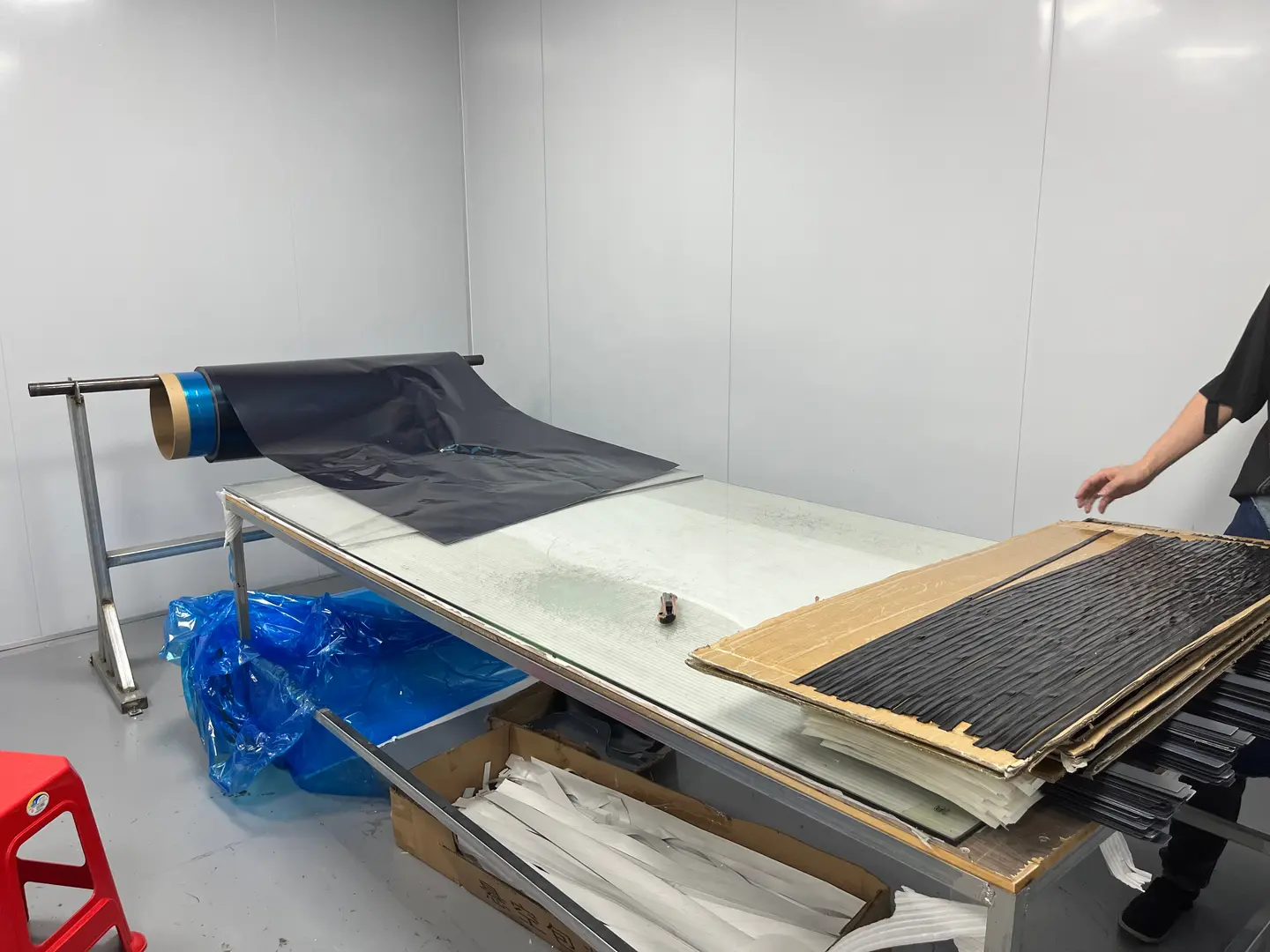
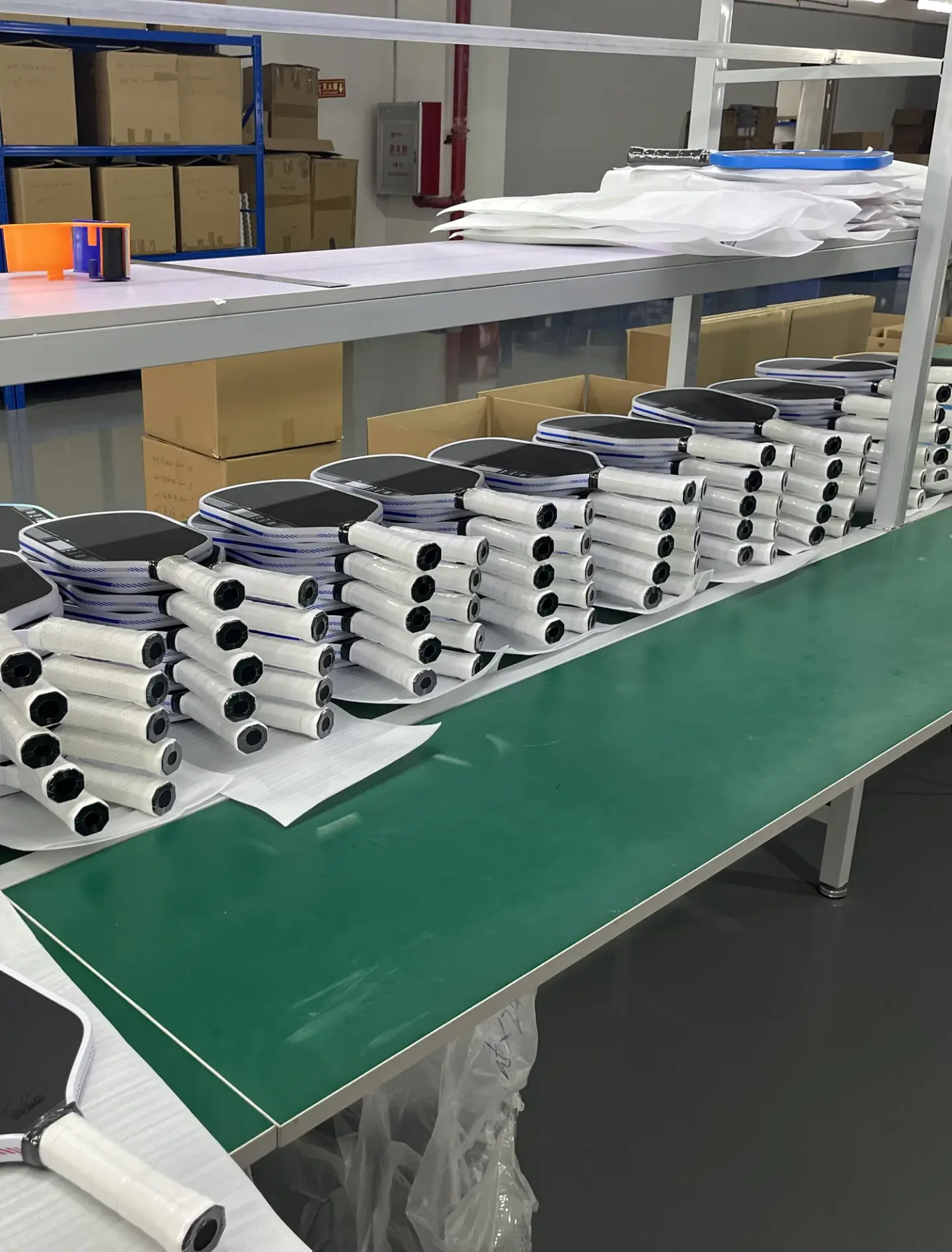
The factory image above is background on material handling. It helps explain that a finished paddle involves several process steps, but it is not evidence that any particular sheet in the frame became this case paddle. If a core claim is critical to a purchasing decision, use a bill of materials, build record, or agreed inspection method rather than asking a finish photo to do a different job.
A useful image request is specific: “Please show the whole face under neutral light, both side edges, the transition near the throat, and the handle with the final grip.” That is easier to act on than “send more photos.” Keep the photographs tied to the same approved sample number or version so the team does not compare different iterations by accident.
How should a buyer review the first sample?
After a sample arrives, one reviewer might focus on color while another checks balance or handle comfort. A single decision record prevents an attractive finish from obscuring an unresolved dimension or material question.
Review the sample in three passes: match the agreed specification, inspect the visible finish, then record any play or handling observations separately. Identify the sample version, measuring method, and conditions before comparing values. Approve changes in writing so the next sample can be compared with the same baseline.

Start with an agreed drawing and the final, gripped sample. Measure overall length and width at defined points; record thickness at agreed positions; measure the handle and grip after wrapping; and weigh the complete paddle using the same scale method each time. NIST's dimensional-calibration discussion2 explains why a measurement is an estimate with uncertainty. For a purchasing team, the practical consequence is straightforward: a number without the method or tolerance can generate avoidable disagreements.
| Check | What to record | If it differs |
|---|---|---|
| Dimensions and weight | Measured value, method, date, sample ID | Confirm tolerance and whether artwork or grip changed the build. |
| Face and gradient | Neutral-light front and side photos against the color reference | Mark the exact location and direction of the correction. |
| Edge fit | Visible gaps, finish consistency, corner and throat details | Ask for a corrected sample or an explicit accepted exception. |
| Grip | Circumference after wrap, feel, end-cap appearance | Choose the wrap and size to carry into the next version. |
| Build record | Face and core fields on the approved specification | Request project documentation for any material-sensitive claim. |
Material names should not be turned into an untested claim about spin, power, or durability. Original research on Kevlar hybrid face-sheet arrangements3 found different impact responses when the layup changed in foam-core sandwich specimens. Those specimens were not pickleball paddles or this MPP + EVA build. For sourcing, the useful lesson is to define the actual layup and test the finished sample if performance matters.
If your product is intended for sanctioned competition, assess its finished version against the current USA Pickleball rules and equipment standards4 and confirm its status through the relevant approval route. This case does not state that the paddle has been approved. That distinction is particularly useful when a private-label team is preparing packaging and marketing copy.
What should a brand send to request a similar build?
When a buyer likes this black face and gradient edge, the fastest next step is a short, complete brief. It should identify what is fixed, what is negotiable, and which choices must be seen on a sample.
Send the reference case, target outline and thickness, Black Kevlar and MPP + EVA requirements, grip dimensions, gradient color reference, artwork, expected order range, intended market, and the date by which you need a sample decision. Ask the supplier to return a written configuration and a sample review plan before a production quote is treated as final.
Write the gradient request in observable terms. “Orange to red toward the throat” is more actionable than “premium gradient,” but even that needs a reference image or swatch and a note about lighting. Specify whether the edge appearance should be identical on both sides, whether the handle wrap and end cap are fixed, and how artwork may intersect the dark face. Separate mandatory attributes from preferences: if the core is essential but the exact edge tone is flexible, say so. That helps a supplier propose a sensible sample without quietly replacing a non-negotiable part.
| Field | What to provide | What to ask back |
|---|---|---|
| Reference | This case URL and your own finish reference | Which pictured details can be matched or need revision? |
| Construction | Black Kevlar face; MPP + EVA core; selected thickness | How will the exact material build be recorded? |
| Geometry | Target 406 × 203 mm, handle 133 mm, grip range | What drawing and measurement convention will be approved? |
| Appearance | Gradient direction, colors, logo and grip artwork | What sample photos and swatches will be used for sign-off? |
| Commercial brief | Estimated quantity range, packaging, market, decision date | Which assumptions affect the quotation or sampling sequence? |
You can compare this build with the other custom paddle case studies if you are deciding between a gradient, metallic, or glossy edge. If the production sequence itself is part of your supplier evaluation, the manufacturing overview provides the broader process context. Neither page substitutes for a project-specific sample approval.
The USA Pickleball equipment-submission FAQ5 describes a separate approval process for finished paddles. If approval is part of your launch plan, raise it early so artwork, final construction, testing, and packaging claims can be managed in the right order.
Conclusion
This Black Kevlar case is most useful as a precise starting configuration and a visible finish reference. Choose the thickness and edge treatment you want, request a documented sample, and compare the sample with the same written brief that will govern the next step.
Planning a Black Kevlar paddle for your brand?
Send your drawing or reference, desired materials, gradient colors, grip details, and sample questions. We can discuss the specification you want to verify.
Footnotes
- Arclin, “What Is Kevlar,” explains the para-aramid material category; it does not document this paddle's exact fiber grade or layup. ↩︎
- NIST, “Uncertainty and Dimensional Calibrations,” supports recording measurement method and uncertainty, not a tolerance for this paddle. ↩︎
- PubMed record of experimental Kevlar-hybrid foam-core sandwich research, used to explain why specific layup and test conditions matter; not a test of this paddle. ↩︎
- USA Pickleball rules hub, the current route to rulebook and equipment standards. No approval is claimed for this case. ↩︎
- USA Pickleball equipment-submission FAQ, explaining that finished paddle approval is a separate process. ↩︎