A quotation can look detailed and still leave you unsure what the paddle actually includes. If the same logo appears on the face, grip ring and butt cap, are you paying for one customization or three? I start with the physical build, because dividing an undefined paddle into smaller prices only makes the uncertainty look more precise.
Our base paddle price depends on the selected face material and core combination. Choose those in our website's paddle configuration section first, then confirm whether the grip-ring logo, grip wrap and butt-cap logo need customization. Once the configuration and accessory requirements are clear, we can give the final paddle quotation and distinguish manufacturing, printing, packaging and any separately quoted development work.
The useful breakdown is not a factory's confidential cost ledger. It is a buying tool: you should understand what each quoted amount delivers, what changes its price and whether it repeats on another order. I work through four decisions, from the base build to the packed product, without turning a price discussion into a list of unnecessary upgrades.
Which Material and Core Combination Sets the Base Price?
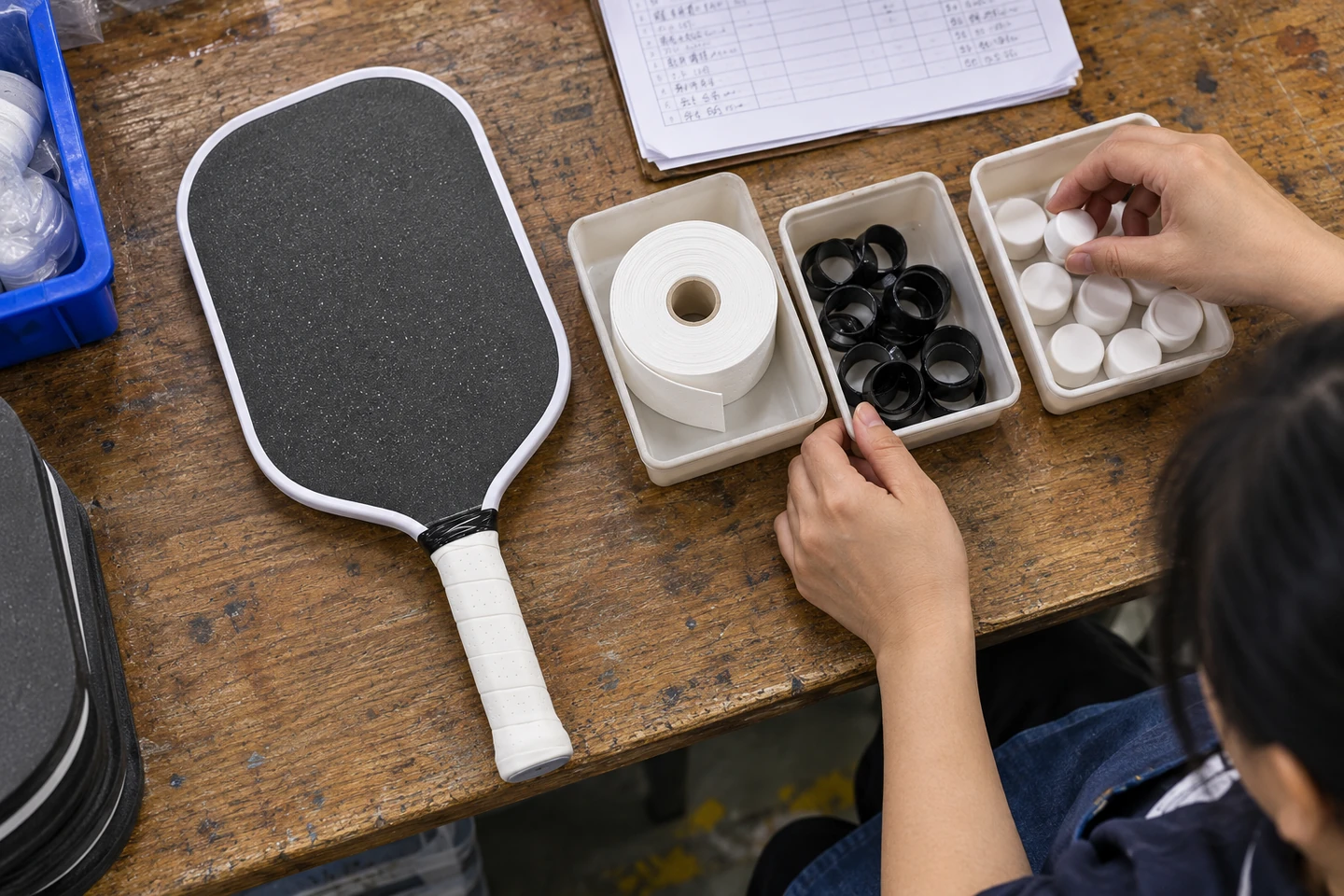
The first price comparison fails when two apparently similar paddles contain different builds. A face description alone leaves too much unanswered, even when both quotations use the same material name.
Fix the face, core, shape and thickness as one quotation baseline. Compare changes against that complete build rather than assigning a universal price to a material name.
Choose a complete configuration before dividing its cost
In May 2026, a private-label buyer in Australia asked about 36 paddles in shape 008, with an Emery Grit face and a C11 Multi-Zone Side-Reinforced Hybrid Core at 14 mm. She wanted separate material prices before deciding on the core. I explained that our base quotation follows the face-and-core combination, so two unfinished configurations would not give her a reliable comparison. She chose that combination as the baseline and asked us to price accessory changes separately, keeping the quantity at 36 for the quotation.
Start from the paddle configuration options, then identify the actual selection in the request. Shape 008 is a catalog reference, not a description such as “the rounded one.” C11 identifies the structure being discussed; its name does not establish a tested performance advantage over another core. The final build still needs project confirmation.
Ask for differences that you can act on
A material comparison is useful when it changes a purchasing decision. Keep the shape, thickness, quantity and branding scope constant, then ask how a different face-and-core combination changes the quotation. If several features move together, ask for a separate alternative rather than describing the entire difference as a face-material surcharge.
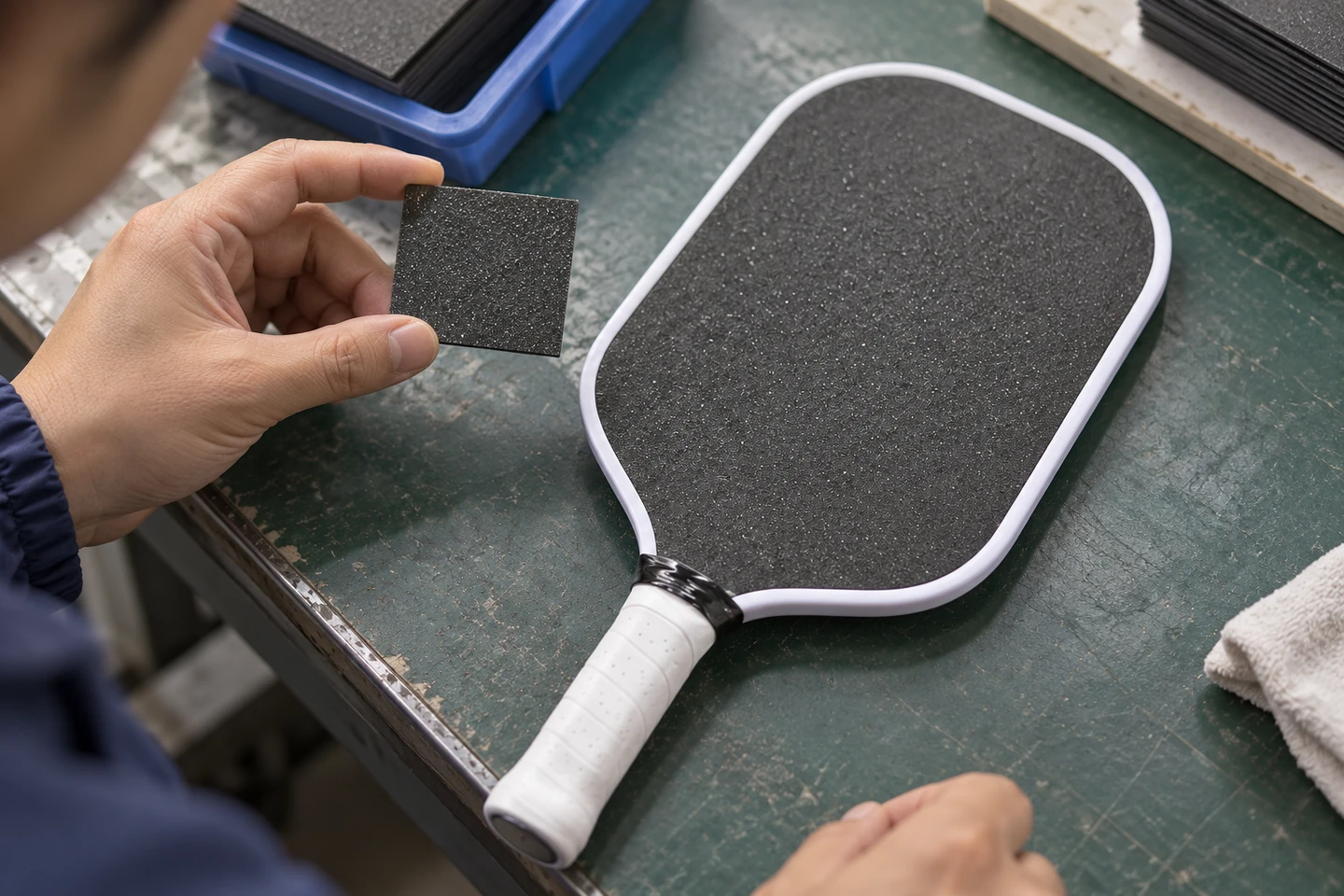
For the custom Emery paddle, review the actual surface sample and the agreed finish. A broad label is not enough to establish appearance. I would rather quote one defined surface than offer an apparently exact price against two different interpretations of what the buyer wants.
NIST's explanation of process inputs and outputs 1 shows why identifying the relevant variables comes before understanding their relationships. My purchasing application is simple: name the feature that changes before attributing the price difference to it.
| Base-build item | What the request should say | What a change means for comparison |
|---|---|---|
| Face | Emery Grit, with the surface sample identified | Reconfirm the face-and-core combination price |
| Core | C11 Multi-Zone Side-Reinforced Hybrid Core | Do not treat a different structure as the same base |
| Shape and thickness | Shape 008, 14 mm | Keep both constant when isolating another change |
| Quantity | 36 paddles for this quotation | Do not mix this total with a different quantity basis |
Keep the base price commercially understandable
You can ask which components and normal production work are included without demanding raw-material purchase invoices or labor rates. A supplier may quote a complete manufactured paddle rather than disclose every internal expense. What matters is whether the scope is clear enough to compare and approve.
For our Australian buyer, the practical result was one baseline rather than several half-defined options. That made later decisions smaller: retain the build and adjust presentation, or deliberately request a second complete configuration. Neither route relies on guessing the supplier's margin, and neither mistakes a catalog choice for an already tested finished specification.
How Should Manufacturing Work and One-Time Charges Be Separated?
A line called “processing” does not explain whether the price includes an ordinary finished paddle or additional development. I want the scope behind that word before deciding that the charge is high or low.
Separate the recurring manufactured-paddle price from any specifically quoted development, tooling or setup charge. Check what is already included before adding a second allowance for the same work.
Connect the process description to the finished product
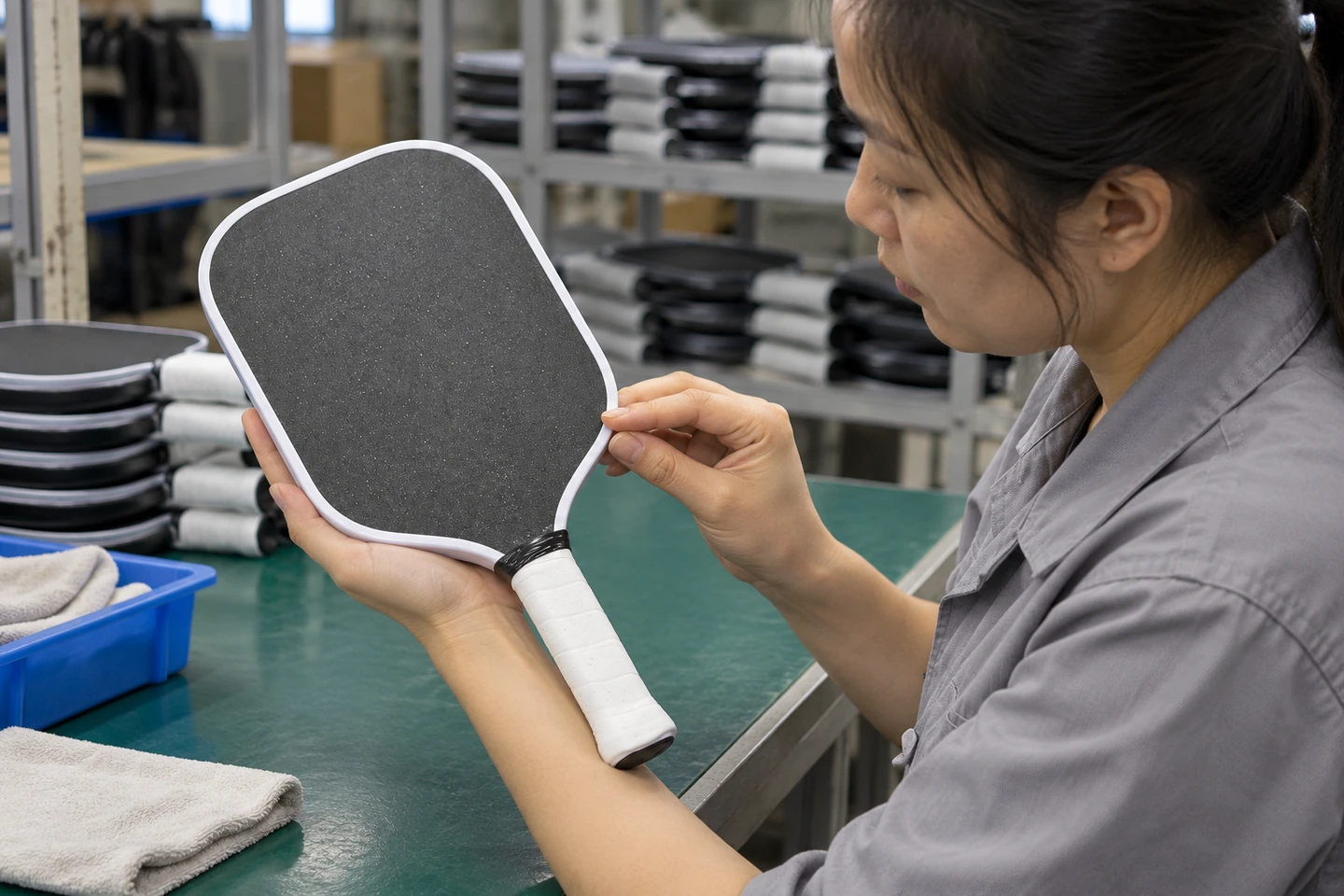
At the finishing bench, I examine the white edge guard and grip connection on the selected paddle while reviewing the requested finish. The buyer's concern is that a lower processing allowance might remove work needed for a saleable product. I separate normal finishing from an optional appearance change, because they solve different problems. The comparison then preserves the agreed finished paddle and prices only the requested variation, rather than treating unfinished edges as a saving.
Our manufacturing process includes preparation, hot pressing, finishing, assembly and final checks. Those stages help a buyer understand the work behind the product. They are not a promise that every stage appears as a separate invoice line, or that the buyer can remove any stage while keeping the same result.
The right question is what the quoted product includes. If the factory describes an extra operation, ask which visible feature or agreed requirement it serves. A clear answer ties the cost to an outcome rather than to an impressive manufacturing label.
Distinguish repeat units from project spending
The SBA's startup cost planning 2 separates one-time and continuing expenses. A paddle quotation benefits from the same distinction: the price of another unit and the spending needed to establish a project are different questions.
If a requested component requires dedicated tooling, obtain its own project quotation. Do not assume the tooling is free because the paddle is customized, and do not assume it will be charged again on every future unit. Ask how the specific quotation treats it. Ownership, reuse and later changes belong in that discussion rather than in an invented universal policy.
Keep the full amount payable on the first order visible. Spreading a setup charge across a hoped-for future sales volume can help internal planning, but it does not reduce the cash required now. A per-paddle allocation is an analytical view, not another charge to add to the same total.
Retain the quality work you are buying
ASQ's explanation of prevention and appraisal costs 3 distinguishes work intended to prevent problems from activities that check conformity. That helps explain why checking and preparation are not simply waste to delete from a quotation.
Ask which checks are included for the selected build and which acceptance questions the sample must resolve. SHUEN's quality staff individually check and mark finished paddles before dispatch. Do not translate that into an unsupported test certificate or a promise that every possible defect has been eliminated.
I prefer a smaller customization scope to a cheaper quote that quietly removes an agreed requirement. If the budget is tight, remove a nonessential presentation feature openly. You can then decide whether the resulting product still belongs in your range without confusing a scope reduction with a manufacturing efficiency.
Which Printing and Accessory Choices Need Their Own Price?
“Put our logo on it” sounds like one instruction, but the face, grip ring and butt cap are different physical locations. The quotation should follow those choices instead of hiding them inside one ambiguous customization fee.
Confirm face artwork, grip-ring logo, grip wrap and butt-cap logo individually. Ask whether each selected option is included, adds a recurring charge or needs separately quoted development.
Treat the logo locations as different decisions
The Australian buyer wanted a branded face but had not decided whether to customize the grip ring and butt cap. I laid the three locations out separately and kept the grip-wrap choice beside them. Her concern was paying for all branding options merely because she had requested a custom paddle. I recommended pricing only the details she intended to use. She retained the face artwork, requested a price for the grip wrap and left dedicated ring and butt-cap logos out of the initial scope.
The customizable paddle details make that distinction easier to discuss. Name the location, intended treatment and artwork, then ask what the supplier needs to quote it. A logo file alone does not say whether you want a printed image or a newly developed physical component.
| Branding decision | Information to provide | Price question to settle |
|---|---|---|
| Face graphics | Front and back artwork with placement | Is the selected print scope included? |
| Grip-ring logo | Logo treatment and component reference | Existing option or separately quoted development? |
| Grip wrap | Selected appearance and wrap requirements | Included choice or recurring difference? |
| Butt-cap logo | Intended design and physical treatment | What component and tooling scope is being quoted? |
Give the artwork enough definition to price
Adobe distinguishes raster and vector artwork 4: vector graphics scale without the same pixelation problem as enlarged raster images. Send a suitable original logo rather than expecting a tiny screenshot to communicate every edge. Clarify whether artwork preparation is included or needs a separate quotation.
Its explanation of spot and process colors 5 also shows that different color instructions describe different print approaches. Use an agreed color reference and ask which treatment fits the selected surface. This is a clarification step, not a rule that a certain color automatically costs a fixed amount.
Do not assume a screen preview settles the physical result. The sample should let you review the intended appearance on the actual selected surface, with any further change clearly separated from the original print scope.
Decide whether an accessory upgrade earns its cost
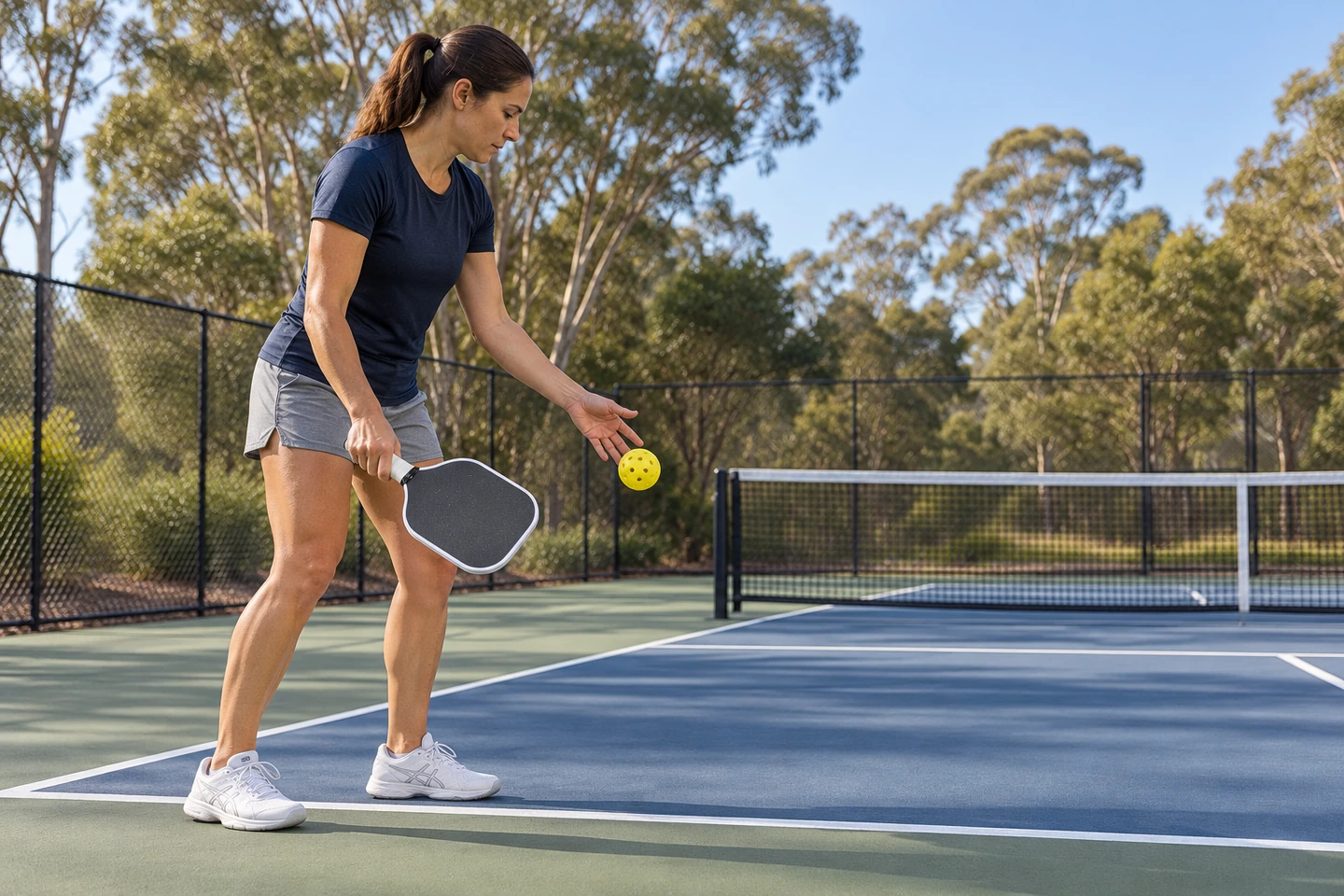
A grip choice should survive normal use, not only a close-up product photograph. During a serving session, a player can notice how the wrap feels in the hand and whether the selected grip suits the intended product. Keep the paddle build unchanged when judging that accessory choice. The purpose is to decide what to buy, not to manufacture a performance claim from a short session.
I keep the spending question narrow: does this particular detail matter enough to retain? If the face already carries the intended brand identity, a buyer may choose to postpone dedicated component logos. Another buyer may consider those details essential. Either choice is reasonable when the quote states the scope and the buyer knows what has been left out.
How Do Packaging Choices Affect the Final Quoted Total?
Packaging is often discussed after the paddle price, although it changes what the buyer receives and can change the shipment's size. A retail box and transport protection are not interchangeable descriptions.
Specify the individual package and shipping-carton arrangement, then show packaging, one-time charges and delivery separately wherever the quotation does so. Reconcile the total without counting an included item twice.
Describe the package rather than requesting “standard”
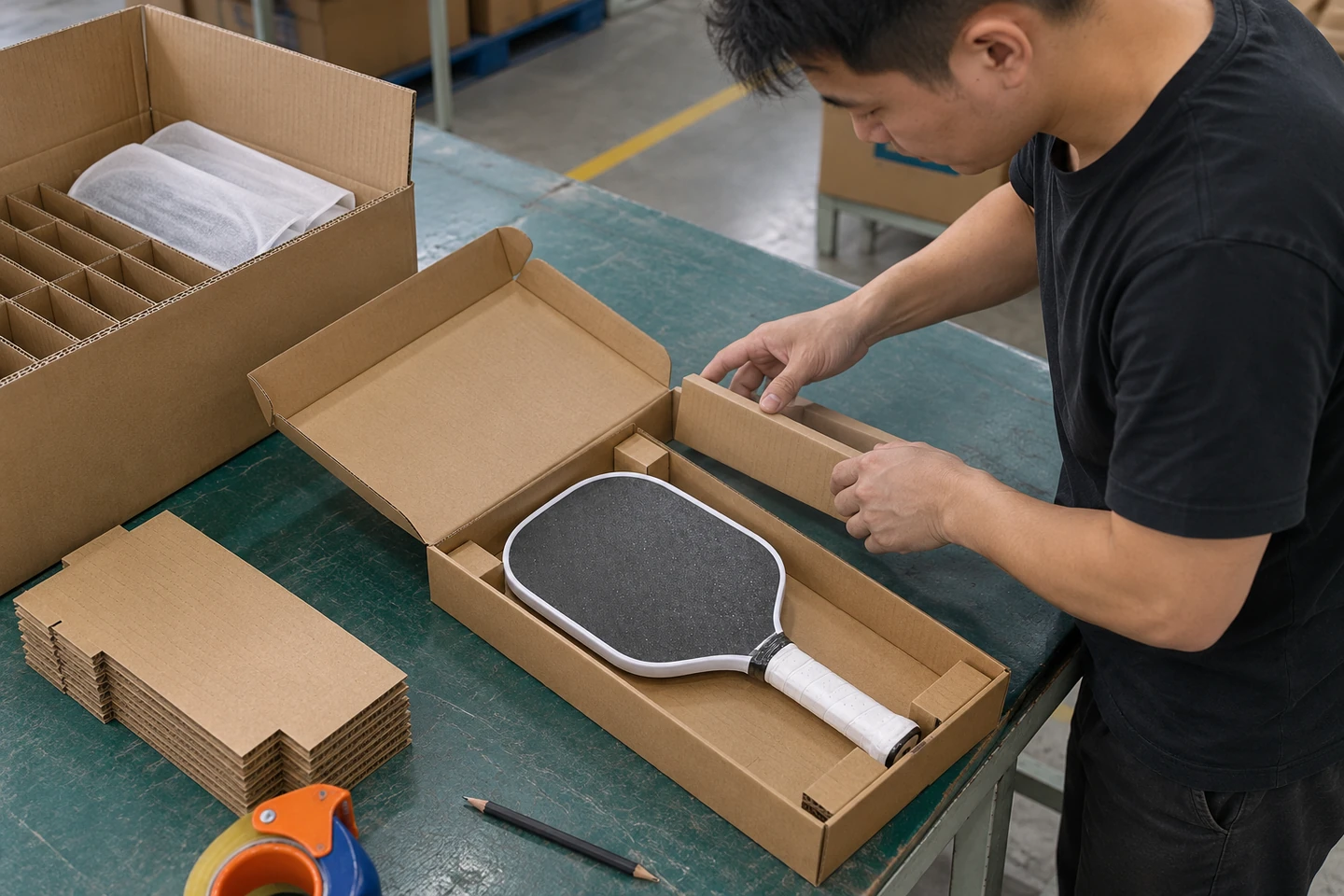
At the packing station, I place the selected paddle into the proposed protective arrangement and compare it with the buyer's retail presentation request. The buyer is concerned that the packaging line might cover a shipping carton but not an individual box. I identify those as separate functions, because a safe shipment and a shelf-ready unit are different deliverables. The next quotation can therefore state the individual-pack scope explicitly instead of leaving the buyer to infer it from the word packaging.
For corrugated boxes, the FEFCO design code 6 provides a common way to identify box constructions. A drawing or appropriate code helps communicate a proposed arrangement; it does not establish the material grade or prove that the package is suitable for your order.
Separate printed packaging from transport volume
If printed packaging is requested, provide its artwork as a separate item. Adobe's guidance on print bleed and trim marks 7 explains why artwork can extend beyond the final cut area. Ask for the requirements of the actual package rather than transferring the paddle graphic onto an assumed box size.
Also establish the packed quantity and carton dimensions before treating freight as final. FedEx explains that dimensional weight 8 reflects the space a package occupies. The applicable carrier and service determine the actual calculation, so a larger presentation package can affect more than the packaging-material price. This article separates those cost categories; the destination-specific transport quotation is a further calculation.
Reconcile one payable amount and one repeat-order basis
Use a final comparison that shows the currency, quantity, selected scope, included items and any separate charges. A blank line should mean unresolved, not free. If printing is included in the base price, do not add an estimated printing allowance again merely to make the sheet look complete.
| Cost category | What to reconcile | What not to assume |
|---|---|---|
| Complete paddle | Quantity multiplied by the quoted unit scope | That material and normal processing must be invoiced separately |
| Selected extras | Only the agreed recurring differences | That all logo locations are included |
| Development or tooling | The explicitly quoted project amount | That an allocation per unit is another payable fee |
| Packaging and delivery | Included scope plus any separate quoted amounts | That retail presentation, cartons and freight mean the same thing |
Before approval, I ask the buyer to read the total back against the physical product. Which face and core? Which accessory treatment? Which package? What remains separately quoted? When those answers agree, the total becomes useful. A breakdown has done its job when it supports a decision, not when it contains the greatest number of rows.
Conclusion
Start with the selected face-and-core combination, not a guessed percentage for materials. Then confirm the grip-ring logo, grip wrap and butt-cap logo requirements before asking for the final paddle price. Separate recurring product scope from additional development, clarify packaging and reconcile the payable total. The best breakdown lets you change one buying decision without losing sight of the complete paddle.
Build a Clear Emery Paddle Quotation
Discuss your custom Emery pickleball paddle with SHUEN. Send the face and core selection, shape, thickness, quantity, front and back artwork, grip-ring logo choice, grip-wrap requirements, butt-cap logo choice and packaging direction. Include the destination when delivery is part of the quotation.