A vague paddle brief can produce a sample that looks right but uses the wrong build. At SHUEN in Dongguan, I separate the physical configuration from the artwork so both can be confirmed clearly.
Choose the paddle shape, face material and core, then provide the paddle design drawing to finalize your custom pickleball paddle. Record thickness alongside the core. If an item is undecided, mark it clearly so we can discuss it before confirming the finished specification.
Below, I explain what to put in the configuration list, how to hand over artwork, and how to keep the approved sample and production instructions connected.
Customer conversations below are illustrative sourcing scenarios, not verified transaction records. Images are AI-generated illustrations.
Which Physical Specifications Should I Confirm First?
A material name and a logo do not describe the whole paddle. I need to know which physical build the artwork will go onto.
Start with the shape, dimensions, face material, core structure and thickness. Give each proposed combination its own line in the brief.
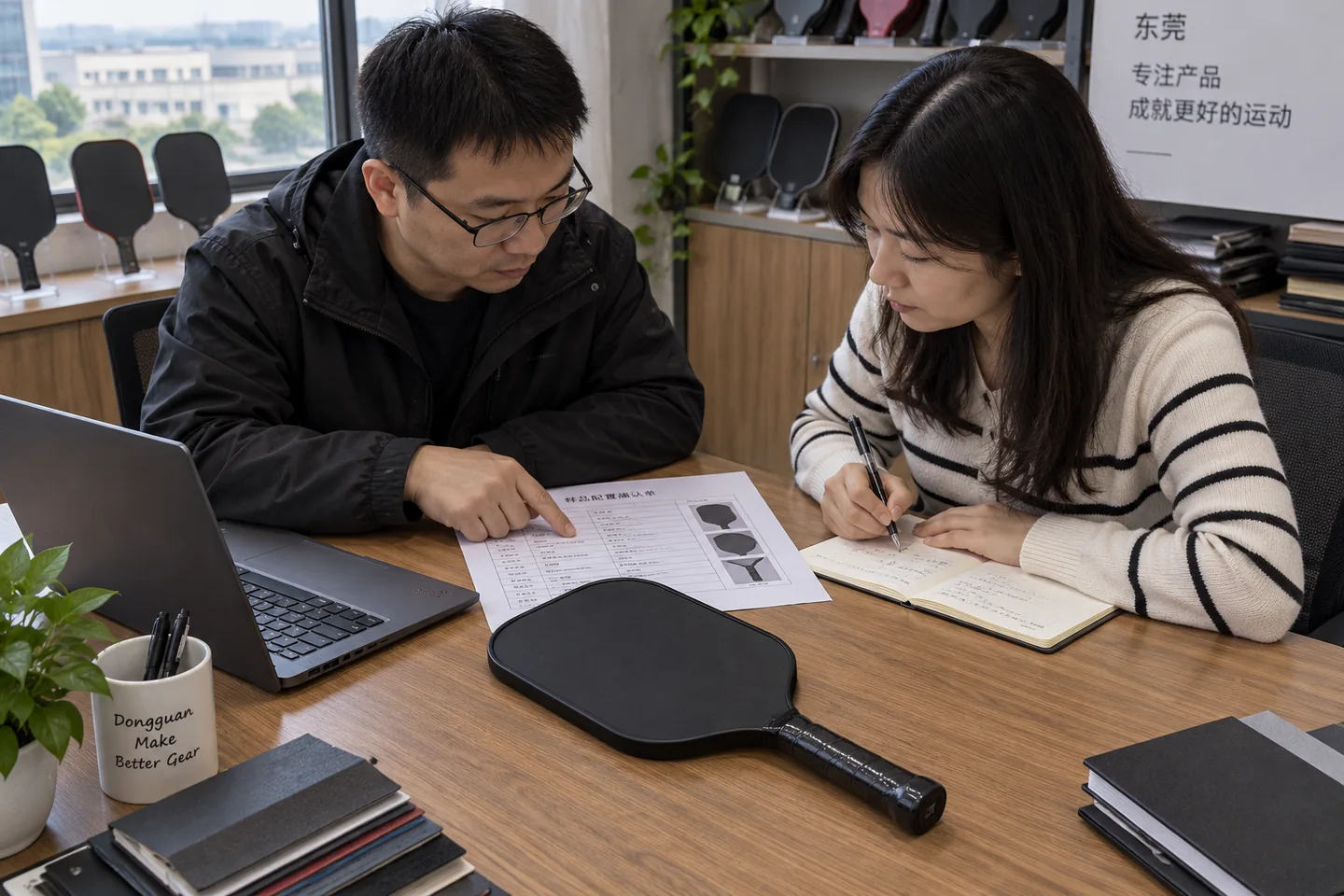
During an initial brief review, a sports-brand product lead in Auckland, New Zealand, sent a black paddle reference and asked, “Can you make this with our logo?” I separated the visual reference from the build requirements and asked her to choose a shape, face and core. She marked the shape as selected and the core as open. We now had a clear discussion list instead of treating the photograph as a complete specification.
Make the configuration identifiable
SHUEN offers eight base shapes, fifteen core structures and 14 mm or 16 mm thickness options. Those options help narrow a brief; the final combination is confirmed for the project. Use a catalog reference or marked drawing to identify the shape. If you need different dimensions, write them down rather than asking for “the same size” as an unmeasured photograph.
Our main platform uses a 16 mm Gen5 PP honeycomb core and one-piece hot pressing. That is a starting point for discussion, not a reason to omit the core from your own specification. We do not manufacture fiberglass or cold-pressed paddles.
| Specification | What to send | What to avoid |
|---|---|---|
| Shape | SHUEN shape reference or a dimensioned outline | “A normal paddle” |
| Dimensions | Agreed overall and handle dimensions | Guessing size from a photo |
| Face | Material and any agreed surface details | “Premium carbon” without a material reference |
| Core | Catalog structure reference or a development request | Assuming every 16 mm core is identical |
| Thickness | 14 mm or 16 mm for each version | One thickness field covering several different builds |
For a carbon option, review our custom T700 paddle. The external Toray T700S data sheet 1 describes the fiber grade. It does not specify your finished paddle's core, surface treatment or playing response. SHUEN can provide supporting T700 sourcing documents for material verification.
What Should My Paddle Design Drawing Include?
Once the build direction is clear, I review the drawing against that particular shape. Artwork for another outline can place a logo too close to the edge or leave its intended position unclear.
Provide front and back artwork on the selected paddle outline, identify the approved file version, and specify component colors and branding separately.
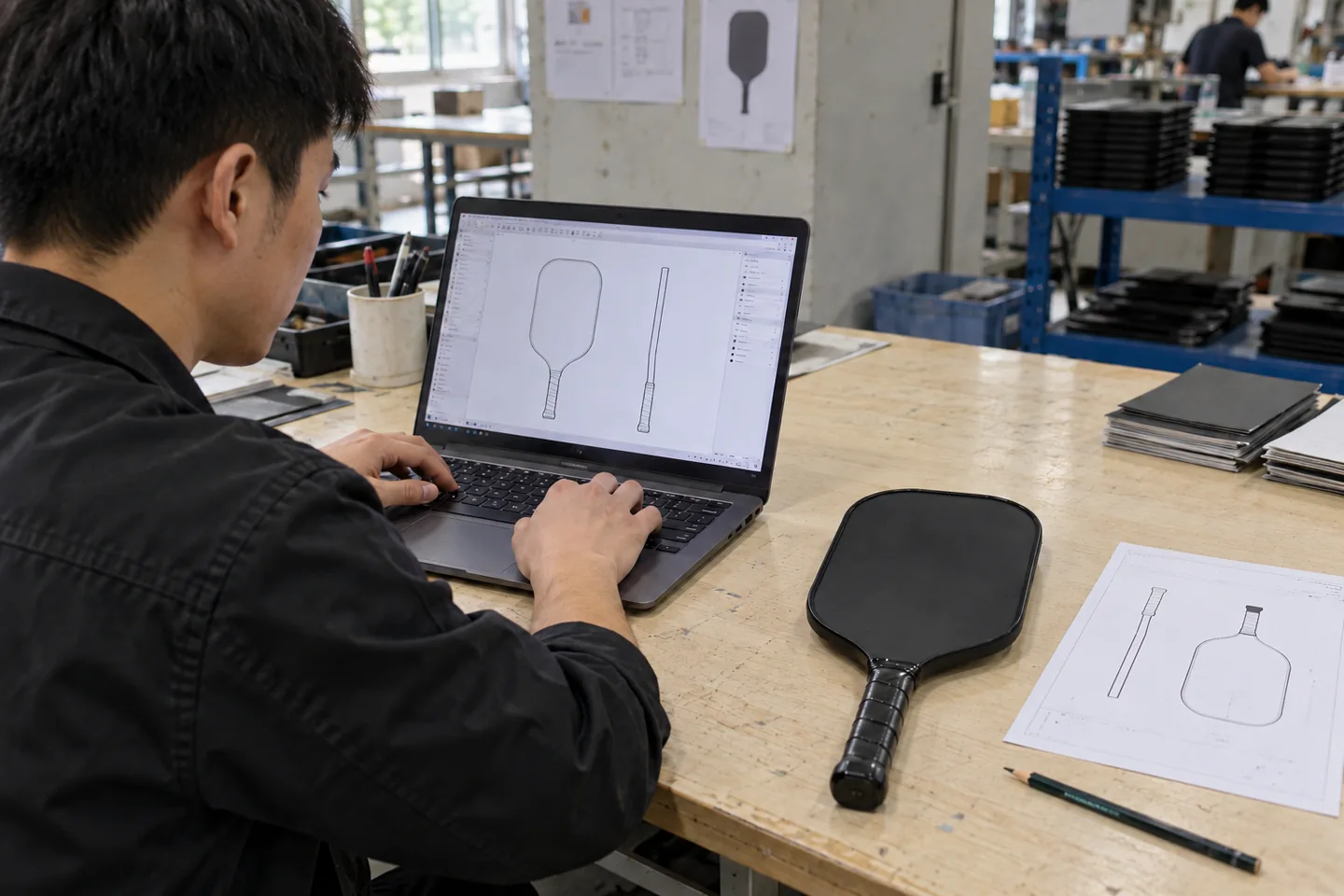
During artwork preparation, a New Zealand specialty retailer asked, “Does this front design also cover the back and the grip?” I put the front face, back face and component choices into separate approval fields. He supplied a back-face design and chose a grip reference. The review could then cover the complete appearance instead of approving one image for every part.
Send files that can actually be reviewed
Keep an editable artwork file and a viewable proof together. Ask us to confirm the file format and template for the selected model before your designer finalizes it. Adobe's Illustrator packaging guidance 2 explains how linked graphics and a report can travel with a document. Share font files only when your license permits it; otherwise agree on an appropriate handoff with your designer.
| Design item | Detail to confirm |
|---|---|
| Front and back | Separate artwork, orientation and placement |
| File identity | Filename, revision and approval date |
| Logo | Size and position on the actual paddle outline |
| Color | Named reference and how appearance will be reviewed on a sample |
| Edge guard and rubber ring | Selected color and any branding request |
| Grip and butt cap | Selected reference and logo requirements |
| Packaging | Contents, artwork and whether it is included in this brief |
Custom logo rings or butt caps can involve dedicated tooling. List the request so the tooling requirement and cost can be discussed for your project. Do not assume that a face-print quotation includes a new component mold.
How Should I Record Alternatives and Undecided Items?
Buyers sometimes want to compare two materials before choosing the finished build. I keep those alternatives visible rather than merging them into a single ambiguous request.
Use one version identifier per configuration. Mark alternatives as sample candidates and keep undecided items distinct from approved requirements.
If you are comparing a T700 face with an aramid option, list each face against its own core and thickness. Our custom Kevlar/aramid paddle page provides another product entry point. The material maker's Kevlar overview 3 gives material background; your brief must still identify the construction to be sampled. A fiber description is not a finished-paddle performance comparison.
You can begin a sample discussion once shape, face and core are clear. Final brand artwork can follow when it is ready. The complete drawing is still needed to finalize a custom appearance, and the applicable sample timing is confirmed against the design status. That distinction lets you evaluate a build without pretending the artwork is already approved.
| Brief status | Meaning | Next action |
|---|---|---|
| Selected | Buyer has named a preferred option | Factory confirms compatibility |
| Open | Buyer needs help choosing | Discuss choices and sample direction |
| Sample candidate | A version is being evaluated | Record its configuration and feedback |
| Approved | Written configuration and relevant proof are accepted | Preserve the version for the next stage |
Avoid using “same as Version A” for a field that has changed. Write the new value. A small change becomes much easier to track when the document says exactly what changed.
What Should Be Confirmed Before Production?
The useful specification is the one both sides can match to the accepted sample. I check that the drawing and build record describe the same version before production instructions are finalized.
Connect the approved sample, physical specification and artwork revision, then record quantity, packaging, destination and any agreed inspection requirements.
Send the quantity for each design and build. The current custom-paddle minimum is five paddles per design; standard models can be mixed with a total minimum of five. Confirm how your specific variants will be counted when requesting a quotation. Samples ship within three to five working days after design confirmation under the current stated policy; destination, shipping method and transit timing are confirmed for the order.
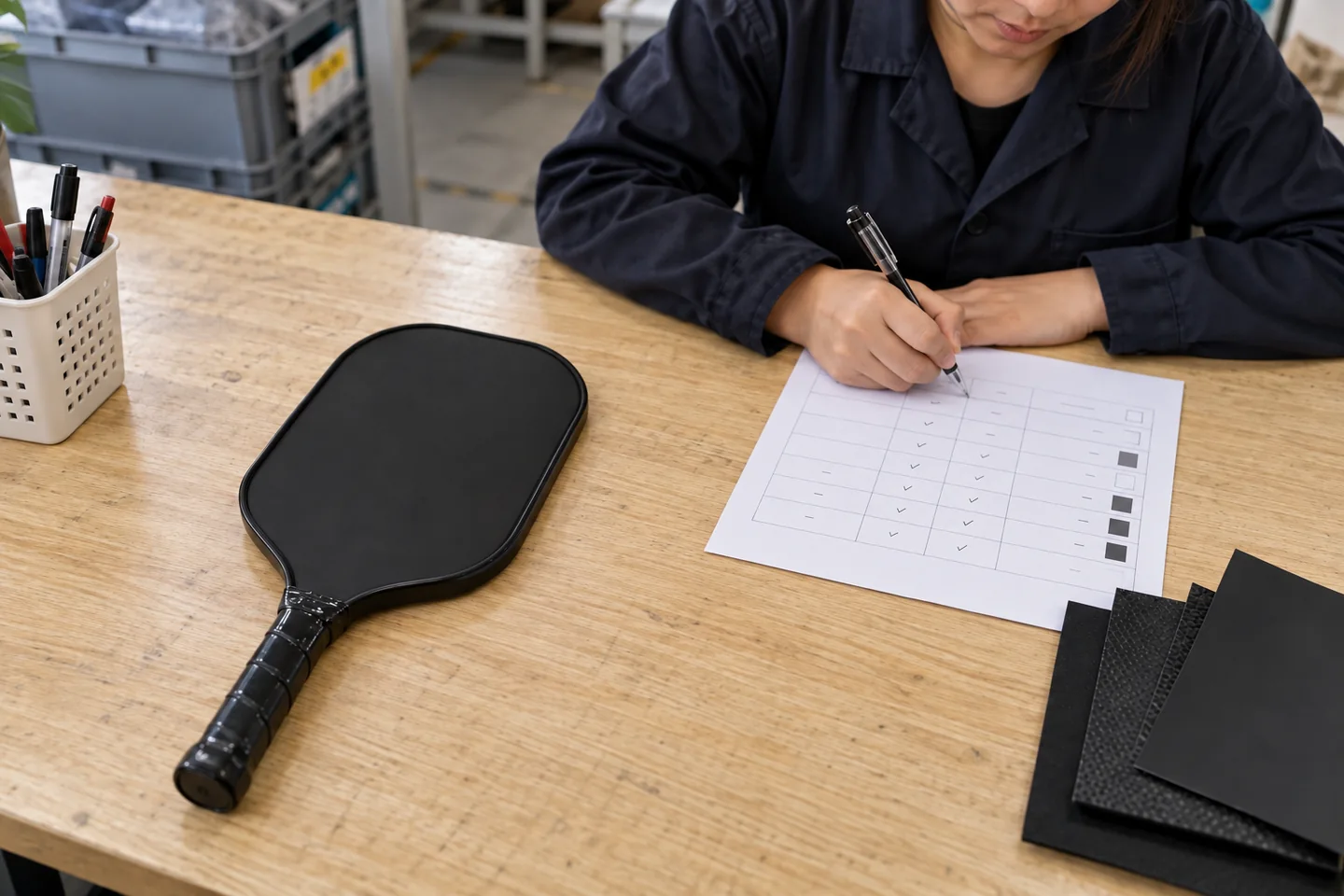
Write down any measurement, tolerance or inspection request that matters to your launch. Ask what can be provided for the project and agree on the criteria. Do not fill blank fields with an assumed industry tolerance, certification or warranty.
Our sampling-to-production guide explains how the stages connect. For your own brief, keep a single revision list with the item changed, the new reference and its approval status.
Conclusion
Start with the shape, face material and core, record the thickness, and provide a design drawing for the selected paddle. Keep alternatives and open questions visible. Finalize the custom build by connecting the accepted sample to the approved specification and artwork.
Send Your Custom Paddle Specification
Review the custom T700 paddle or custom Kevlar/aramid paddle, then send your shape reference, face material, core, thickness, front and back drawing, quantity and delivery destination. Mark any undecided items so we can help you complete the brief.