
A target selling price does not tell me which paddle your customers will choose. At SHUEN, I ask buyers to bring local player observations into the material discussion before committing to a custom build.
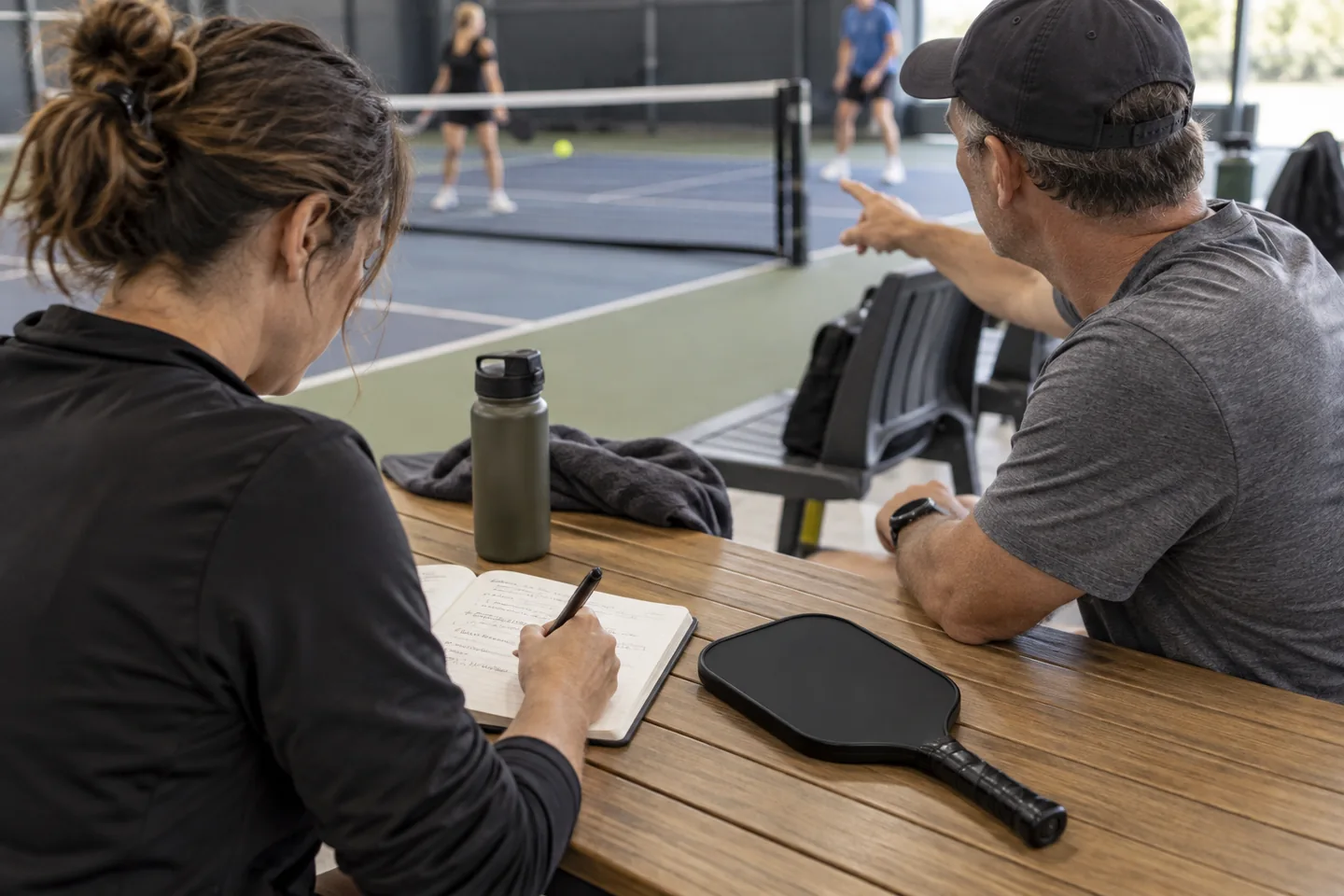
Visit local pickleball clubs and courts, observe the materials and thicknesses players use, and ask why they chose them. Use that research to shortlist a face material and 14 mm or 16 mm thickness, then evaluate complete samples and compare the cost with your target selling price. SHUEN can customize different materials and both thickness options.
This guide turns those observations into a sampling brief, explains how to compare configurations, and shows where the retail price belongs in the decision.
Customer conversations below are illustrative sourcing scenarios, not verified transaction records. Images are AI-generated illustrations.
What Should I Learn at Local Clubs and Courts?
A familiar material name is easy to copy. The harder question is whether the players you intend to sell to want that particular paddle at your intended price.
Observe your intended customer group, record actual model specifications, and ask about buying reasons and concerns. Treat each visit as evidence from that group, not a conclusion about every player in the country.
Before selecting samples, a sports-brand product lead in Auckland, New Zealand, asked me, “If we want a higher retail price, should we start with the most expensive face?” I asked her to visit the club sessions her brand planned to serve and record the players' models and reasons for choosing them. She returned with a shortlist of material and thickness combinations, while leaving the price claim open. We could discuss a product direction grounded in a customer group rather than a material label alone.
For New Zealand research, the PNZA club and playing-group network 1 is a useful starting point for understanding the types of local organizations. Arrange access with the club or venue. The network itself does not establish what those players use or what they will pay; collect that evidence directly.
| What to record | How to confirm it | Why it helps |
|---|---|---|
| Player group | Session type and intended use | Keeps the research tied to your customers |
| Paddle model | Exact model and version | Allows a specification check |
| Face material | Manufacturer specification or documentation | Appearance alone can be misleading |
| Thickness | Model specification; record uncertainty | Separates 14 mm and 16 mm candidates |
| Buying reason | Ask the player in their own words | Shows whether material, feel or another detail mattered |
| Price context | Actual purchase price if shared and current offer context | Avoids treating a discount as the usual price |
| Dissatisfaction | Ask what they would change | Identifies a useful sample question |
Look at more than the people using the most visible brands. A borrowed paddle, a discounted purchase and a deliberate full-price choice can appear identical on court but tell you different things about demand.
How Should I Shortlist Face Materials?
I want the buyer to explain what a material choice is meant to solve. “It looks premium” is a visual direction, but it does not establish a performance result or a selling price.
Shortlist documented materials that fit your product direction, then evaluate them as complete paddle builds. Separate material identity from claims about finished-paddle performance.
Our custom T700 paddle is one starting option. SHUEN uses imported Toray T700 carbon fiber and can provide supporting sourcing documents. The Toray T700S technical sheet 2 describes fiber properties; it does not tell you how a particular finished paddle will play.
You can also discuss our custom Kevlar/aramid paddle and other documented carbon weaves. The material maker's Kevlar material overview 3 provides background for that material family. Ask what material and construction the proposed sample actually uses. Do not infer the finished paddle's rebound, spin or durability from a fiber name.
| Candidate | Procurement question | Evidence to request |
|---|---|---|
| T700 carbon face | Is the specified material documented? | Material identity, sourcing documents and build record |
| Kevlar/aramid face | Which proposed construction is being sampled? | Material description and matching sample specification |
| Another carbon weave | What changes relative to the comparison sample? | Weave/build identification and a controlled comparison brief |
SHUEN's range is positioned for mid-to-high-end private-label projects. We do not manufacture fiberglass or cold-pressed paddles. If your planned product requires either, that requirement does not fit this manufacturing range.
How Do I Compare 14 mm and 16 mm Samples?
Thickness is useful to record, but it is not a complete playing specification. Changing the core, shape and face at the same time makes the feedback harder to interpret.
Ask for an agreed 14 mm and 16 mm comparison, keep other variables consistent where feasible, and record the full construction for both. Test with the players you intend to serve.
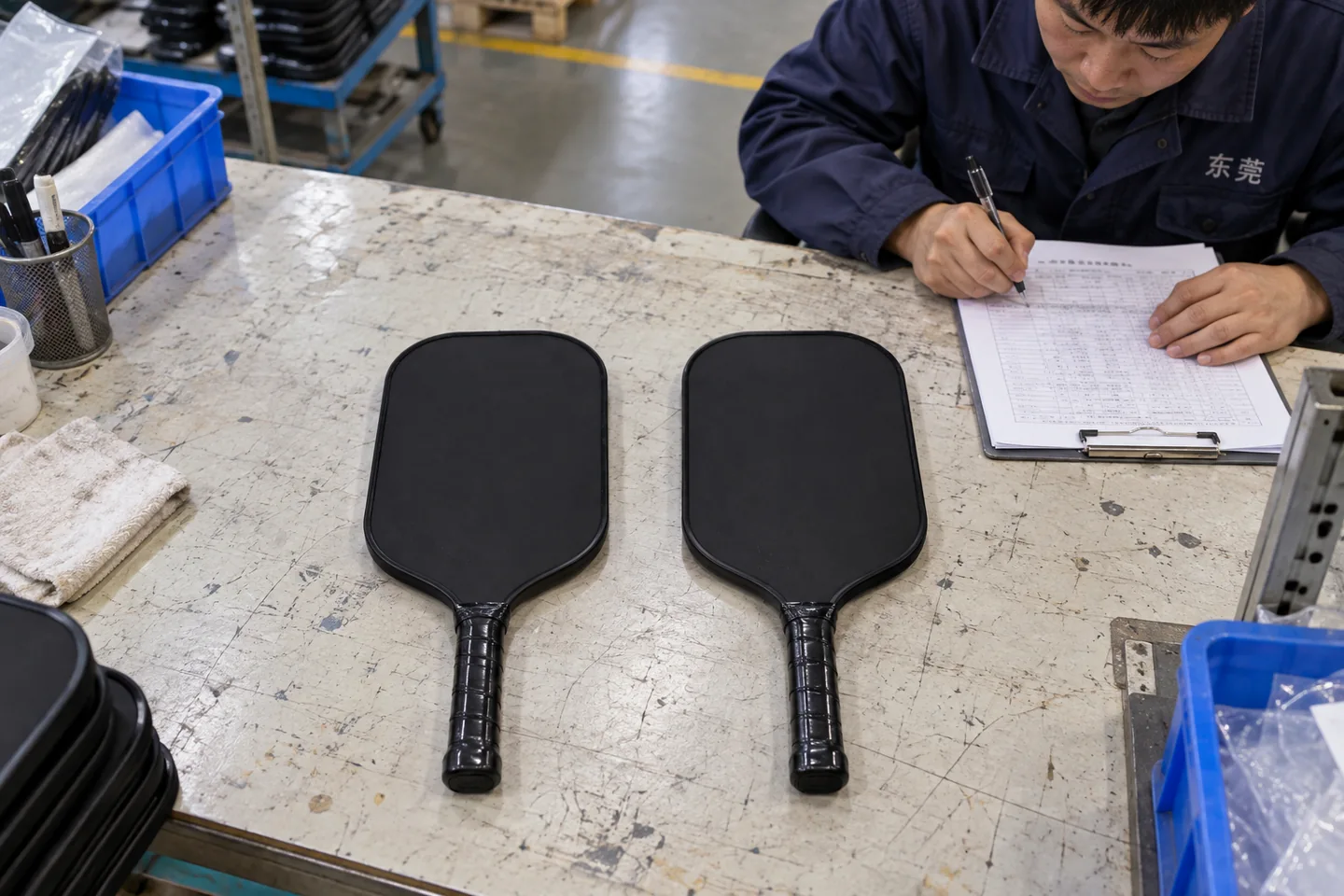
At the sample-planning stage, a club buyer in Christchurch, New Zealand, asked me, “Can we compare a 14 mm T700 paddle with a 16 mm aramid paddle and say which thickness is better?” I split the request into a whole-build comparison and a thickness comparison. He chose to keep the face and shape the same for the thickness trial, subject to our configuration review. The feedback could then address a clearer question instead of attributing every difference to thickness.
Set the question before the trial
SHUEN can customize 14 mm and 16 mm paddles, with material and structure combinations confirmed for each project. We offer eight base shapes and fifteen core structures; our main platform is a 16 mm Gen5 PP honeycomb build formed through one-piece hot pressing. Ask which comparison is feasible rather than assuming every catalog choice can be combined unchanged.
Use the same feedback sheet for each sample. Record the model identifier, confirmed construction, player group, conditions and comments. Ask about the tasks relevant to your intended use, such as placement confidence, repeated play and grip comfort. Keep subjective feedback clearly identified as player feedback. If you need numerical performance evidence, agree on a method and request the applicable data; do not invent it from comments.
| Comparison field | Sample A | Sample B |
|---|---|---|
| Thickness | 14 mm candidate | 16 mm candidate |
| Shape and dimensions | Agreed reference | Same where feasible; record differences |
| Face | Selected material | Same where feasible |
| Core structure | Confirmed structure | Confirmed structure; record differences |
| Grip and weight details | Record agreed values | Record agreed values |
| Player feedback | Notes from intended group | Notes from intended group |
| Decision | Keep, revise or reject with reason | Keep, revise or reject with reason |
If the builds cannot be matched closely enough, compare them as two complete products. That is still useful for a buying decision. It simply does not isolate the effect of thickness.
Where Does My Target Selling Price Fit?
A suitable sample can still leave too little room for your operating costs. I bring the target price back into the discussion once the shortlisted builds are specific enough to quote.
Compare the quoted configuration and your planned selling price on a consistent basis, including the costs your business must cover. Select the build that fits both customer evidence and the commercial plan.

Send the expected quantity per design, component choices, packaging and delivery destination with the shortlist. Separate product cost, tooling where applicable, packaging and freight so you know which item changes between versions. Your own plan should also account for applicable import costs, channel fees, fulfillment, marketing and service provision. Confirm those amounts for your business; this article does not supply tax rates or a target margin.
A practical worksheet subtracts your applicable selling and fulfillment costs from the planned revenue, then shows what remains to cover procurement and your required return. Use the same currency and a consistent tax basis for all candidates. Treat a quotation as configuration-specific; changing the build or order quantity may require a new quote.
The current minimum for custom paddles is five per design. That can support a small custom project, but it does not decide your launch quantity for you. Confirm how the proposed variants are counted and evaluate demand before buying stock.
Use our custom paddle brief guide to turn the selected direction into a written inquiry. Keep the research notes alongside the brief so later revisions stay connected to the buyer need.
Conclusion
Begin at local clubs and courts. Record what your intended players use, confirm the specifications and ask why they chose them. Shortlist documented face materials and 14 mm or 16 mm builds, compare complete samples, then check the selected configuration against your target selling price and costs.
Turn Your Local Research into a Paddle Shortlist
Explore the custom T700 paddle and custom Kevlar/aramid paddle. Send your New Zealand customer group, research notes, target selling price and currency, preferred shape, material candidates, 14 mm or 16 mm choices, quantity and destination. We can review the feasible configurations and prepare the next sampling discussion.