
A metallic edge can be the first thing a buyer notices, but it is often the last thing specified precisely. “Gold edge” can refer to different tones, shine levels, and visible transitions around the throat and handle. Meanwhile, a face and core name alone leave important sample decisions unresolved.
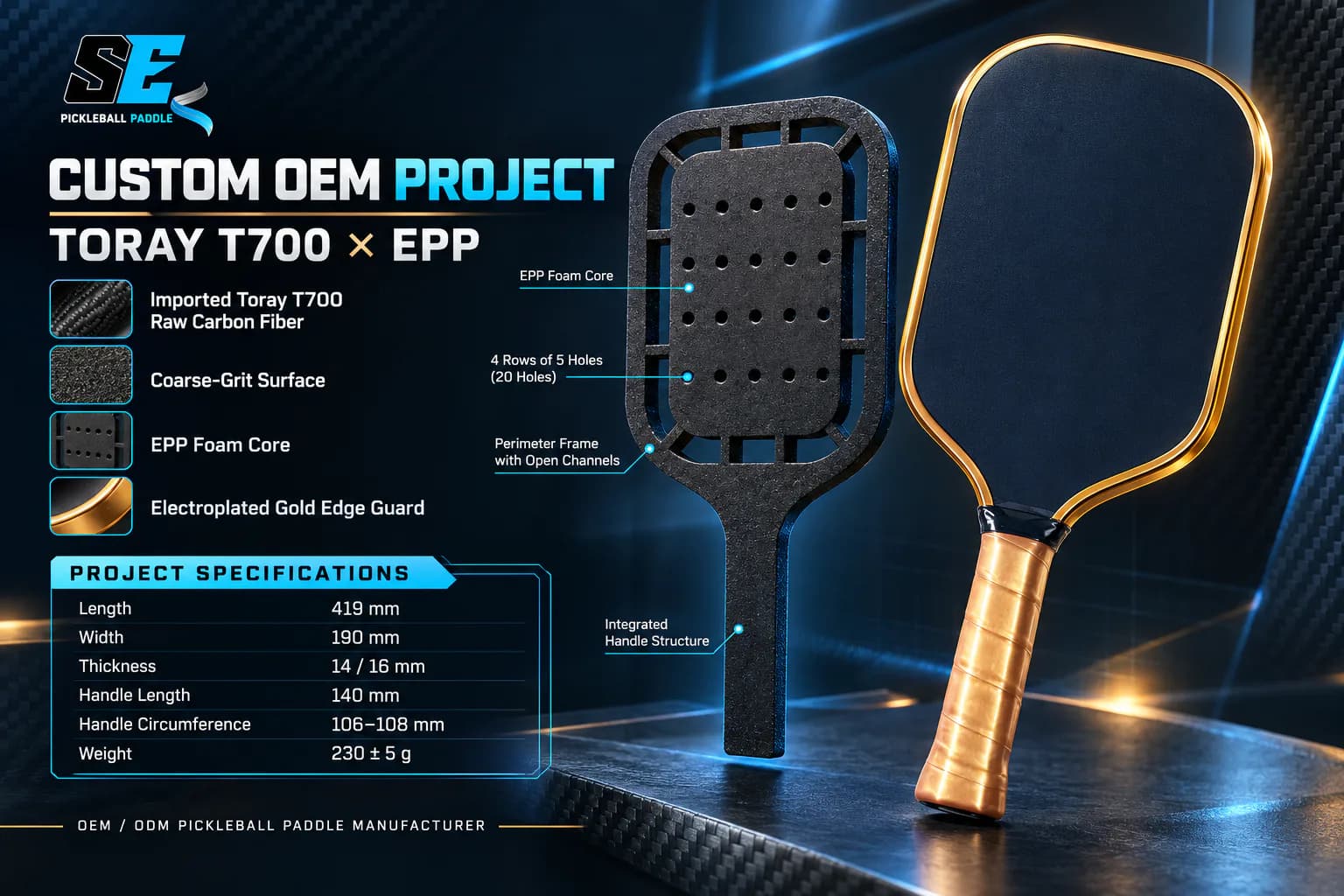
This project records a Toray T700 face, perforated EPP core, and electroplated gold edge on a 419 × 190 mm paddle. The configuration graphic lists 14 mm and 16 mm thickness options, a 140 mm handle, a 106–108 mm grip circumference, and 230 ± 5 g. Use the real project photos to discuss the finished gold border and wrapped handle, then confirm the selected thickness, material build, and finish against a physical sample.
For a brand or distributor, the useful question is not whether the photograph looks premium. It is which parts of the configuration are fixed, how the gold finish should be evaluated, and what to include in a comparable sourcing brief. This case walks through those decisions.
Which parts of the Toray T700 and perforated EPP build are specified?
A sourcing team may put “T700 + EPP” in an email subject and expect a complete quotation. The supplier still needs a versioned drawing, core description, finish reference, and target dimensions to price and sample the same product the buyer imagines.
The recorded face is Toray T700, the recorded core is perforated EPP, and the recorded edge is electroplated gold. The overview also lists the 419 × 190 mm outline, two thickness options, 140 mm handle, 106–108 mm grip circumference, and 230 ± 5 g weight. Choose which option is being sampled and identify any required material documentation before treating those values as an approved finished-sample result.
Toray's own carbon fiber data-sheet index1 distinguishes T700S from T700G and notes that published values are typical material properties for selection. This case only records “Toray T700,” so it should not borrow the properties of one specific grade or claim a precise fabric or laminate from that label. If grade, traceability, weave, or resin matters in your launch, put the required evidence in the purchase brief.
“Perforated EPP” is likewise a construction description, not a visible feature of the finished face photo. Expanded polypropylene foam can be produced with different densities and microstructures. An experimental EPP foam study2 examined how those variables affect compression results in foam specimens. The study was not a test of this paddle. Its relevance for sourcing is the need to define the proposed core rather than assuming every EPP label means the same construction.
| Field | Recorded configuration | What to settle before sampling |
|---|---|---|
| Face | Toray T700 | Exact material description and any required traceability. |
| Core | Perforated EPP | Core construction, perforation pattern, thickness and permitted substitutions. |
| Edge | Electroplated gold | Gold tone, reflectivity, edge coverage and finish reference. |
| Outline | 419 × 190 mm | Approved drawing and measurement points. |
| Thickness | 14 mm or 16 mm | One option or a controlled sample comparison. |
| Handle and grip | 140 mm; 106–108 mm circumference | Wrapped-grip size, end cap and artwork. |
| Weight | 230 ± 5 g listed | Complete-paddle target and weighing method. |
See the broader custom paddle range for other shape and material directions. A catalog can help frame options, while this article keeps the decisions for one recorded configuration together.
What can the gold-edge project photos help a buyer judge?
Suppose a brand team is comparing three metallic samples on a laptop. A side view may reveal edge depth and shine; a front view may reveal whether the border distracts from the face. Neither view answers every construction question.
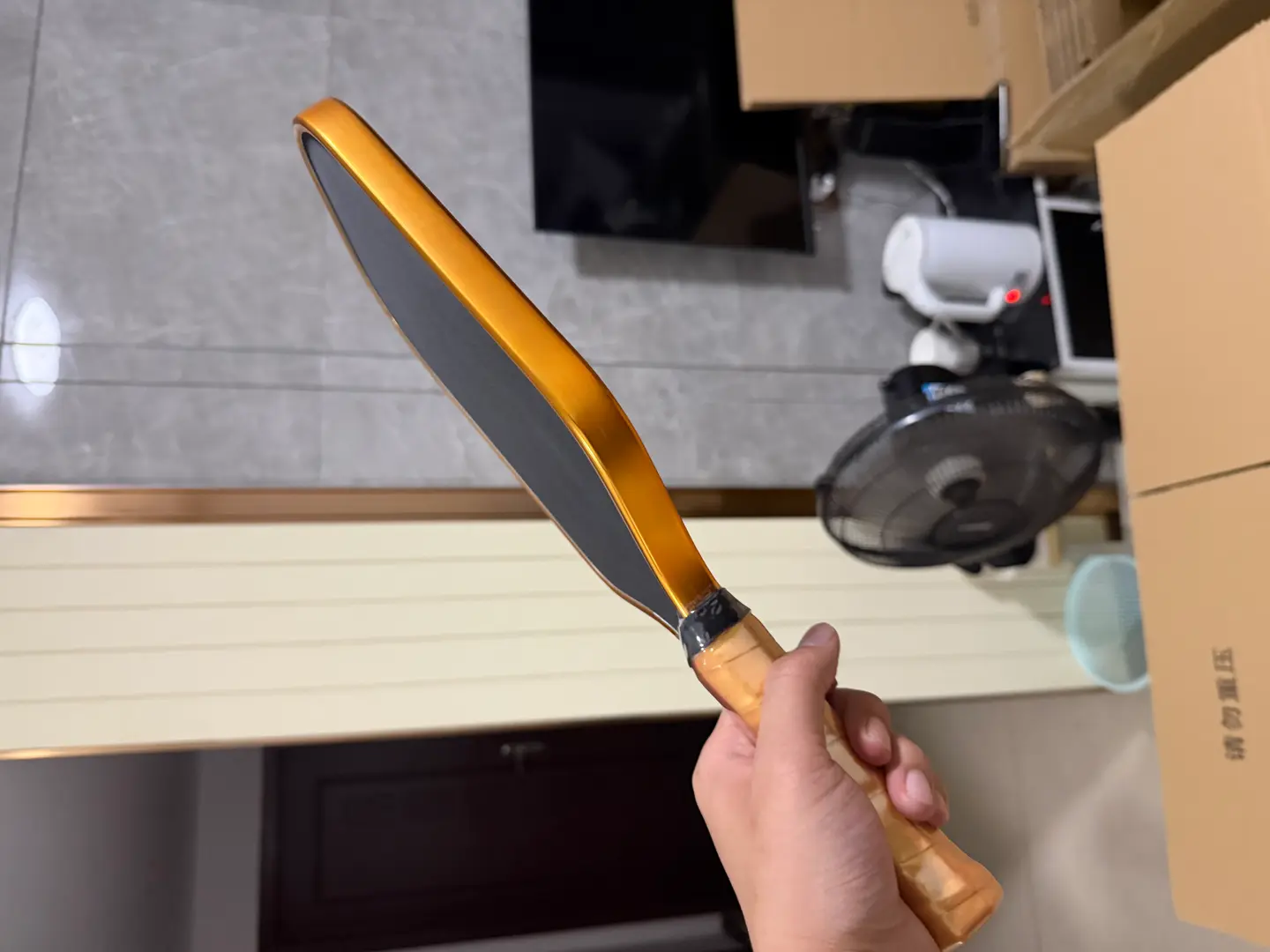
The real project photos show a dark finished face, a gold-colored border viewed from different angles, and a wrapped handle. They are evidence of visible appearance and assembly details. The cover is a configuration overview graphic carrying the material and dimension labels. Keep these two image roles separate when reviewing or sharing the case.
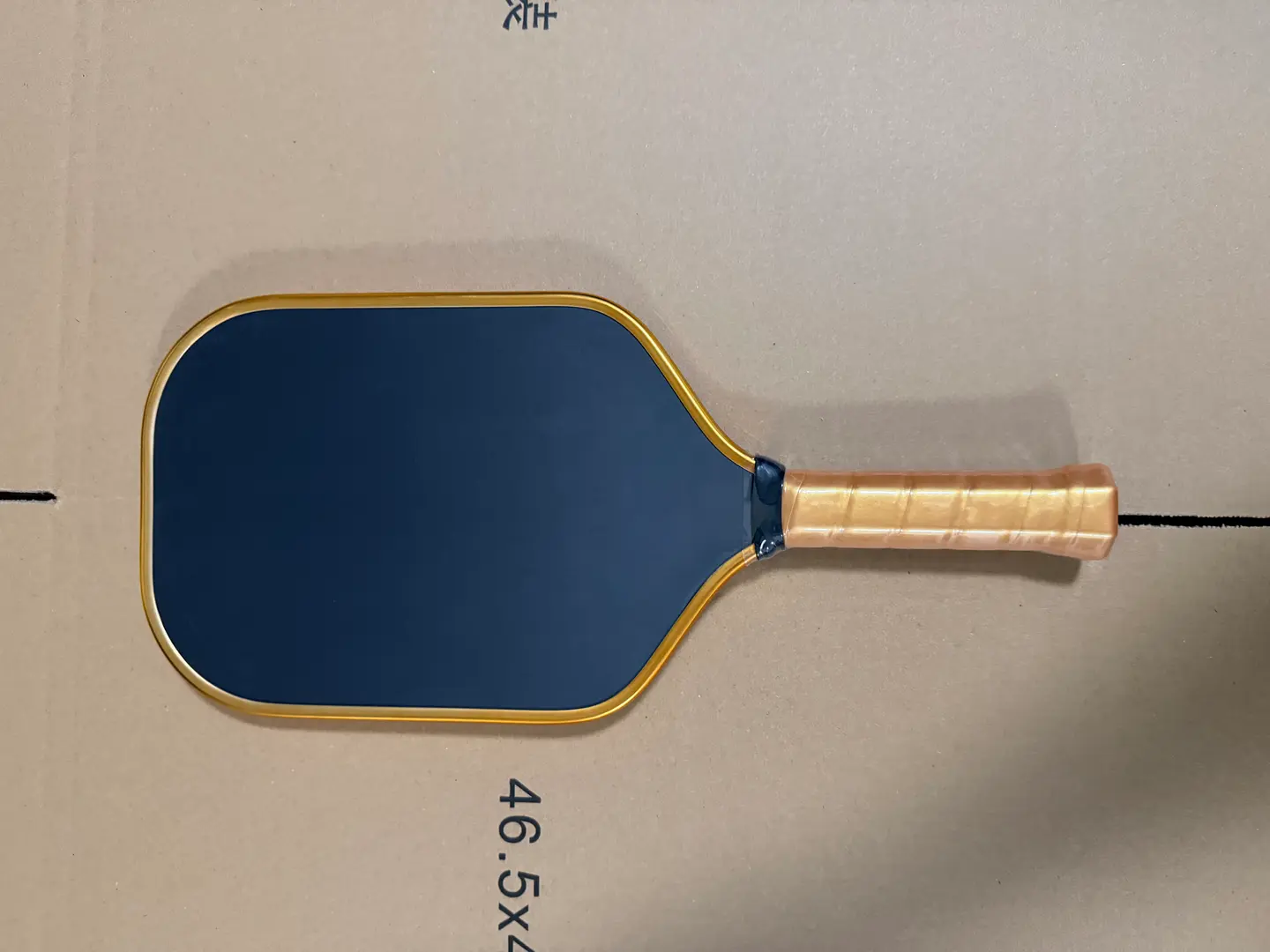
In the angled photo, follow the edge around the top and down toward the throat. In the front photo, judge the width of the visible gold line against the dark face. Ask for a short set of neutral-light photos of the approved sample: face-on, side profile, upper corner, throat, and handle. The aim is not to prove an invisible core from a picture; it is to agree how the visible finish is expected to look on the version being ordered.
Gold is especially sensitive to viewing angle and surrounding color. A buyer can reduce subjective disagreements by supplying a physical color sample where possible, a written description of gloss, and an acceptable range for small appearance variation. If the design includes a dark face, specify whether the gold should read as a thin outline or a broader metallic feature. The project photographs can guide that discussion without becoming a substitute for sample approval.
For a private-label project, decide where your own logo will sit in relation to the dark face and gold border. Ask to see the artwork on the same physical sample used to approve the edge. A small change in border width or logo placement can alter the overall look even when the material list stays the same.
How should the sample and the supplier's evidence be checked?
A buyer may receive one sample photo, a weight typed into a message, and a claim that the construction is “the same as requested.” That may be enough to start a discussion, but not enough to close a specification.
Use one sample ID and one written review sheet. Check the selected dimensions and wrapped grip, inspect the edge in consistent light, and request the material/build record agreed in the brief. Record what was measured, what was visually inspected, and what remains a supplier declaration. If tournament approval is required, treat that as a separate finished-paddle process.

For measurement, agree where to place the caliper, whether the grip is measured after wrapping, and whether weight includes final artwork, grip, and end cap. NIST's explanation of dimensional uncertainty3 is a useful reminder that a reported number depends on method. The project overview lists dimensions and weight, but it does not supply a measurement log for a particular sample.
| Decision | Useful evidence | Approval question |
|---|---|---|
| Geometry | Versioned drawing and measurements of the same finished sample | Do the agreed shape and handle fit? |
| Gold appearance | Neutral-light sample photos and physical reference | Is the tone, shine and edge coverage acceptable? |
| Face and core | Supplier material description, build record, and any agreed supporting document | Is the proposed construction the one requested? |
| Grip and artwork | Finished sample, artwork proof, end-cap and wrap view | Will the delivered version carry the right finish? |
| Performance or compliance | Project-specific test plan or approval record, if required | Which claims can be made for this exact version? |
The USA Pickleball rules and equipment standards hub4 is the current starting point if a buyer intends to make sanctioned-play claims. The case itself does not state a certification or approval result. Decide that requirement before finalizing construction, graphics, and packaging language.
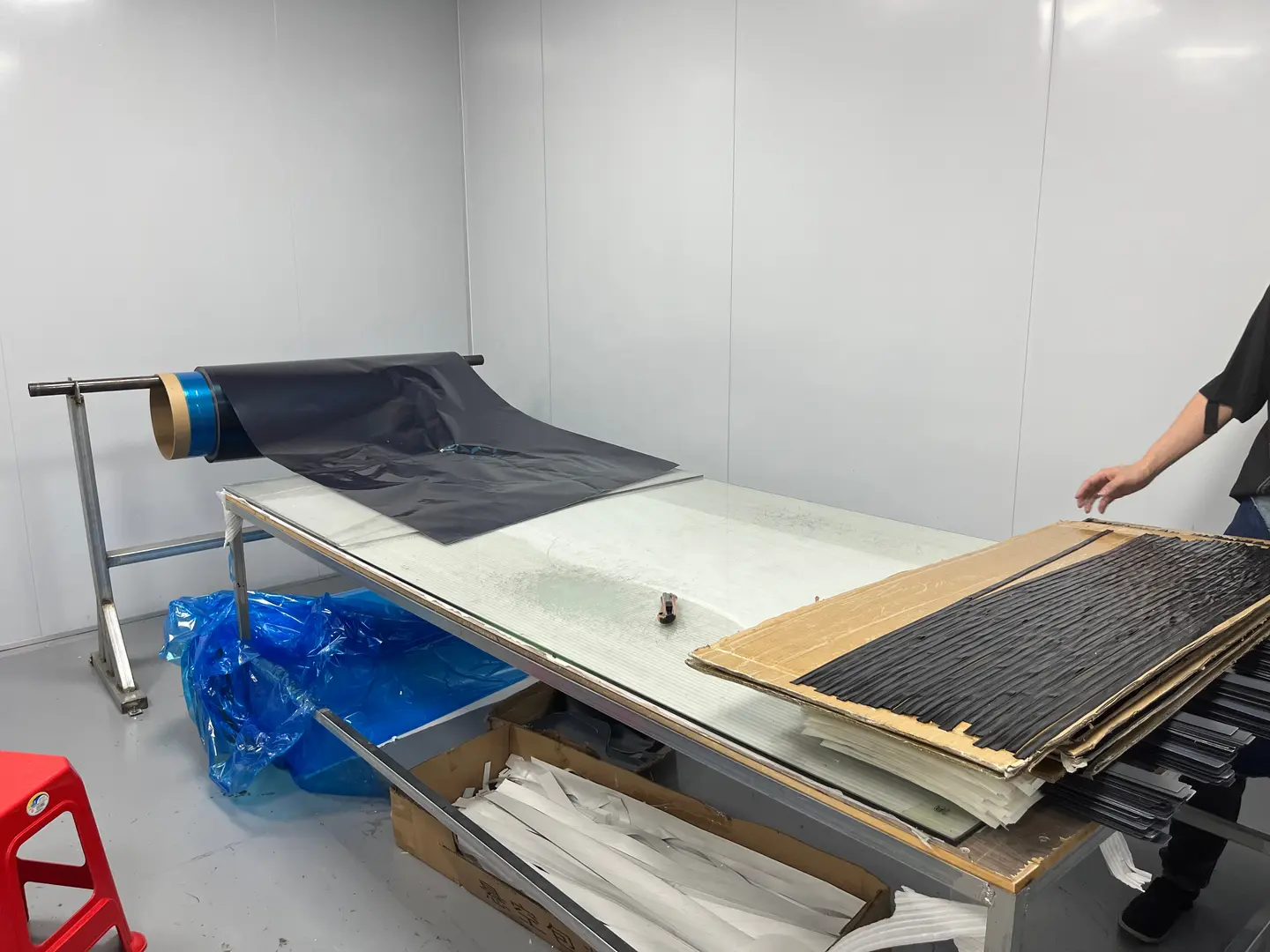
The work shown in the manufacturing capabilities overview gives context for preparing, pressing, and finishing a custom paddle. For this case, ask which records and inspection photos can be tied to your actual sample rather than assuming that every process image depicts the same order.
What should go into a request for a similar gold-edge build?
A good request can be concise. The key is to make the design priorities and open questions visible to both sides before a quotation hardens into an assumption.
Send the recorded case as a reference and specify your intended face, perforated EPP core, selected thickness, 419 × 190 mm target outline or revised drawing, 140 mm handle target, grip size, weight target, gold-finish reference, artwork, market, and estimated order range. Ask for a versioned proposed specification, a sample plan, and a list of assumptions that affect price or feasibility.
If “Toray T700” is essential, ask what exact material designation will appear in the supplier's record and what evidence will be available. If you are still choosing between 14 mm and 16 mm, request a comparison with the other variables controlled as far as practical. If the gold border is the signature feature, include a reference seen in neutral light and describe the amount of visible gold around corners and throat. A word such as “luxury” is less useful than a reference and a specific acceptance question.
| Brief section | Fixed if you want this configuration | Open choice to state explicitly |
|---|---|---|
| Face | Toray T700 as recorded | Exact grade/documentation and artwork treatment |
| Core | Perforated EPP concept | Detailed construction and evidence requested |
| Geometry | 419 × 190 mm reference; 140 mm handle | 14 mm or 16 mm and final grip wrap |
| Finish | Gold edge direction | Tone, sheen, coverage and acceptable variation |
| Commercial | Target market and use | Artwork, quantity range, packaging, sample decision date |
For an alternative edge treatment on a similar Toray T700 outline, compare the Gen5 PP honeycomb and high-gloss edge case. That comparison can clarify whether your project decision is mainly about core construction, visible finish, or both.
If sanctioned-play approval is necessary, consult the official equipment-submission FAQ5 as part of the planning stage. It describes a process for a finished paddle; it does not make this case an approved product.
Conclusion
This gold-edge case gives a detailed reference for a Toray T700 and perforated EPP specification, together with real views of the finished border and grip. Turn those references into a versioned sample brief, then approve the selected construction and appearance on the same physical sample.
Discuss a Toray T700 and gold-edge project
Share your target shape, thickness, core requirements, gold-finish reference, grip, artwork, and the questions you want the first sample to answer.
Footnotes
- Toray Composite Materials America data-sheet index, used to distinguish available T700 material designations and the limits of typical material values. ↩︎
- PubMed record of experimental EPP foam research, cited for material-variable context only, not paddle performance. ↩︎
- NIST publication on dimensional calibration uncertainty, used to support recording a consistent measurement method. ↩︎
- USA Pickleball rules hub, linking to current rules and equipment standards. No approval is claimed for this case. ↩︎
- USA Pickleball equipment-submission FAQ, explaining the separate submission process for finished paddles. ↩︎