Three suppliers can send attractive samples and leave you less certain than before. One feels faster, another has cleaner printing, and the third costs less. I do not choose a supplier from the most memorable shot. I want to know what each sample actually proves.
First compare appearance, face material, core structure and printing. Then play-test the samples to compare hitting power, ball spin speed and ball exit speed under consistent conditions. Combine those observations and any properly measured data with the intended player's needs, the supplier's explanations and the complete offer before making your choice.
The aim is not to create a winner in every category. It is to identify which supplier can provide the right complete paddle, explain the remaining differences and support a sensible next purchase.
Are My Supplier Samples Comparable Enough to Rank?
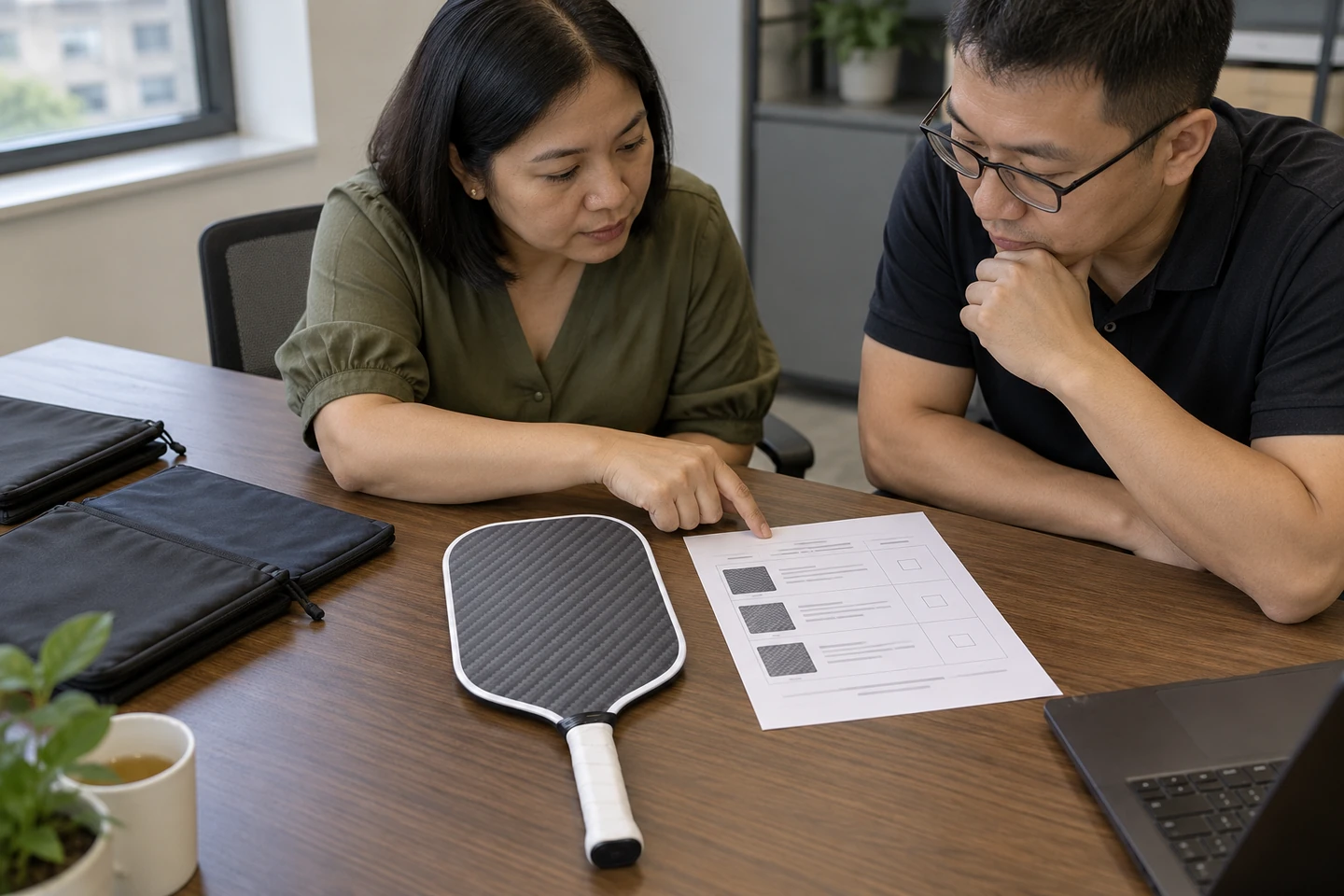
Before a sample can win, you need to decide what competition it is entering: the same requested specification, or different finished products aimed at the same customer.
Give every sample an identity and a complete build description. Separate like-for-like supplier comparisons from alternative product concepts, and keep unknown construction details visible rather than guessing.
Settle what the comparison is meant to answer
A private-label owner in the Philippines could not decide whether the nicest-looking sample deserved the order. In February 2026, she told me that three suppliers had sent different explanations of what they called a premium carbon paddle. I asked whether she wanted the closest match to one brief or the most suitable product among several builds. Those are different buying decisions.
Her enquiry with us covered five paddles in shape 001, with 3K Carbon Fiber faces and the C01 Interlocking EPP–EVA Dual-Density Core, at 16 mm thickness. One competing description named only the thickness. She kept that sample in the product shortlist but requested its core description before assigning a construction score. The comparison could continue without pretending the missing answer was already known.
Our custom 3K paddle is a starting point for that configuration discussion. The face name does not specify the complete paddle. Confirm the selected core, shape and finishing details for the project instead of attributing every playing difference to carbon weave.
Identify each unit, not just each supplier
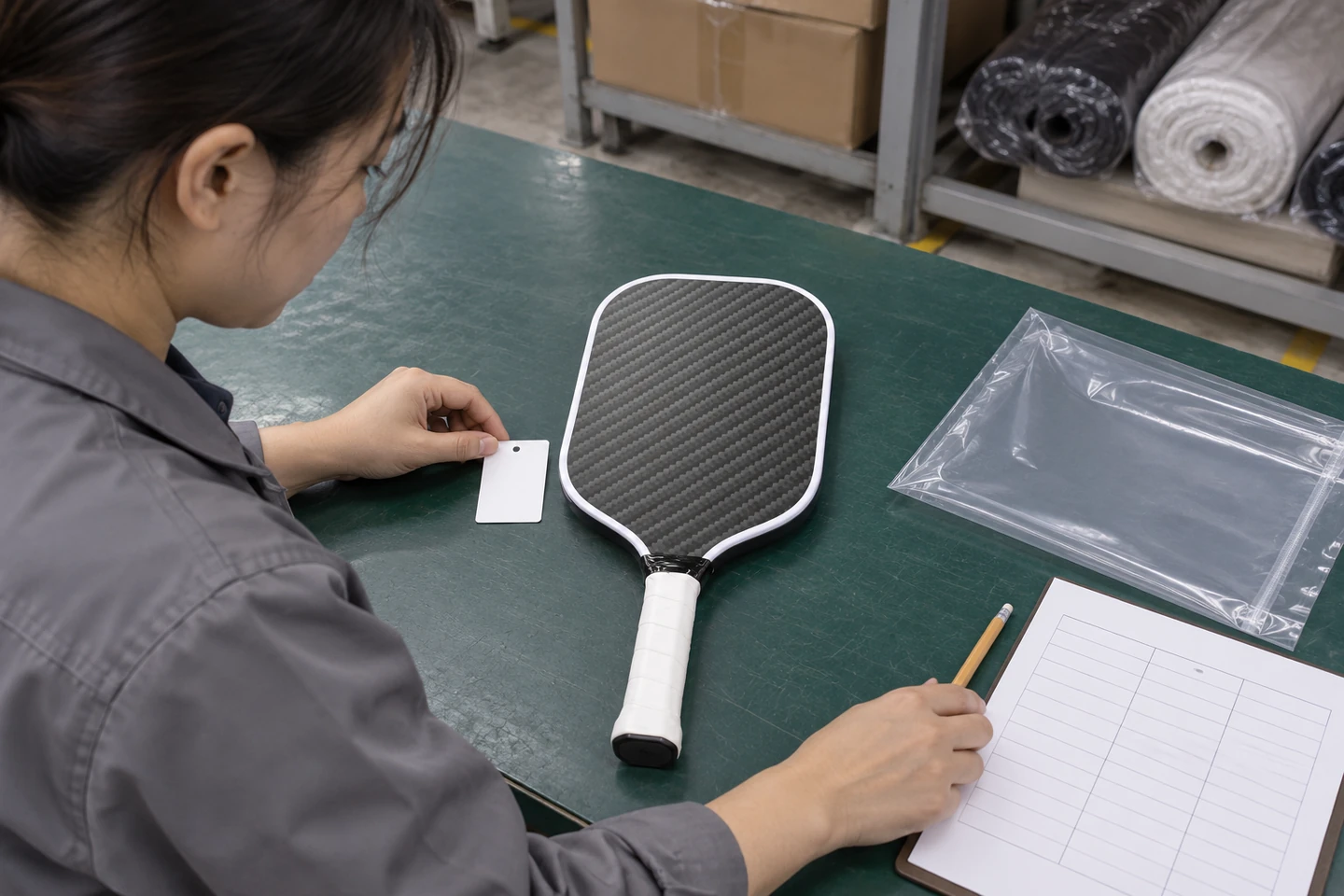
Use a neutral sample code and an individual unit number. Keep the supplier key separately while players complete their first assessments. Do not cover the hitting area with labels or alter the grip simply to conceal branding; those changes could affect the experience you are comparing. A code on the sleeve and the corresponding feedback sheet is often enough.
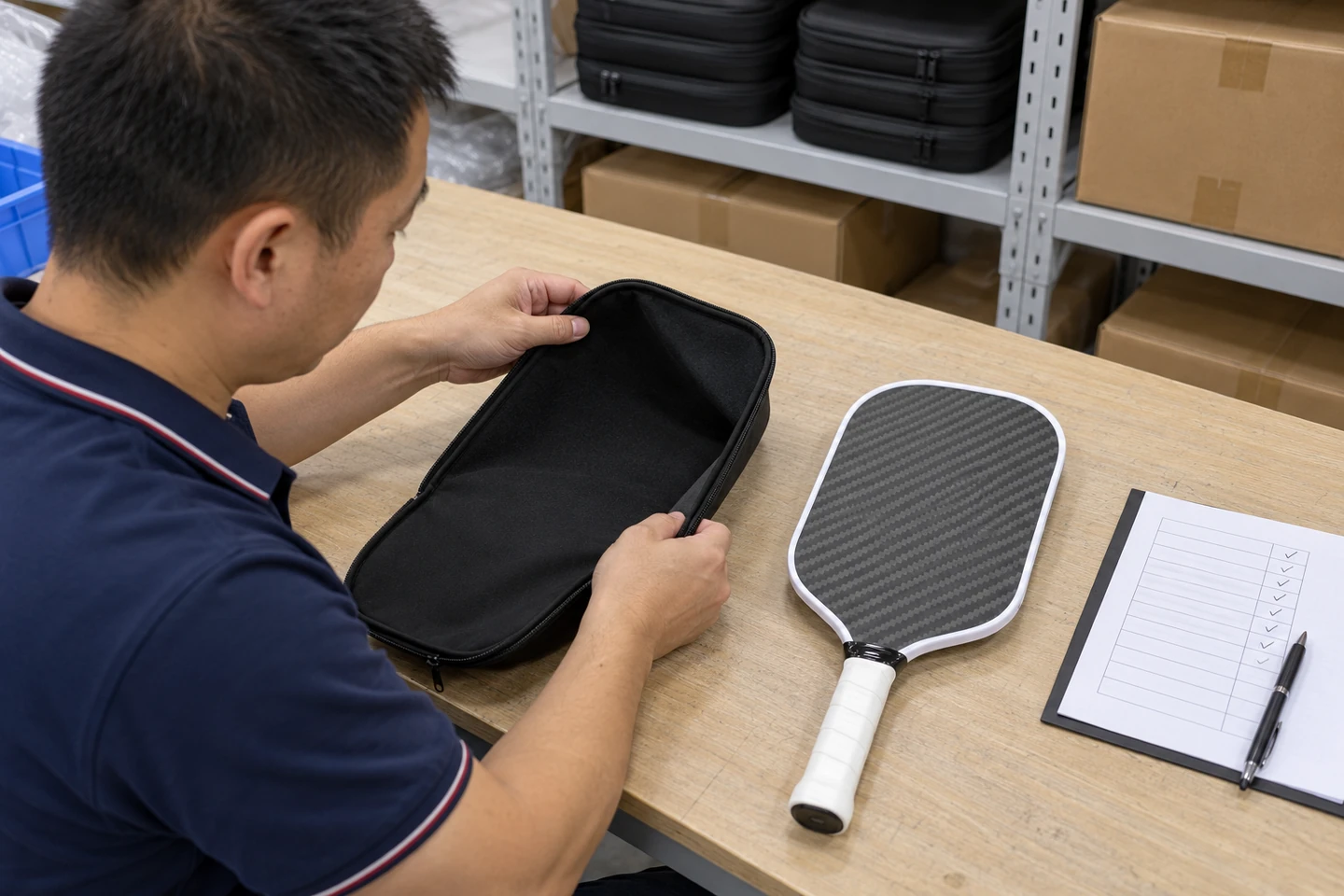
Record received condition before use. A scratched paddle after several sessions tells a different story from one arriving with the same mark. If one supplier provides several units, inspect them individually rather than letting the best-looking piece represent the whole set. This small sample will not establish a production defect rate, but visible differences deserve an answer.
| Comparison field | Record for every sample | What a gap means |
|---|---|---|
| Identity | Supplier code and individual unit | Feedback may be attached to the wrong paddle |
| Build | Face, core description, shape and thickness | Construction comparison remains incomplete |
| Components | Grip, edge, ring and cap | Feel or finish differences may have another cause |
| Intended scope | Stock sample or requested custom build | Artwork and customization may not yet be comparable |
Decide which differences are acceptable
A stock sample can help you assess handling and general finish even when it lacks your logo. It cannot answer whether your small lettering will print cleanly. Likewise, two different shapes can be compared as complete products, but the result does not isolate supplier workmanship. Name the question each sample can answer before paying for another round.
Send the same paddle specification checklist to each shortlisted supplier. Mark mandatory requirements separately from preferences. If a supplier proposes an alternative core, ask why and keep that alternative identifiable. It may be useful, but it is not an unchanged response to the original request.
Use a prepared check sheet 1 with defined observations so the same visible issue is recorded consistently across suppliers. A short list used carefully is more valuable than a long form completed from memory.
Which Physical Differences Should Affect My Shortlist?
A finish problem, an undocumented core and a color preference need different responses. Mixing them into one appearance score hides the reason for your choice.
Inspect appearance, face identity, core evidence and printing as separate categories. Decide whether each difference is a failure against your request, an acceptable variation or a question that still needs evidence.
Compare the finished assembly before the sales description
At our sample bench, I put the received condition beside the requested finish before discussing which paddle looks more expensive. If a buyer dislikes a grip color that was never specified, I treat it as a revision request; if the edge is visibly lifting, I keep it as a workmanship concern. The distinction matters because changing a preference does not resolve a physical fault. The buyer gets a specific follow-up instead of a vague instruction to improve quality.
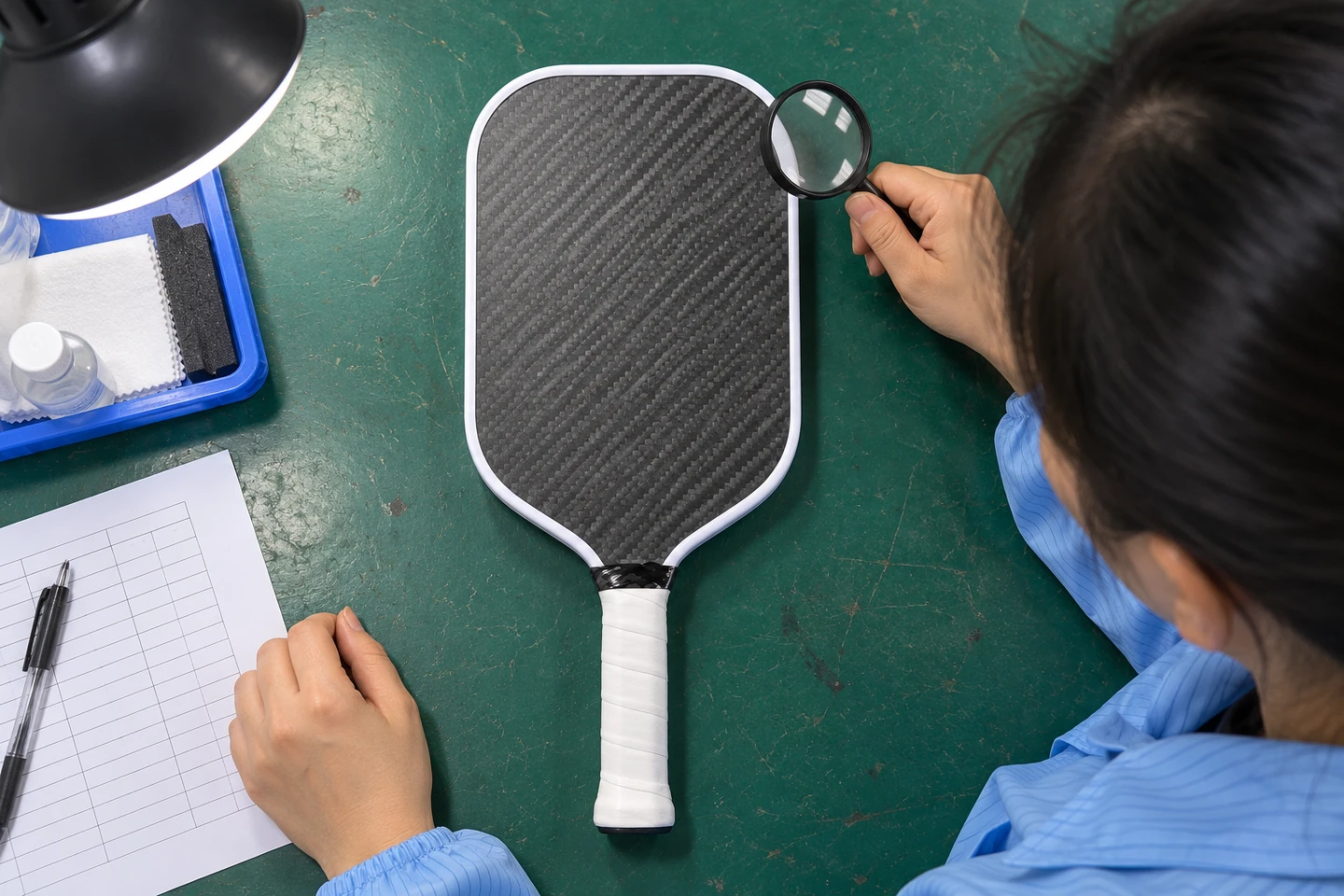
Look at the full outline, edge attachment, throat transition, grip wrap and cap fit. Examine both faces under the same lighting and take comparable photographs. Do not force or dismantle the only available sample merely to satisfy curiosity. If destructive evaluation is needed, agree on an additional unit, the method and its purpose first.
Our manufacturing process explains where surface checks and finished assembly checks sit in the work. Ask each supplier which stage addresses the issue you found and what evidence they can provide for the proposed correction. A broad claim of strict inspection is not a response to a particular loose component.
Separate material identity from what the eye can confirm
A visible weave is useful for matching the appearance reference. It does not establish every layer beneath it. Ask for the named face material, surface treatment and core layout associated with the actual sample code. A core photograph is useful only when the supplier explains how it relates to that build; a generic catalog image does not establish the contents of a sealed paddle.
Record physical measurements in consistent measurement units 2, with the measuring method beside them. Do not compare grams in one column with ounces in another or treat a rounded catalog figure as a measurement of the sample on your table. Agree acceptable ranges with the supplier instead of inventing tolerances after seeing the results.
For our selected C01 enquiry, the core name identifies an interlocking EPP and EVA layout. It does not establish a power or spin ranking. I would rather discuss the finished sample evidence than sell a performance conclusion hidden inside a structure name.
Judge print execution against the same reference
Compare logo orientation, edge clearance, small details and visible coverage against the intended artwork. If one sample has a full custom print and another is unprinted, record that limitation rather than giving the blank face an automatic perfect print score. Ask the supplier to show how the relevant artwork will be assessed on the selected face.
A shared color-managed workflow 3 helps production partners communicate their color settings, but a phone image is not your physical color approval. Compare the samples together in a consistent viewing environment. Discuss any material texture that changes the apparent finish rather than asking for an unexplained screen match.
For PDF artwork, output preview and object inspection 4 can reveal color-space, resolution and separation details before printing. Use those checks to clarify the file being compared; they do not replace inspection of the printed paddle.
How Do I Compare Power, Spin and Ball Exit Speed Fairly?
An impressive rally is easy to remember. It is harder to tell whether the paddle, the incoming ball or the player's swing created that impression.
Use the same players, balls, drills and recording method for every candidate. Keep measured ball exit speed and spin speed separate from subjective power impressions, and repeat the comparison before trusting a small difference.

Give every paddle the same practical tasks
The Philippine buyer's first playing notes favored whichever sample a player had tried last. I asked her to rotate the order within each player's session and repeat the same drills with every candidate. A last-used preference was not enough to decide which supplier suited her line. She arranged another comparison before reducing the shortlist, rather than requesting a bulk quotation from the first favorite.
Include ordinary drives, controlled placement and the shots that matter to your intended users. A backhand groundstroke can show how a sample responds during a repeatable drive after the bounce; it should not be judged against another paddle used only for soft shots. Give players time to become familiar with each grip, then collect comments before they discuss preferences as a group.
Keeping important conditions together follows the practical logic of blocking and randomizing comparisons 5: reduce avoidable differences and vary the order of the candidates. You do not need to turn a sourcing session into a laboratory study to avoid giving one paddle all the fresh-player trials.
Keep three performance questions separate
Power is often a player's description of how readily the paddle produces a useful shot. Ball exit speed is a measured speed after contact. Spin speed describes rotation. They can inform the same buying decision, but they are not interchangeable scores. A deeper landing ball is not, by itself, a spin measurement.
| Question | Useful comparison evidence | Avoid claiming |
|---|---|---|
| Hitting power | Player effort and response during the same drill | A feeling is an instrument reading |
| Ball exit speed | Consistent measurement setup, units and repeated shots | One fastest shot represents every rally |
| Ball spin speed | A suitable validated measurement method and repeated trials | A rough face proves a numerical spin advantage |
| Practical fit | Placement, grip comfort and repeatable player comments | Every player values the same response |
If you have suitable instruments, agree the setup and retain the readings for all candidates, including ordinary results rather than only the best shot. If you do not, label the finding as a player observation and ask for applicable test evidence where a numerical claim matters. Do not manufacture an RPM figure from a short clip that cannot resolve the ball's rotation.
Look for a useful difference, not a dramatic adjective
Record where players agree and where they disagree. An aggressive player and a placement-focused player may legitimately choose different samples. That is a customer-fit question, not automatically a testing failure. Relate the feedback to the people who will buy the product, as in our material, thickness and target-price discussion.
Repeat close calls under comparable conditions. Stop using a sample that develops a concerning physical problem and ask the supplier to assess it; do not continue simply to finish the scorecard. Keep the initial condition photographs so later observations have context. Your objective is a defendable shortlist, not a universal performance league table.
How Do I Turn the Results into a Supplier Choice?
The strongest sample is not automatically the most workable offer. Equally, a low quotation cannot repair a sample that misses a mandatory requirement.
Apply mandatory requirements first, then weigh physical quality, playing fit, evidence quality and the complete commercial offer. Select a supplier, request a focused clarification or stop the candidate with a written reason.
Set the priorities before adding the scores
When a buyer wants to average every result into one number, I first remove candidates that fail a non-negotiable requirement. A beautiful print should not cancel out an unresolved construction mismatch. Only the remaining candidates belong in the weighted comparison. The next discussion is then about genuine trade-offs rather than arithmetic that hides a reason not to buy.
A decision matrix 6 makes criteria and relative weights explicit. Agree the scale before scoring, keep higher scores favorable in every category, and retain the evidence behind each rating. Do not change the weights afterward just to make the cheapest supplier win.
| Decision layer | What to compare | Possible next step |
|---|---|---|
| Mandatory fit | Agreed build and essential requirements | Exclude or clarify a mismatch |
| Product evidence | Finish observations and repeated playing feedback | Keep the suitable candidates |
| Supplier response | Specific answers and feasible corrective proposal | Request a focused revised sample |
| Commercial fit | Comparable price, scope and terms | Choose the workable offer |
Compare the offer for the paddle you actually selected
Ask for pricing on the selected configuration and intended quantity, not the cheapest unrelated model in the supplier's range. Include artwork allocation, components, packaging and destination. A sample that needs several changes has not yet demonstrated the final proposed build; identify which changes need another physical review before committing further.
Check the stated delivery responsibilities and named place 7 when comparing offers. Goods price, freight and import responsibilities must not be silently treated as the same scope. Confirm the actual amounts and terms for your shipment instead of assuming one supplier's quotation includes what another lists separately.
A pro forma invoice 8 can bring the product description, quantities, prices, payment terms and validity together. Read it against the selected sample and your unresolved questions before proceeding. The format is useful; it is not a substitute for agreement.
Make the next action smaller and specific
If two candidates remain close, ask the question most likely to change the decision. That might be confirmation of the core, a corrected print sample or another controlled playing session. Do not request an entirely new design when the only uncertainty is one detail. Keep the earlier candidate identifiable so you can tell whether the revision solved the original problem.
If no candidate fits, say so. You can revise the brief or search again without declaring a weak sample the winner. If one supplier does fit, retain the chosen sample and the reasons for selecting it. Supplier selection answers whom to continue with; production approval is a subsequent decision about the exact build and terms.
Conclusion
Compare appearance, face material, core structure and printing first. Then evaluate hitting power, ball spin speed and ball exit speed through consistent play and appropriate measurements. Combine the results with player fit, the supplier's answers and the complete offer. Choose the supplier whose evidence supports your requirements, not the paddle with the strongest first impression.
Build a Clear Supplier Comparison
Discuss a custom 3K paddle with SHUEN. Send your intended player group, selected shape, face and core, thickness, sample quantity, artwork needs, comparison observations and delivery destination. Identify the question you still need the sample to answer so we can discuss a focused next step.