A supplier calls a sample hybrid after you ask to change the edge color. Before you pay for another prototype, you need to know whether anything inside the paddle changed. I ask for a material schedule because the change might be no more than an exterior trim, or it might move a different material closer to the hitting area. The price alone won't tell you which.
I read the core by composition. Full-foam, as I use the term, means the full core body uses one foam material. A perimeter-foam example uses EPP in the center and EVA at the edge, with another foamed layer outside the EVA in some builds. A hybrid might combine an EPP center with a PP honeycomb handle, or a PP honeycomb center with an EVA edge. Factory terms vary, so identify what's in each area before approving a quote.
If you are comparing a technical core change and a visible update, keep two lists. Put the center, shoulders, perimeter and handle on the core list. Put the face, grip wrap and exterior trim on the other. The Emery Grit custom paddle option, for example, is a face choice. It doesn't tell you what sits behind it.
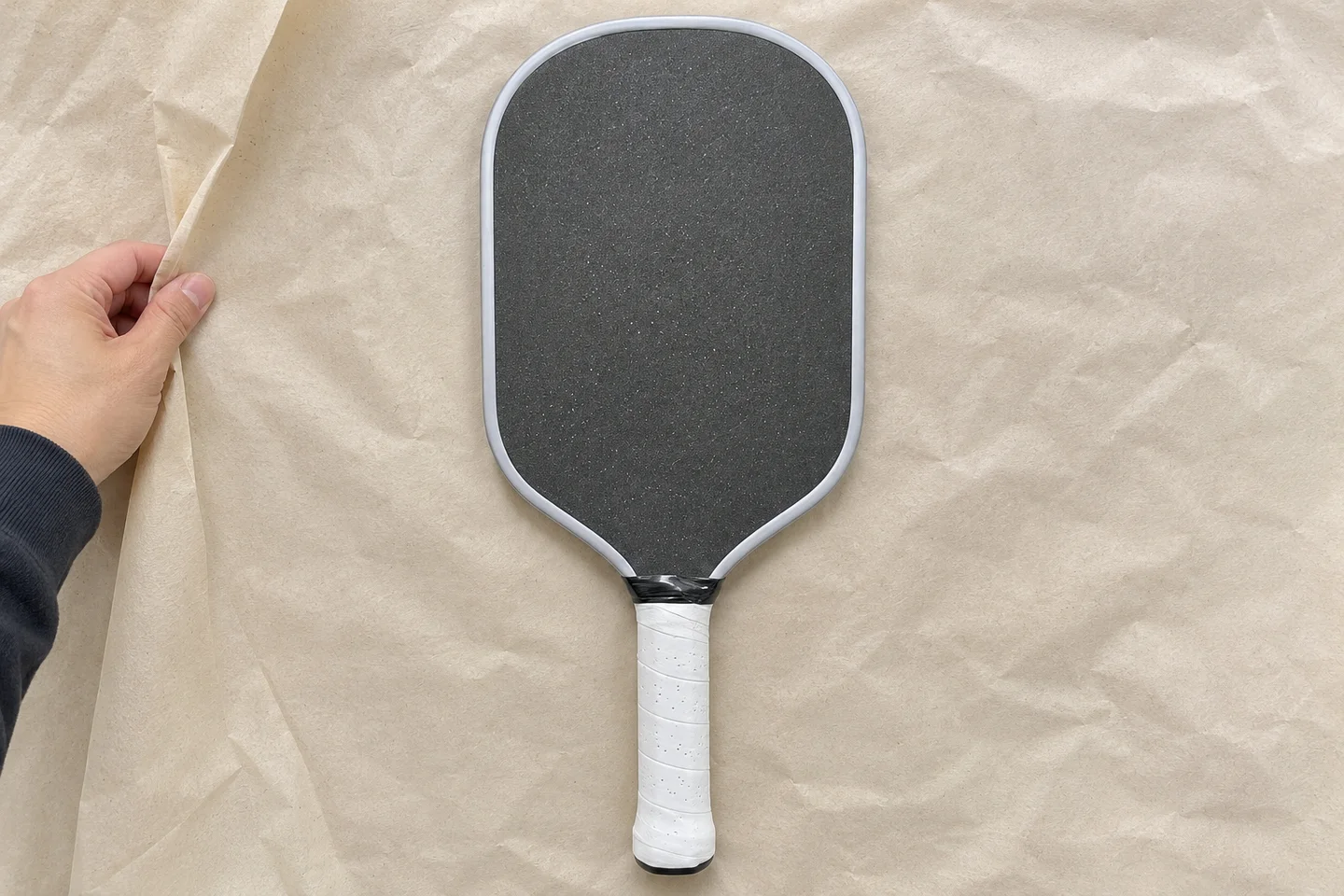
How do I check whether the whole core uses one foam material?
The first evidence I want isn't an answer to “Is this full foam?” It's a plain-language line that says what material runs across the head and into the other areas the supplier includes in its definition of the core body.
For a full-foam comparison, ask whether a single foam material is specified across the entire core body, how far that body extends, and whether differences inside it are grades of that material or additional materials.

Ask for a material name rather than a core category
EPP is expanded polypropylene. It is a foam structure, not an instruction to build with any one density or supplier grade. JSP's ARPRO product information 1 shows why an EPP description can still leave a grade decision open. I don't add a specific commercial grade to the quote unless we've discussed it. Write down what has been decided, and leave an open line for the supplier to complete if the grade is still in development.
I use the same principle when an all-foam quote describes a softer shoulder region. That may mean the same material in a different grade, or it may mean a different foam. I want the supplier to say which. Then I'll know whether I'm choosing a variable within one material or approving a second substance at the shoulder. Neither answer is automatically better for a brand.
Describe the geometry separately from the polymer
A PP honeycomb and EPP can both contain polypropylene, but the first description identifies a cellular honeycomb component and the second identifies expanded foam. ThermHex's polypropylene honeycomb core range 2 makes the distinction concrete. It does not identify which supplier or cell dimensions a paddle uses. If the quote only says PP, ask for the form and where it sits.
| Description in a quote | First item to confirm | Why the label alone falls short |
|---|---|---|
| One foam body | Name and extent of that foam | There may be more than one grade or density in the body |
| Foam around the perimeter | Material inside the perimeter | A foamed edge doesn't make a honeycomb center into foam |
| Hybrid core | Materials and locations that are being combined | A hybrid handle and a hybrid head are different configurations |
Do not combine an unconfirmed internal change with a cosmetic one
“Why does it say hybrid now? I only asked about the trim.” An Australian brand buyer asked me that in September 2026 when planning a development run of eight paddles. The outline and thickness in the brief were shape 002 and 14 mm. The Emery Grit face was to remain unchanged. The buyer wanted to compare a C11 Multi-Zone Side-Reinforced Hybrid Core with a simpler build and didn't want the new edge color to get bundled into that decision.
I asked for two quote lines with the same visible finish: one for the baseline construction and one for the alternate core. The buyer asked us to keep the baseline price separate and mark the alternate as a sample inquiry rather than putting it on the purchase order. That gave us one real comparison without making the edge color the explanation for a change inside the paddle.
Where exactly is the foam around the edge?
“Foam to the edge” can describe a band inside the construction or an oversimplified answer about what you see from the side. I want to be able to point to each boundary on a view of the head.
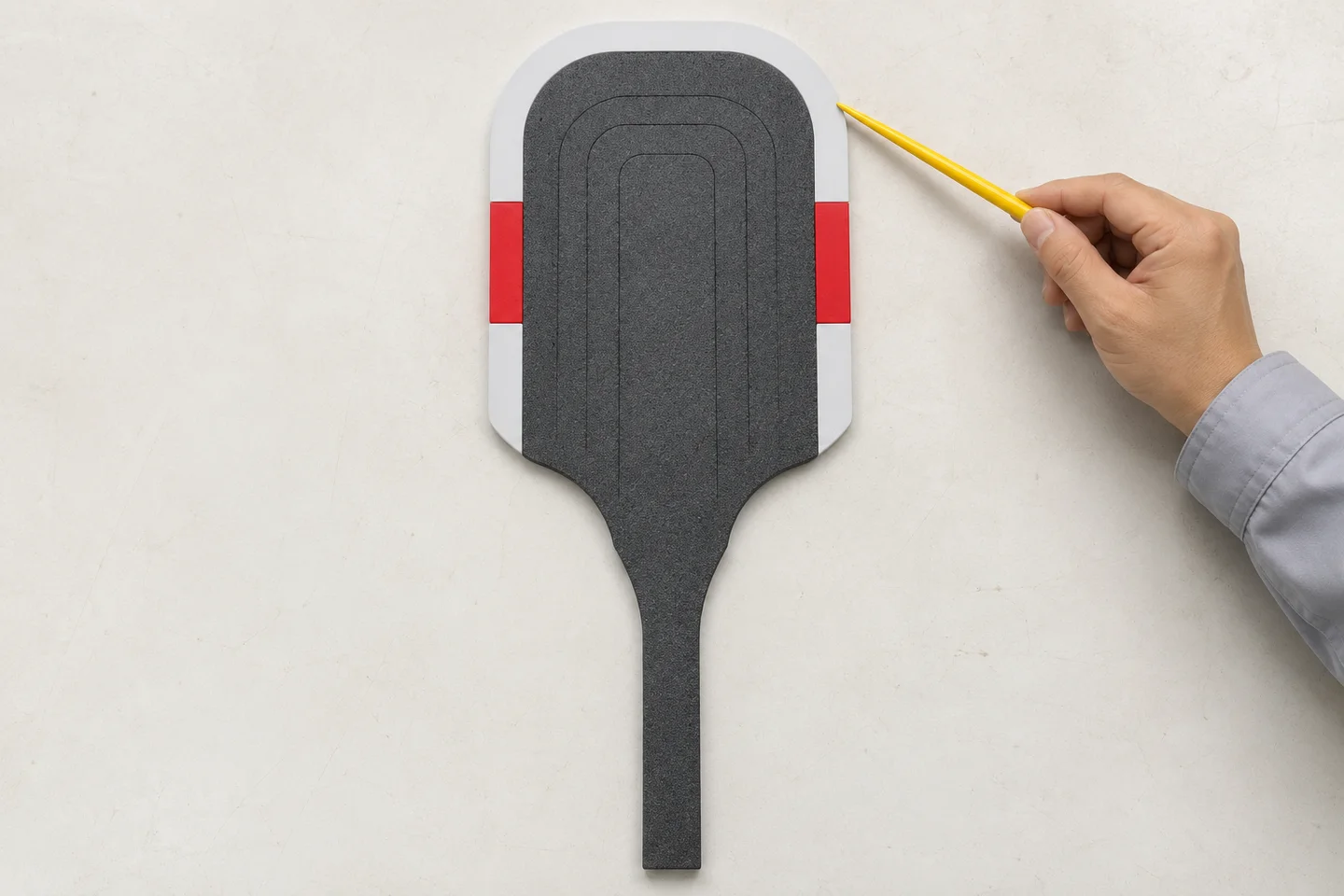
Ask for a plan view showing where the EVA rim runs and a section showing its position relative to the face, any additional outer foam and the exterior guard. Don't infer those boundaries from the trim color.
Check whether the rim goes around the whole head
In an EPP-plus-EVA arrangement, put the EPP center and EVA perimeter on separate lines. Then ask whether the EVA is continuous, partial, or reinforced at selected points. If another foamed layer sits outside the EVA, name that layer and mark it separately. The width of a band is a different dimension from total paddle thickness. Keeping the units and arrows next to each item prevents a width from being mistaken for a sample thickness.
Zotefoams' Evazote material range 3 illustrates the range of grade choices even within a named EVA foam family. It isn't a source for the grade of anyone's paddle. Use the family name to start a conversation and the approved specification to end it. If the grade is not known at inquiry, keep it open rather than assuming that all EVA options are interchangeable.Give the internal rim a different reference from the external trim
With the trim color change on the table, I asked the buyer to leave the exterior swatch in the artwork folder and put the supplied core view beside the quote. A photo of colored trim couldn't tell us whether it sat outside EVA, another foam or another substrate. We could approve the swatch without approving the underlying construction. I wouldn't use a visual swatch to release a hidden foam change.
When a supplier proposes to bond one layer against another, 3M's explanation of bonding plastics 4 helps explain why the identity of both materials matters. It tells you nothing about the supplier's specific adhesive or joint strength. Ask which surfaces meet first and leave manufacturing details out of the quote unless they are necessary to agree the change.
Match each boundary to a type of evidence
| Check | Useful evidence | Don't infer it from |
|---|---|---|
| Center material reaches its marked boundary | Labeled plan view of the core | Visible face color |
| EVA rim runs around specified areas | Plan view with starts, stops and widths | A dark ring in an unannotated photo |
| An extra outer foam is present | Supplier section marking the separate layer | Thickness of an exterior guard |
| Exterior trim keeps the agreed finish | Physical swatch or assembled sample | An internal material code |
The custom paddle configuration catalog is useful when you want to discuss a visible reference for a particular layout. Ask the supplier to confirm which features in that reference apply to the sample being quoted. A product card does not cover every variant a supplier could build.
Which part of the paddle makes a build hybrid?
Hybrid doesn't tell me whether the material change is below the hitting area, around it or below the grip. Start with the change the sample is intended to show. If the customer didn't ask for a different handle, a handle-only change may not answer the question.
Have the supplier identify what is combined and where. EPP in the center with PP honeycomb in the handle is not the same layout as PP honeycomb in the head with EVA at its edge.

Locate the first change that the factory should price
For a foam center and honeycomb handle, ask whether the change is a separate handle insert, a bridge or a continuation through the throat. For a honeycomb center and EVA perimeter, ask where the honeycomb stops below the face and how the surrounding rim is identified in the construction. Put the unchanged areas on the same drawing instead of leaving them implicit. That gives you a way to catch a second material change before you pay for it.
Hexcel's sandwich construction guide 5 treats the face layers, core and their interfaces as a system. The guide isn't a paddle specification or a reason to promise a play response. It does explain why I don't use a center swatch to answer questions about the complete assembly.Keep alternative layouts separate even if they share a label
I didn't accept a single “hybrid” line covering both a new handle and a new perimeter when the buyer wanted to hear whether adding material to the head changed the sample quote. I asked the factory team to split the change into two sketches and mark which component it had to price in each. The buyer could set aside the handle variant without losing the sample question that mattered. Both designs might fit a supplier's hybrid category; they don't belong on the same line item.
A simple custom paddle brief helps you keep the held-constant specifications visible. List the face, thickness, head shape and trim once. Note one revised zone beside the alternative. If a supplier cannot hold the other specifications steady, put that difference on the quote rather than letting it show up only after samples arrive.
Connect the drawing to the price without outsourcing your decision
PTC's engineering bill of materials explanation 6 explains why designers separate an assembly into named components. A buyer doesn't need a full engineering system to ask for this. A dated one-page list that distinguishes the head, rim, extra layer and handle can be enough to ask whether one change should be priced separately. I also ask whether a different minimum or sampling fee belongs to the changed part or to the entire layout. That makes it easier to compare the proposals.What should carry from the first sample to the purchase order?
A signed-off sample is useful only if purchasing and the factory can point to the same build. When two finished paddles look alike, a photograph and a product label aren't enough to carry that decision into production.
Keep the approved build revision and sample identifier together. Put the accepted material zones on the release, and ask for written review if a supplier proposes to change a confirmed zone.

Match the evidence to what it can establish
Intertek's explanation of flatwise compression testing for sandwich cores 7 describes a specimen test, not on-court behavior. A component test can answer a component question. By contrast, a finished paddle can be taken to court to evaluate the complete sample, but that won't identify a concealed polymer. If your concern is the material boundary inside the paddle, look for the matching drawing or a supplier-provided section.The buyer wanted an assembled sample that could go to the brand team without leaving the factory to guess which drawing should travel with it. I asked for the sample code to match the drawing revision in the brief. We kept the configuration annotation with the sample instead of trying to mark the EVA boundary on the outside of the paddle. The team could review sound and feel without mistaking those observations for a check of the internal build.
Define what a material change means before it is proposed
Autodesk's guide to reviewing engineering changes 8 separates making a revision from authorizing it. Put that distinction into the purchase process. If the proposed substitution changes a named foam or moves a material boundary, ask what is affected, whether a fresh sample is needed and who can sign off. Don't agree to an automatic substitute just because it would still be called hybrid.Hand over the same reference at each step
| Step | Evidence to carry forward | Reason to stop and ask |
|---|---|---|
| Request a price | Material list by zone and unchanged visible features | A line describes only a supplier's category |
| Authorize a development sample | Sample identifier and dated construction view | The alternative silently changes another variable |
| Release production | Purchase line references the approved sample and revision | The factory proposes an unapproved material or boundary change |
The guide from sampling to production puts sample approval into the wider order sequence. If face artwork and core layout change at the same time, get both versions onto the sample record. You may be comfortable approving a new visual without another internal review. If so, say what did and didn't change rather than relying on the date of a shared photograph.
Conclusion
Ask what runs through the center, what surrounds it, and what continues into the handle. For full-foam, confirm what the supplier means by one foam body. For an EPP and EVA build, identify the rim and any further outer layer. For a hybrid, name the materials and their locations. The best quote is one you can compare, sample and approve without having to accept an undefined change in the middle.
Preparing a custom foam-core brief? Start with our Emery Grit custom paddle option if that is your intended face. Send the head shape, thickness, and the center, rim and handle materials you want reviewed. Include the single change you want quoted separately.