A hot-pressed paddle can look convincing in a production video and still leave you unsure what to promise your customers. A long warranty sounds reassuring until a replacement is needed. I want our buyers to understand the remedy and its timing before turning a manufacturing description into a retail promise.
Our paddle warranty is six months. For product-quality-related problems during that period, we provide free replacements rather than repairs, adding the corresponding number of new paddles to your next bulk order. We recommend inspecting the shipment within seven days of receipt and telling us about problems promptly; seven days is an inspection recommendation, not the warranty period. Set your own customer-facing promise with these terms, the selected build, relevant evidence and your local obligations clearly separated.
The useful question is not simply whether six months sounds competitive. You need to decide what the process and testing establish, how incoming checks help, how a replacement reaches you and what your brand will undertake separately. Those four decisions prevent a short service statement from growing into an unsupported guarantee.
What Can Hot Pressing and Durability Tests Tell Me About a Warranty?
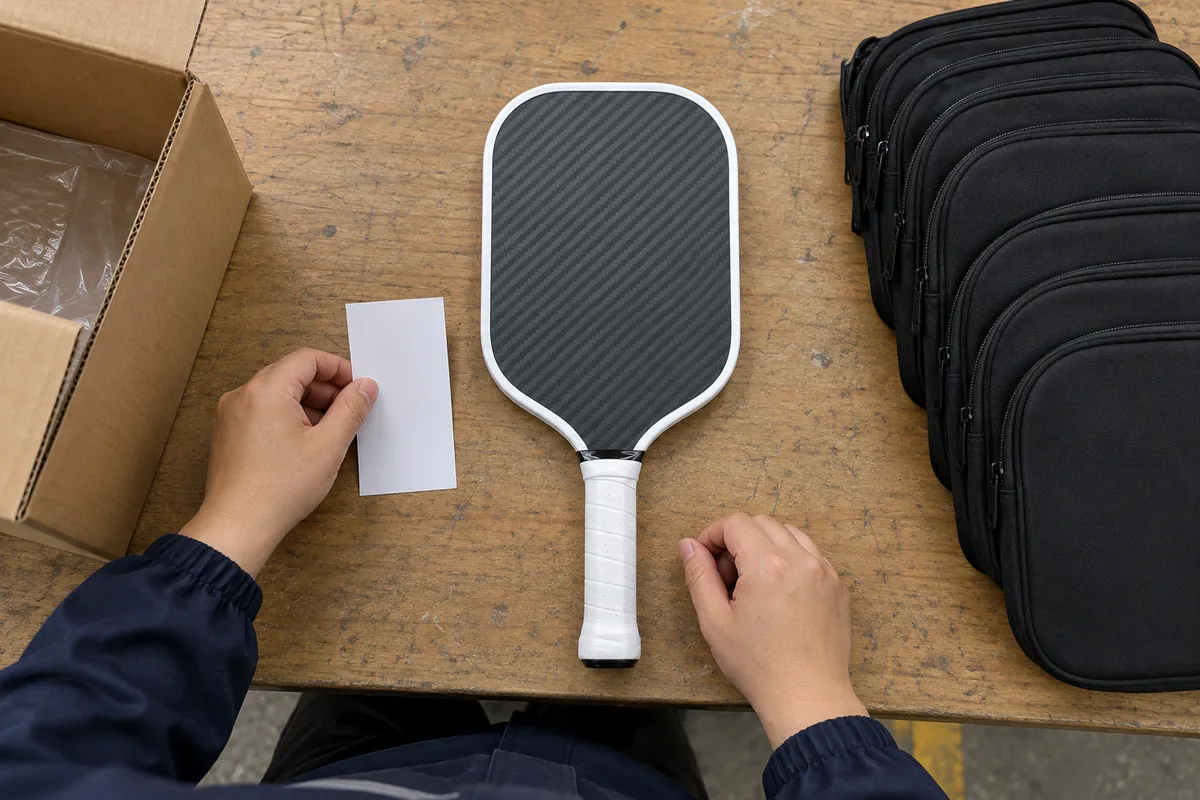
A manufacturing method explains how a paddle is made. It does not, on its own, tell you how long every player will use it without a problem.
Use the selected construction and relevant testing to assess the product, but do not convert a process name, a material label or a short playing session into a guaranteed service life. Our confirmed warranty remains six months.

Begin with the promise the buyer wants to make
The American brand owner wanted to put a full year on his product card because the paddle was hot-pressed. We discussed that in April 2026, while he was preparing an enquiry rather than placing an order. I explained our six-month replacement arrangement and asked him to separate that factory support from any additional promise his brand intended to fund.
His enquiry covered 60 paddles in shape 006 with Kevlar / Aramid faces, C05 Stabilizing-Rim Dual-Density Foam Cores and 16 mm thickness. He kept that build in the enquiry but held back the one-year wording. The next decision was to review the sample and the service arrangement before finalizing his customer information.
That is the distinction I want early. Our Kevlar / Aramid paddle options identify a face direction to discuss, not a fixed lifetime. Kevlar belongs to the aramid fiber family 1; a fiber description cannot settle the behavior of the complete face, core, joints and fitted components in your chosen paddle.
Ask what the evidence actually covers
I discuss our manufacturing process as a sequence of preparation, hot pressing, finishing, assembly and checks. When a buyer asks how it supports a warranty, I bring the question back to the selected construction and the issue they want evaluated. A description of the press stage is not a report of long-term failures in the field.
A meaningful discussion of product reliability 2 connects function, time and operating conditions. Ask which build was examined, what was done, what was measured and which conclusion follows. We can discuss available internal information, but you should not turn internal checking into a third-party certification claim or invent a pass threshold that was never agreed.
| Evidence or description | Useful purchasing question | What not to infer |
|---|---|---|
| Hot-pressing process | Does this describe the agreed construction? | Every unit has a guaranteed playing lifetime |
| Material description | Is this the specified face material? | The complete paddle inherits a fiber's properties unchanged |
| Documented test | Which build, conditions and outcome does it cover? | Any test automatically validates a longer warranty |
| Court feedback | Does this sample suit the intended use? | One successful session predicts months of service |
Keep a test result within its conditions
Different tests address different questions. The published scope of ASTM D7136 composite impact testing 3, for example, concerns specified composite specimens and impact conditions; it cautions against transferring results indiscriminately to other configurations. It is not a claim that our paddles have passed that test.
Likewise, projecting accelerated results to normal use requires a justified relationship between the test and use conditions. The NIST guidance on reliability projection 4 explains why the model and failure mechanism matter. For a buyer, the practical decision is straightforward: ask for the basis of a lifetime claim instead of dividing a laboratory cycle count by a guessed number of daily shots.
A court session still has a useful role. You can serve, rally and observe how the sample handles, then ask specific questions about anything that changes or feels wrong. Keep that feedback connected to the identified sample. Do not require a short test to answer a question it cannot answer, such as whether every future unit will remain unchanged for a year.
What Should I Check During the First Seven Days After Delivery?
An unopened carton preserves neither useful information nor your ability to plan the next step. Early inspection helps you identify a problem while the shipment is still easy to separate and describe.
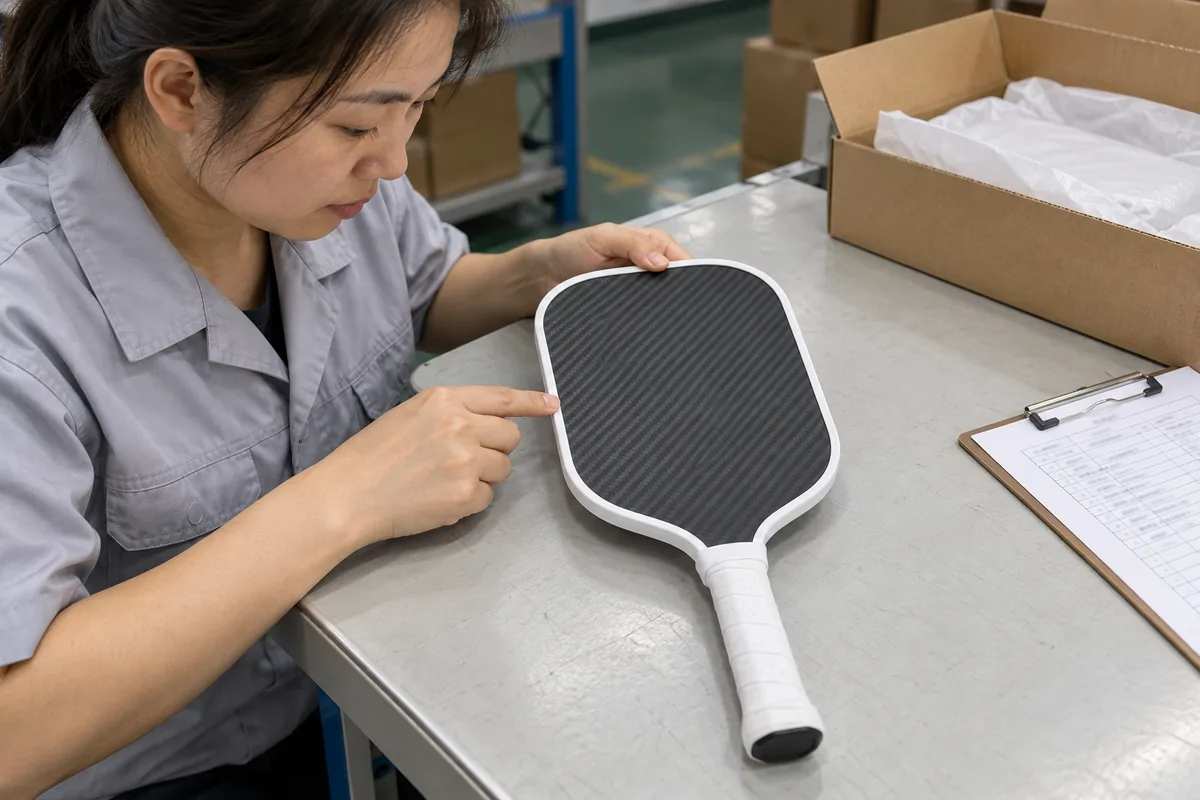
Try to inspect the goods within seven days of receipt and tell us promptly about any problems. Record what you found and how many paddles are affected; this recommendation does not shorten our six-month warranty.
Separate receiving checks from a long playing trial
When a buyer wants to wait until every club member has tried the paddles, I separate the receiving check from extended use. I ask them to inspect the shipment first and keep any visibly affected units identifiable. Waiting for a full playing programme can mix an arrival concern with later feedback, so the immediate decision is to report the visible issue rather than postpone all communication.
Start with the goods you received: the versions, quantities and visible condition. Compare the paddle with the agreed product specification checklist, including the face artwork, edge and handle components. Examine the individual paddle as well as the carton. A carton that looks sound does not answer every question about its contents.
You do not have to finish a long-term durability study in the first week. The purpose is to notice and communicate issues that can already be seen, while keeping later product-quality concerns open to the six-month service discussion. If something appears unsafe or seriously damaged, stop using that paddle and explain the concern instead of continuing play to see how far it deteriorates.
Give the issue a useful count and description
A simple check sheet 5 can help keep observations and quantities consistent. It need not be a complicated inspection system. Distinguish the units you inspected from the ones that showed a concern, and avoid counting the same paddle twice because it has two visible symptoms.
Clear pictures, a short explanation and the relevant order details can help us understand what you mean. These are practical ways to communicate, not newly imposed claim conditions. The precise information needed to assess a particular concern should be discussed with us; do not assume that a missing photograph automatically cancels the service arrangement.
| Receiving question | Useful action | Reason |
|---|---|---|
| Is this the agreed version? | Compare appearance and identified configuration with the approved reference | Avoid mixing a specification difference with a new preference |
| Which paddles show a concern? | Separate and identify affected units | Keep the replacement quantity understandable |
| What can be seen now? | Describe the location and visible symptom | Give us a specific issue to discuss |
| What remains untested? | Distinguish unperformed checks from satisfactory results | Avoid treating an unchecked item as accepted evidence |
Report early without inventing a seven-day cutoff
Our recommendation is to check within seven days because early communication is useful. It is not a statement that the warranty disappears on day eight. If a product-quality-related problem appears during the six-month period, contact us and explain it. Keep the timing factual rather than trying to fit every concern into the first-week inspection.
I also want the buying team and the receiving team to use the same wording. If purchasing hears “six months” but the warehouse hears “seven days only,” the company can give contradictory answers before a player even receives the product. Put the inspection recommendation and warranty duration on separate lines in your internal handover. Each line then has a clear purpose.
How Do Free Replacements Reach My Business?
“Free replacement” answers the price of the replacement paddle, but it does not explain when that paddle will join your stock. The order connection matters to your service plan.
For product-quality-related problems within six months, we record the replacement quantity and add that many new paddles free of charge to your next bulk purchase. One affected paddle means one replacement; two mean two.
Understand replacement rather than repair
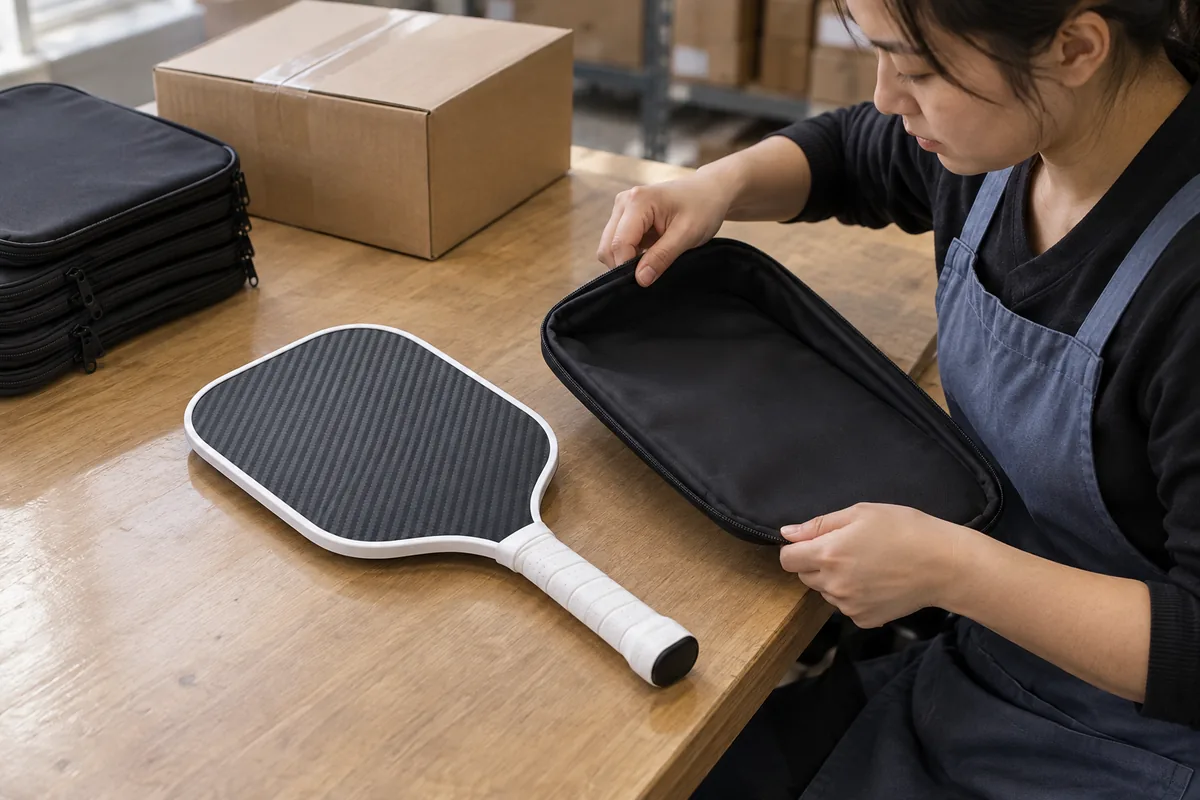
Our service is replacement-based because a damaged paddle is not something we repair back into the original finished product. I explain that distinction before a buyer promises customers a factory repair service. The useful remedy is a corresponding new paddle, not an unspecified workshop repair or an automatic refund.
If two paddles need replacement, we record two. Those two replacement paddles are added to the next bulk order without charging for the replacement units. Keep that quantity separate from the new paid purchase so both teams understand the shipment. The arrangement does not mean that every future order receives a fixed number of free extras.
Plan for the next bulk order, not an immediate parcel
A buyer who needs stock immediately faces a different question from one who is already preparing another bulk purchase. I explain that our stated arrangement joins the replacement paddles to the next bulk order. If the buyer has not planned that order, I ask them to discuss the timing with us before promising an immediate replacement shipment to their customer. That avoids selling a delivery schedule we have not agreed.
The order and delivery discussion should therefore identify the paid quantity, the recorded replacement quantity and the intended shipment. Confirm the actual arrangement rather than interpreting “free” as including every possible freight, duty or handling cost. Responsibility for those costs and any separate-shipment request needs explicit agreement; this article does not assign it to either party.
| Point to settle | Our confirmed arrangement | Separate discussion if needed |
|---|---|---|
| Remedy | New replacement paddles rather than repair | Any different remedy requested |
| Replacement quantity | Corresponds to the affected quantity recorded | Clarification of the specific issue and count |
| Inclusion in shipment | Added to the next bulk purchase | Timing if no next bulk order is planned |
| Replacement-unit charge | Free replacement units | Freight, duties or separate-shipment costs |
Keep the issue open until the arrangement is clear
A replacement count should lead to a practical next step. Confirm which order it will accompany and reconcile that count when the order is prepared. Do not let the service discussion disappear into a general remark that the factory will “take care of it.” Equally, do not treat a proposed arrangement as a confirmed dispatch date.
Feedback also helps distinguish a single concern from a recurring one. Guidance on customer-complaint handling 6 connects complaints with learning and corrective action. For our discussion, describe the actual issue and affected count instead of assuming that every concern has the same cause. This is a practical feedback principle, not a claim of ISO certification.
What Should My Brand Promise Its Own Customers?
Your customer buys from your brand, not from an internal conversation between you and the factory. They need a clear statement of the service you will actually provide.
Use our six-month replacement support as one input to your plan, not as a ready-made retail warranty. Confirm your own obligations, handling arrangements and any additional promises before publishing customer-facing terms.

Separate factory support from your retail undertaking
When I see proposed wording that says “instant replacement directly from the factory,” I bring it back to our actual arrangement. We add recorded replacement paddles to the next bulk order; we have not promised direct individual parcels to each retail customer. The buyer must decide how to serve customers between replenishments rather than pass an invented dispatch promise through to them.
A brand can consider holding service stock or choosing a different customer response, but those are its own commercial decisions. They do not automatically extend our warranty or change our shipment arrangement. Calculate what your proposed service would require, including stock availability and administration, before choosing words that sound attractive on a product page.
Have the customer-facing wording reviewed for your market
For the United States, the FTC's business guide to warranty law 7 distinguishes written warranty terms and consumer-law obligations. Have appropriately qualified advice review how the rules apply to your offer and sales channel. Our business-to-business service statement is not legal advice or a substitute for that review.
The period, coverage, remedy and way to obtain service should be understandable together. The FTC's consumer guidance on reading warranty coverage 8 illustrates why duration alone is not the whole offer. Do not copy a competitor's exclusions, call the warranty “full” without checking the implications, or assume supplier support removes local rights.
Confirm the unanswered points before promising them
Our confirmed policy establishes six months, replacement rather than repair, corresponding quantities and inclusion with the next bulk order. It does not specify every contractual detail. Confirm the start point for the period, the assessment process and relevant costs with us for your order rather than filling those gaps with assumptions.
Write the final customer message in plain language and check it against your operational plan. If the message promises faster service than your next replenishment allows, decide how your brand will provide it. If it promises a longer period, identify who will support that additional period. A clear, deliverable promise is more useful than an impressive number nobody has planned to honor.
Conclusion
Set the warranty around a service you can explain and deliver, not around the words “hot-pressed.” Our paddle warranty is six months, with corresponding free replacement paddles included in your next bulk order for product-quality-related problems. Inspect promptly, preferably within seven days of receipt, and keep that recommendation distinct from the warranty duration. Then confirm the remaining order details and your own customer-facing obligations before making a broader promise.
Discuss your paddle and after-sales plan with us. Send your intended market, selected configuration, planned quantity and proposed customer-facing service wording. For a custom Kevlar / Aramid paddle, identify the shape, core and thickness you want to review, and tell us how your next bulk purchase is likely to fit your service plan.
Rudy · Factory Partner · info@shuenpickleball.com · WhatsApp +86 137 1215 6638