A little powder on a paddle face can make a buyer hesitate over the whole order. Has the ball left material behind, or is the surface coming off? At our factory, I start by separating those two possibilities before discussing whether the sample deserves the next purchase.
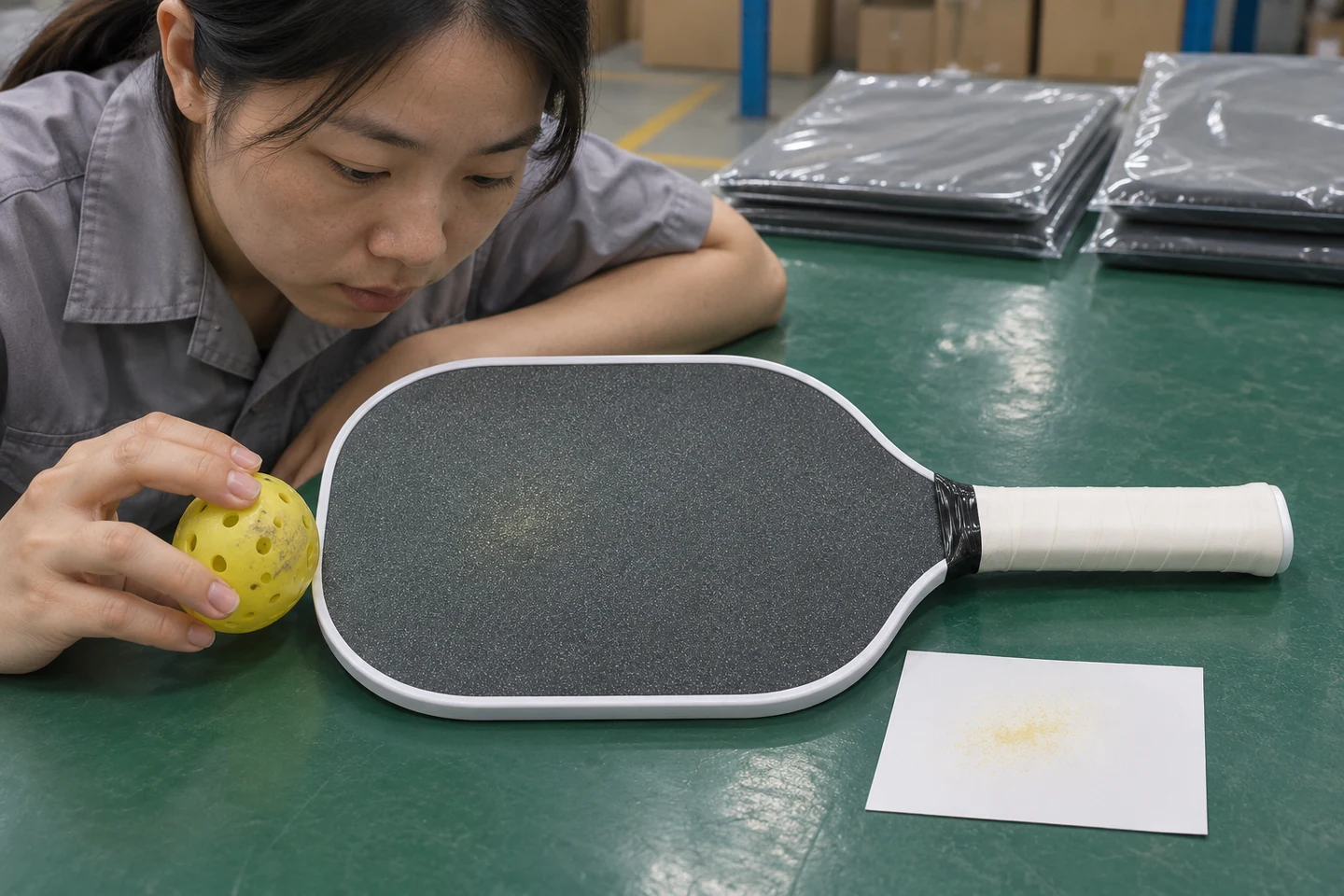
Ask for evidence tied to the exact paddle: its configuration, the rubbing method, clear before-and-after views, the condition of the ball, and observations of the face after suitable cleaning. We repeatedly rub a pickleball against the silicon carbide face for about five minutes and examine the debris. If it is mainly ball residue rather than material coming off the face, that provides a useful visual reference for face wear resistance. This is an informal observation, not a standardized certification test or a guarantee of playing life. Unclear residue or visible surface damage needs further investigation.
The useful evidence lets you decide what to do next: continue evaluating the sample, ask for a more controlled test, or resolve a surface concern before ordering. A convincing video should help that decision, rather than ask you to accept “durable” without knowing what was examined.
Which Paddle and Test Conditions Should the Evidence Identify?
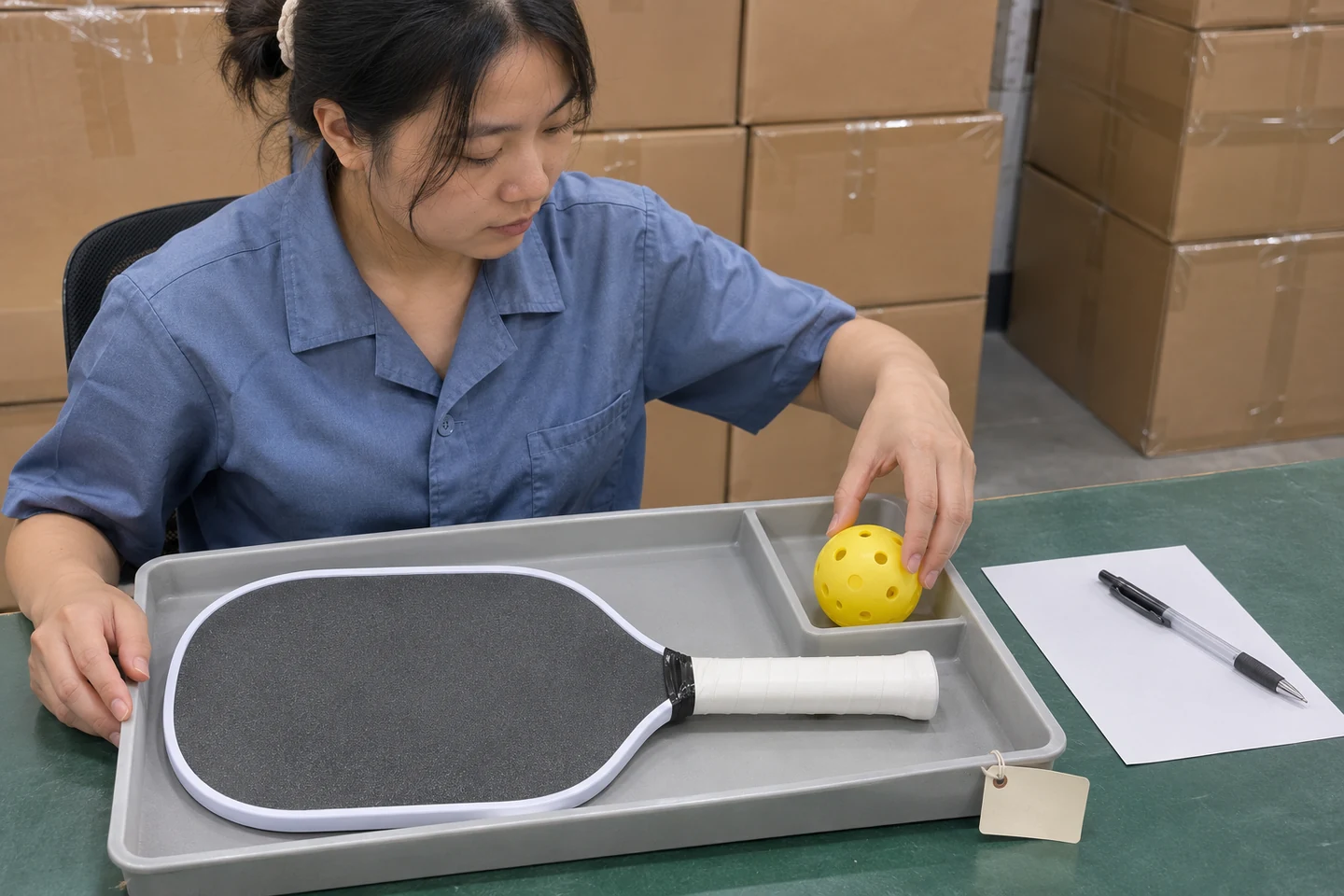
Before judging a result, make sure it belongs to the product you intend to buy. Two dark faces can look alike while representing different finishing choices.
Request the sample identity, agreed face and construction, ball details, rubbing procedure and starting condition. Compare suppliers only after you understand which conditions are shared and which differ.
Connect the demonstration to your selected build
The Canadian distributor's concern was whether a supplier's existing demonstration covered the face he wanted to order. In April 2026, he had a short rubbing video but could not connect the paddle in it to his enquiry. I asked him to keep that clip as background and request evidence for the proposed build before comparing durability claims.
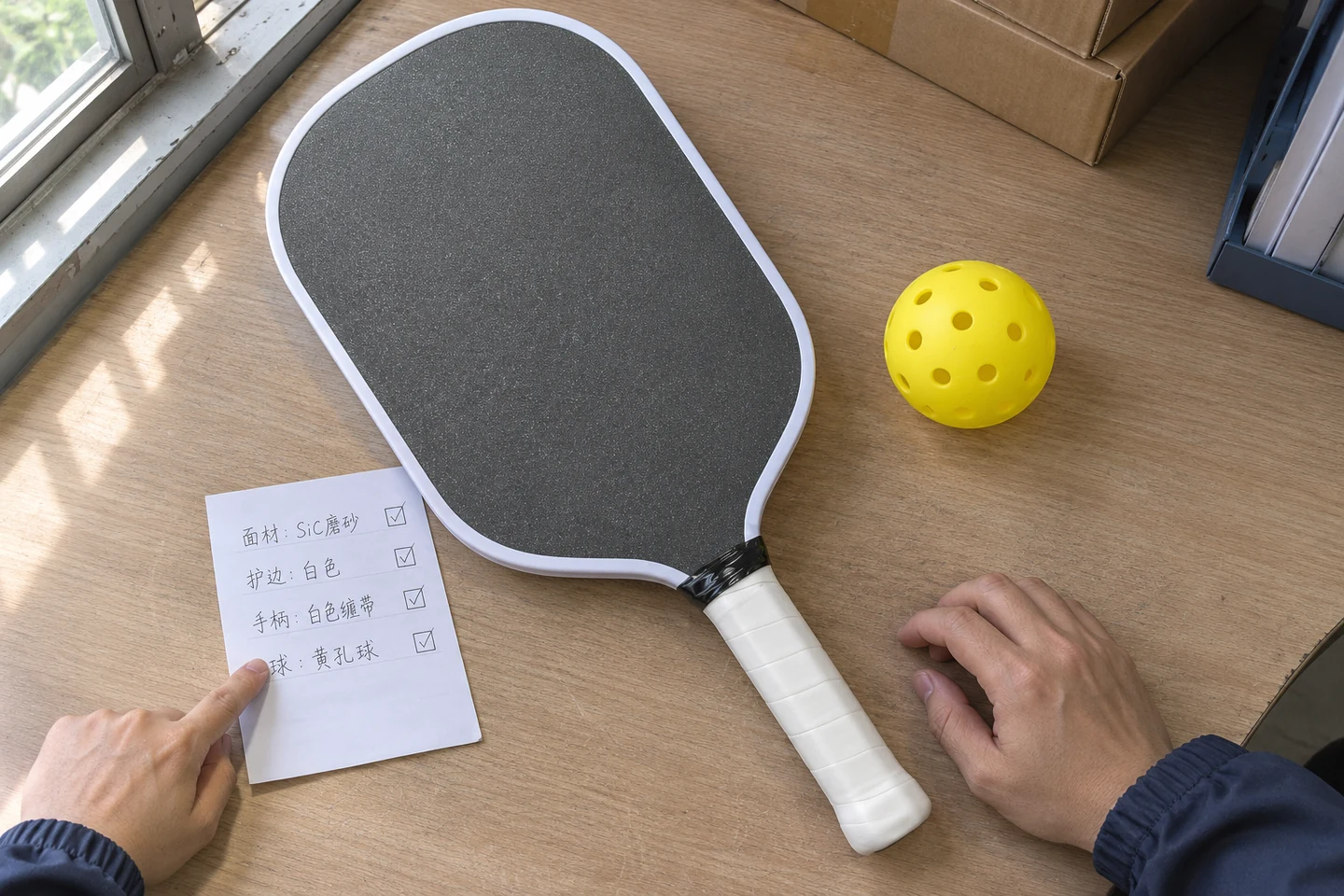
His enquiry covered ten paddles in shape 004 with Silicon Carbide Grit faces, C10 Split-Handle MPP–EVA Foam Cores and 16 mm thickness. He kept that configuration and requested an identifiable sample for the next comparison. The immediate decision was to evaluate one defined build, rather than assume every paddle with a similar surface would produce the same result.
For our silicon carbide grit face configuration, confirm the actual surface against the sample. Include the final artwork or finishing stage when it affects the area being evaluated. A result from an unfinished panel deserves a different description from a result on the finished paddle offered to you.
This attention to the complete build also matters in formal equipment submissions: USA Pickleball's submission requirements 1 address materials, manufacturing, surface-finishing processes and final graphics. Its approval process is separate from our informal rubbing observation; do not present one as the other.
Ask what actually happened during the rub
“Five minutes” describes duration, but leaves several important questions unanswered. Which ball was used? Was it new or already scuffed? Where was it rubbed, how was the paddle supported, and was the operator applying hand pressure or a defined load? Ask for those details in ordinary language.
Abrasion depends on the contacting surfaces, force, movement and environment, among other test conditions 2. That is why two videos of equal length are not necessarily comparable. Hand rubbing is especially difficult to reproduce precisely, so record it honestly rather than attach a laboratory-style number to an unmeasured force.
| Evidence to request | Detail that makes it usable | Purchase decision it supports |
|---|---|---|
| Sample identification | Face, shape, core, thickness and finishing stage | Whether the result covers your proposed build |
| Ball identification | Model, condition and whether the ball changed | Whether residue observations can be compared |
| Rubbing procedure | Duration, path, support and applied pressure description | Whether a second trial is meaningfully similar |
| Starting condition | Clear views of the face and ball before contact | Whether a mark was already present |
Keep the request proportionate to the order
Put the selected build and requested evidence into the custom paddle brief. For an initial sample decision, an understandable demonstration may be enough to continue evaluation. A larger commitment or a specific durability claim can justify a more controlled assessment.
Ask what evidence already exists and what would require additional work. Discuss the scope, cost and timing before commissioning a new test. Collecting an impressive report for the wrong construction spends money without reducing the uncertainty that matters to your order.
How Should I Judge the Powder Left After About Five Minutes?
The amount of visible dust can be striking, but the buying question is where it came from and what happened to the face underneath it.
Examine the ball, loose debris and paddle surface together. Preserve the initial observation, then inspect the face after a supplier-approved cleaning method; treat an uncertain residue source as unresolved rather than calling it a pass.
Ask for a connected before-and-after record
When a buyer sees pale dust and assumes the face has failed, I compare the ball's contact area with the rubbed part of the paddle before agreeing with that conclusion. Dust alone does not tell us which object lost material. I ask for the starting view, the uncleaned result and the cleaned surface so the buyer can decide whether to continue or investigate a specific change.
A useful record keeps the same paddle identifiable throughout. Ask for an overall view and a close view of the rubbed area under similar lighting. The first shows where the observation belongs; the second shows the detail. Keep the original files where possible, since repeated messaging-app compression can hide small surface changes.
Request the test setup, observations and photographs 3, rather than only a “pass” statement. Taber's testing service describes that kind of report content. For our hand-rub check, the same purchasing principle is useful: see what was done and observed, without implying that the demonstration was conducted by that laboratory.
Separate transferred residue from a changed surface
Ball residue is a real possibility on an abrasive paddle surface. Selkirk describes ball residue on its Infinigrit face 4. That observation concerns its product, not proof of the debris source on a SHUEN sample. It is a reason to examine both surfaces instead of deciding from dust color alone.
Before cleaning, photograph the residue and keep a small collected sample if its identity may need investigation. Then ask the supplier how to clean the selected face without changing it. Do not borrow a solvent, abrasive cleaner or cleaning tool from an unrelated paddle's instructions. A cleaning method that alters the surface would make the next comparison harder to interpret.
| What you observe | What it can suggest | What I would request next |
|---|---|---|
| Debris resembling the ball's color | Possible transfer from the ball | Compare the ball and inspect the cleaned face |
| A patch still visibly changed after suitable cleaning | A surface change worth investigating | Matching-light close views and a repeat review |
| Flakes or a visibly lifting area | Possible material separation | Stop that trial and assess the affected sample |
| Mixed or ambiguous particles | Origin remains uncertain | Preserve residue and discuss suitable identification |
Escalate uncertainty instead of guessing composition
Color, a close-up photograph and a fingertip impression do not establish the chemical identity of a particle. If the decision depends on whether debris is ball polymer, face material or a mixture, ask a competent laboratory what comparison and analytical method would answer that question.
Methods for particle identification 5 can combine microscopy and material analysis, with the choice depending on the sample and question. Do not prescribe one instrument as a guaranteed answer for mixed debris. Send the laboratory the actual concern and ask what reference materials it needs.
What Additional Evidence Should I Request Before a Larger Order?
A sample can look acceptable after hand rubbing while leaving questions about use, comparison or a supplier's stronger claims. Choose the next check to answer the remaining question.
Add controlled playing observations for the actual sample, and request a properly scoped laboratory report when a specific technical claim needs stronger support. Keep court feedback, abrasion measurements and official equipment approval as separate conclusions.
Observe the face during normal paddle use
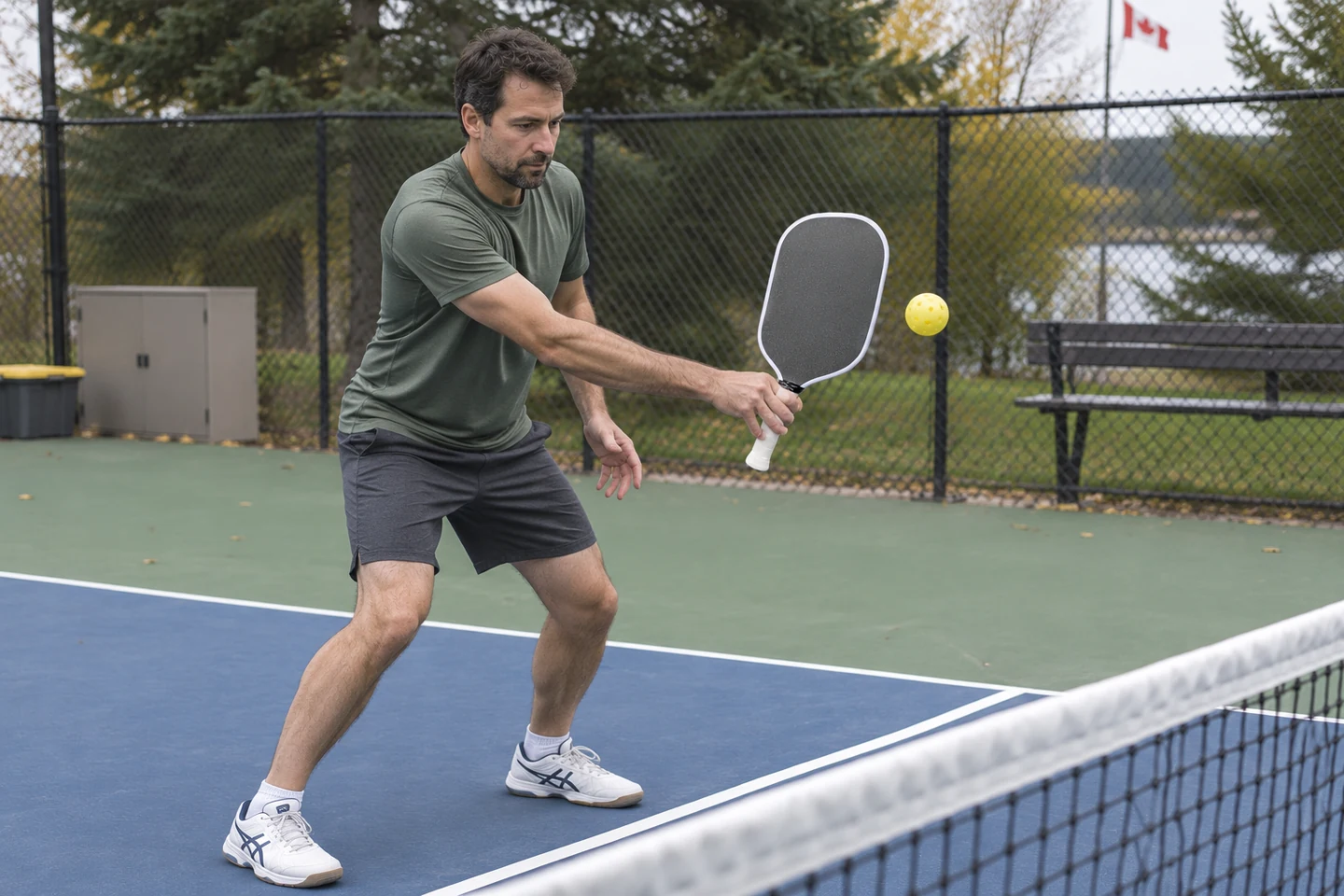
The Canadian buyer also wanted to know whether a clean-looking rub result was enough to stop evaluating the sample. I asked him to keep one paddle protected and use a separate identified paddle for court observations. Concentrated hand rubbing does not reproduce every contact during play, so he kept the playing review in his sample plan before deciding on a larger enquiry.
Use a consistent ball model and note its condition. Have the tester describe the session and any visible changes, with views of the same face area before and afterward. A controlled volley sequence, for example, can provide relevant playing observations without pretending that one session represents months of use.
Ask the player to distinguish handling preferences from visible surface concerns. “I liked the feel” and “this patch changed” lead to different decisions. Avoid translating an impression of grip into an unmeasured spin-retention percentage. If a concern appears, preserve the sample and explain the location before continuing to wear it further.
Read the method behind a laboratory result
If a supplier cites ASTM D4060 6, ask for the report and exact edition. The published scope concerns abrasion resistance of organic coatings on a plane, rigid surface using a Taber Abraser. It does not turn a five-minute ball rub into that method, nor automatically establish how a complete paddle will behave in play.
Check whether the tested item was a flat coupon, a component or the finished construction. Ask which contact material, load, cycle count, conditioning and endpoint were used, and what deviations were reported. The supplier should explain why the specimen is relevant to your face. A result from a different substrate or finish may answer a different question.
Do not rank two suppliers by a single result until their methods are comparable. Even mass loss needs context when different constructions or fillers are involved. Ask for the measurements and conditions behind the conclusion rather than requesting the highest-looking number.
Verify who issued the report and what it covers
Obtain the complete report, including sample description, dates, method, result and any qualifications. If laboratory accreditation is claimed, check the relevant laboratory accreditation scope 7 through the responsible accreditation body. A logo does not tell you whether this particular method falls within that scope.
Where a result is unclear, ask for clarification before commissioning a duplicate test. The sensible next step may be identifying the specimen or obtaining a missing page. If further testing is needed, agree who commissions it, which samples are used, what question it answers and how the cost is handled.
How Should the Evidence Become a Purchase Acceptance Agreement?
Once the sample decision is clear, connect it to the order. Otherwise the buyer can collect good evidence without settling which product or production checks it applies to.
Agree the selected face, reference sample, inspection approach, decision criteria and response to an unresolved result. Keep those points specific to the order instead of treating one successful demonstration as acceptance of every future paddle.
Preserve the reference without wearing it out
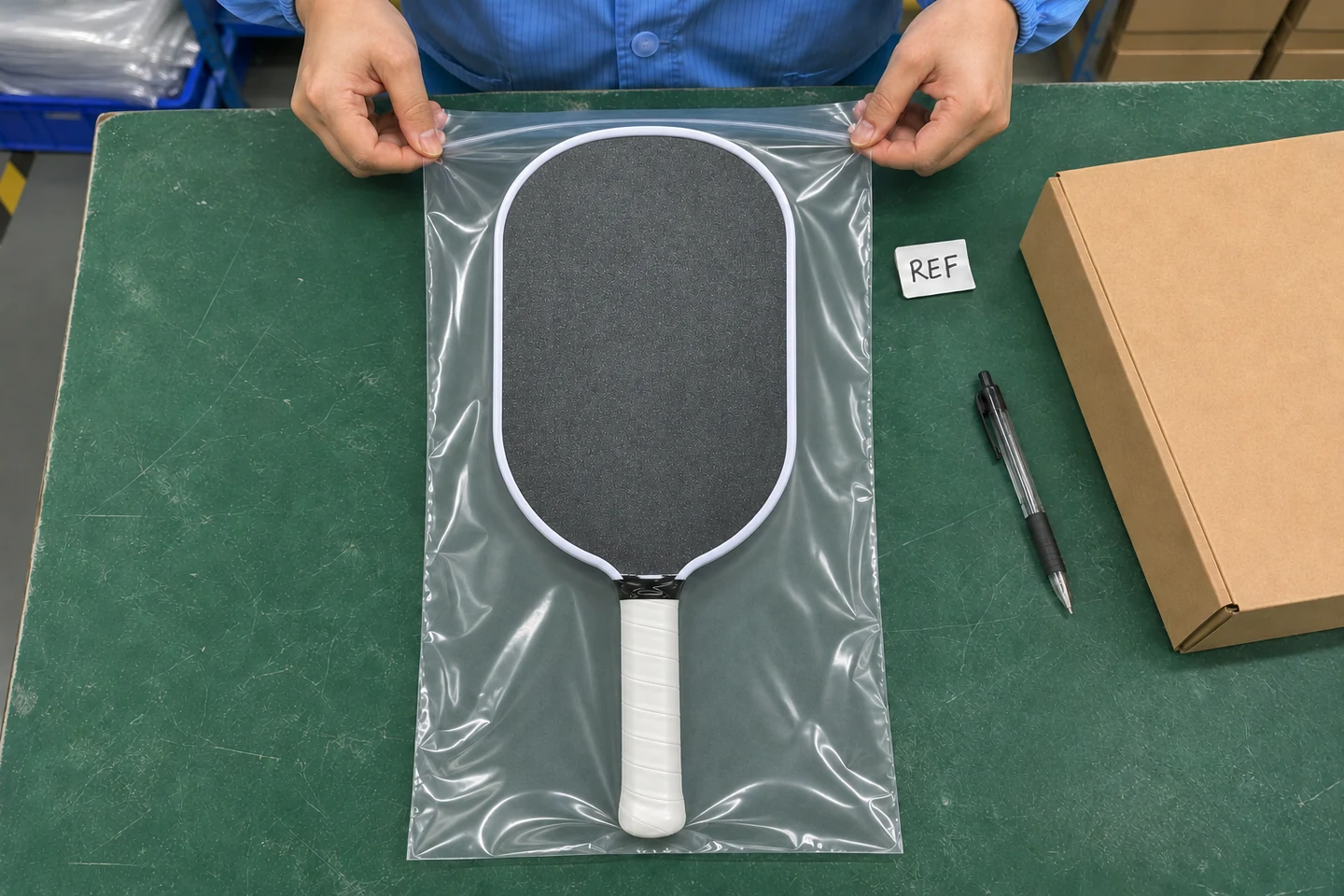
When a buyer wants to circulate every accepted sample among players, I separate the playing samples from the reference needed for later comparisons. Repeated use changes the object we are trying to compare against. Keeping one identified paddle protected leaves a clearer basis for the next order, while the other samples can continue the agreed evaluation.
Keep the approved sample and production record together. State which face finish and construction the approval covers, and identify anything still unresolved. Store the reference suitably and keep the original observation files. If the proposed construction changes, discuss whether the earlier evidence still applies before carrying its conclusion forward.
Agree how production evidence will be selected
A chosen demonstration paddle cannot stand in for an unspecified production lot. Discuss how samples will be selected, how many will be examined and what result leads to acceptance, further inspection or a hold. The appropriate arrangement depends on the order and the risk; this article does not invent a universal sample size or failure limit.
In lot acceptance sampling 8, a random sample supports a decision about a lot. Make that decision rule explicit rather than assuming a supplier-selected clip proves uniformity. Ask how the relevant surface finishing and production checks connect to the face being ordered.
| Point to agree | Useful wording to discuss | Decision it keeps clear |
|---|---|---|
| Product covered | Identified face finish and complete sample configuration | Which build the evidence supports |
| Inspection approach | Agreed method, sample selection and conditions | How production will be assessed |
| Acceptance criteria | Defined observations or measurements and their limits | What requires acceptance, review or rejection |
| Unresolved result | Responsible contact and agreed next assessment | How to proceed without guessing |
Resolve the concern before broad approval
Avoid an approval that says only “wear resistance is good.” Identify what you accepted, what was observed and what remains untested. If the result is unclear, ask for a focused repeat or suitable analysis rather than changing the criteria after seeing the outcome.
Discuss any proposed remedial work, replacement, additional inspection or independent assessment as an order-specific arrangement. Do not assume a surface observation automatically creates a refund policy or a lifetime warranty. Clear acceptance terms let both sides handle the actual concern without promising more than the evidence supports.
Conclusion
Ask for evidence that shows the exact paddle, the rubbing conditions, the ball and the face before and after the observation. Our roughly five-minute ball-rubbing check can provide a useful visual reference when the debris is mainly from the ball rather than the face. Preserve uncertainty when the origin is unclear, and request stronger evidence for stronger claims. Then connect the accepted sample and agreed checks to your order, without turning a short observation into a certification or lifetime promise.
Discuss Your Silicon Carbide Face Evaluation with Rudy
For a custom silicon carbide grit paddle, send your selected shape, core, thickness, enquiry quantity and the face-wear concern you want to resolve. Include any supplier video or report you are comparing and state what decision the evidence needs to support. We can discuss the sample configuration and the evaluation request together.
Rudy · Factory Partner · info@shuenpickleball.com · WhatsApp +86 137 1215 6638