The price beside one paddle does not tell you what the order will cost at your door. A small carton, a retail box and a second delivery address can change that number. I start with quantity and packed volume, then price the delivery scope instead of guessing a freight allowance.
First confirm your quantity; our minimum order starts at five paddles. We calculate the packaging volume from that quantity, then quote DDP door-to-door shipping to your destination. Customs clearance and applicable import duties are included in our DDP quotation, so you do not arrange clearance or pay those included duties again. Combine that delivery charge with the product price and any separately agreed extras to establish the complete order total.
A useful landed-cost calculation answers four questions: what is actually being shipped, which costs the delivery quote covers, how to add the figures without duplication, and whether the chosen quantity still makes commercial sense. The cheapest unit is not necessarily the smallest sensible commitment.
What Must I Confirm Before the Freight Calculation?
In July 2026, a distributor in Canada asked me to cost 24 paddles in shape 002, with 12K Carbon Fiber faces and C12 EVA–TFP Wrapped Reinforced Honeycomb Cores at 14 mm. She wanted to divide the shipment between her shop and a coach rather than receive everything together. I explained that two destinations needed separate packing and delivery calculations. She chose one delivery to the shop and kept local distribution outside our freight quote.
Fix the quantity, exact paddle build, packaging and delivery address first. Freight is calculated for packed goods moving to a particular destination, not for an abstract number of paddles.
Give the product line a definite meaning
Our custom 12K pickleball paddle is a starting point for confirming the face option, not a complete price by itself. The core, thickness, shape, graphics, accessories and packaging still describe the product being ordered. Keep the selected construction on the same line as its quantity. Otherwise, a change to the product can be mistaken for a change in freight.
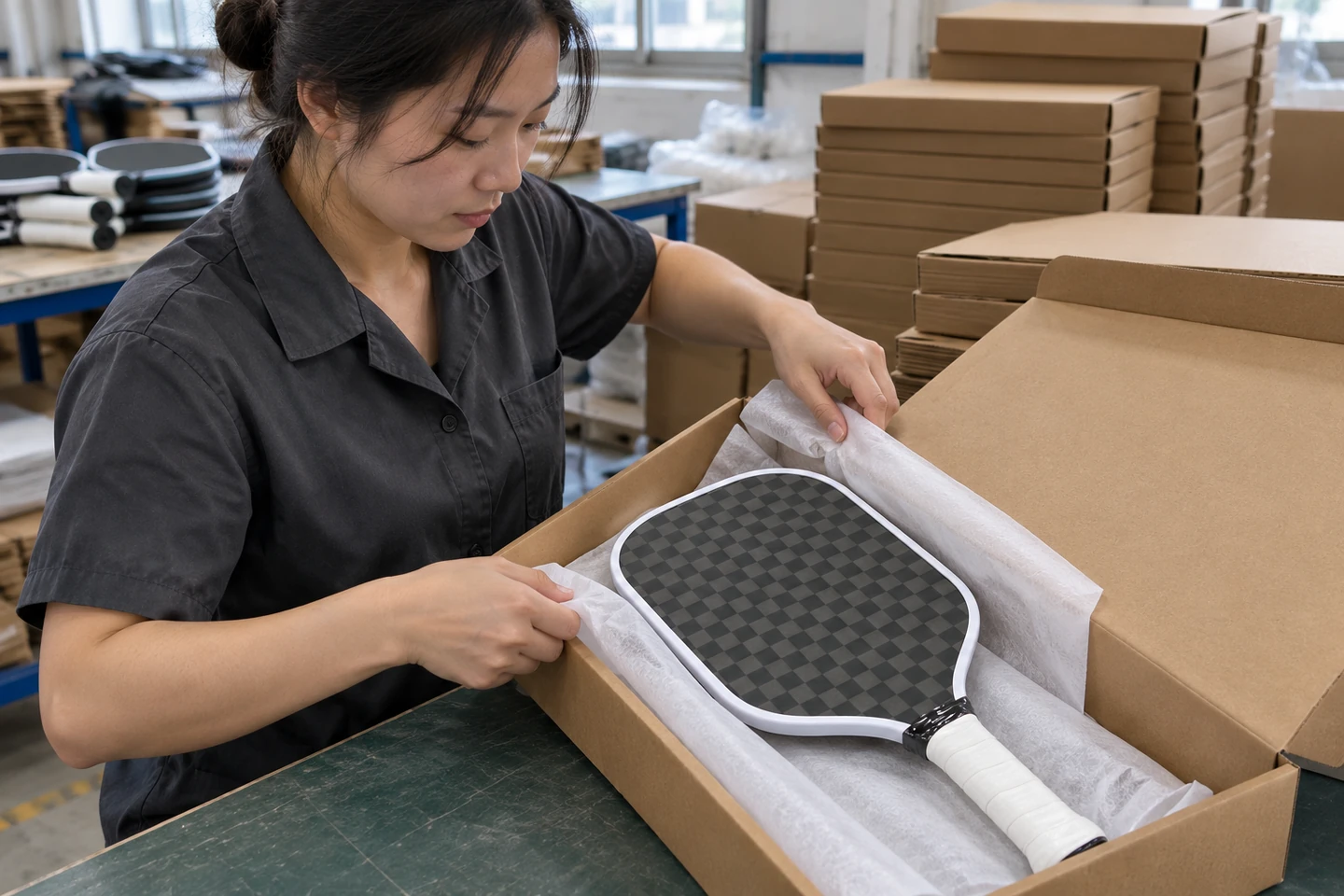
The Canadian inquiry used one build for all 24 paddles. That made its quantity clear, but the packing choice remained open. A quote for individually protected paddles and a quote for paddles inside rigid presentation boxes do not describe the same shipment. Ask which packing method is included before comparing the totals. The name C12 identifies the selected construction; it is not a promise of a particular playing result.
Use packed dimensions, not paddle dimensions
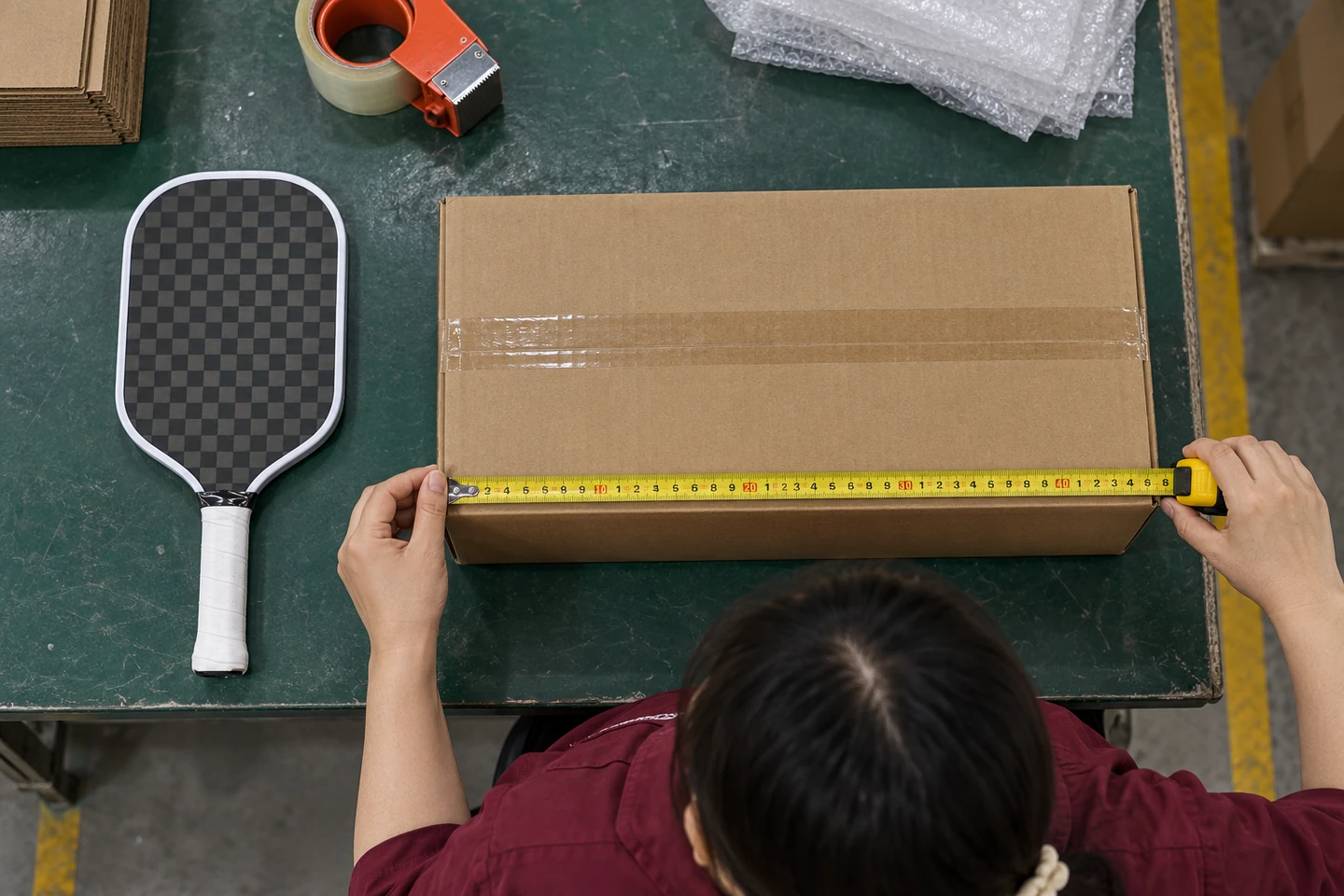
At the packing bench, I compare the protected paddle layout with the proposed outer carton. The buyer wants a low shipping figure, but the empty retail boxes occupy space before any extra paddle is added. I check the packed arrangement rather than multiplying the paddle thickness by the quantity. That gives us a realistic shipment to price, so the buyer can choose the retail presentation knowing its freight consequence.
FedEx explains dimensional weight 1 as the space a package occupies relative to its actual weight, with the greater weight used for billing under its stated approach. The practical lesson is to request both gross weight and external carton dimensions. The actual service determines its divisor, rounding and charging rules; a formula copied from another shipping lane is not a confirmed SHUEN freight quote.
| Input to settle | What to send or confirm | What it changes |
|---|---|---|
| Quantity by build | Paddle count and selected configuration | Product total and packing requirement |
| Individual packaging | Protective sleeve, retail box or agreed alternative | Outer-carton volume and packing expense |
| Carton plan | Carton count, outside dimensions and gross weight | Freight rating basis |
| Delivery point | Complete address, postal code and receiving contact | Route and final delivery service |
| Additional destinations | Separate addresses and quantities | Separate consignments rather than one assumed shipment |
Reduce empty space without removing protection
A smaller carton is useful only if the paddles remain properly protected. I do not recommend replacing sensible cushioning with a tight fit that presses a handle against the outer wall. The carrier's packing guidance 2 specifically distinguishes the box's inside measurements from the outside measurements used for rates and advises cushioning that prevents movement.
Use our paddle specification checklist to keep the build and packing request together. Send the planned quantity and destination even if the final graphics are still being discussed. We can identify what remains open without pretending that an unfinished packing plan already has a final shipping cost.
What Should the DDP Door-to-Door Quote Actually Cover?
DDP is helpful because the buyer wants the paddles delivered, not an unexpected clearance job. I still want the quoted destination and included charges written plainly. Three letters should make the responsibilities clearer, not hide them.
Our DDP quote includes delivery to your agreed destination, customs clearance and applicable import duties. Confirm the named delivery point, import-tax treatment and any exceptional services in writing; DDP is not a tax exemption.
Separate who pays from whether a charge exists
ICC Academy's explanation of DDP responsibilities 3 assigns import clearance to the seller and describes delivery at the named destination ready for unloading. That is different from DAP, where the buyer normally carries out and pays for import clearance. A supplier offering only transport to your door has not necessarily quoted the same responsibility.
For our order discussion, I identify clearance and applicable import duties as included in the DDP amount. Do not add those included charges again in your cost sheet. Equally, do not write “no import taxes” merely because the buyer does not pay a separate customs bill. Ask for the treatment of applicable import taxes, the agreed billing arrangement and any proposed exception before accepting the total. Where a local requirement affects the route, settle it before dispatch rather than assuming a label removes it.
Match the description to what is in the carton
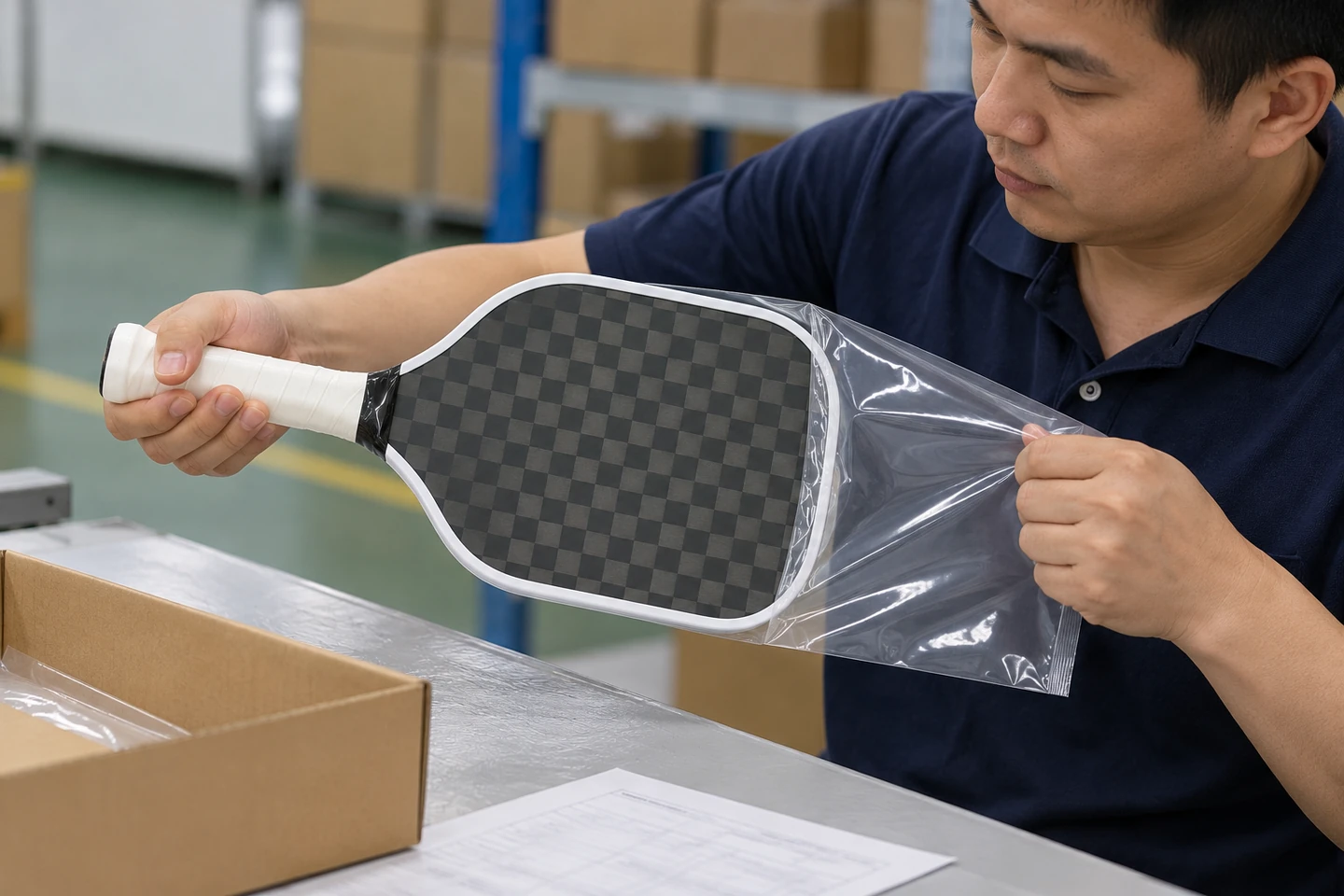
While an operator bags the finished paddles, I check the quantity and product description against the packing plan. The buyer is worried that a vague description will create a clearance question. I make the description identify the actual goods and keep the count consistent. Accurate shipping information supports the quoted service, so the buyer supplies the receiving details before the shipment is booked.
DHL's guide to customs invoice information 4 identifies descriptions, quantities, values, origin and other transaction details used for clearance. The specific requirements depend on the shipment and destination. DDP does not mean the buyer can ignore a legitimate request for receiving information. It means the agreed clearance responsibility is not quietly transferred to the buyer.
For the Canadian distributor, the receiving shop remained the destination after the two-address option was removed. The coach's allocation stayed within the product count but not within a second international delivery. This distinction is small on a spreadsheet and important on a shipping instruction.
Ask about exceptions before they become arguments
A remote address, unusual receiving requirement or address change can affect the service. FedEx's published remote-area and additional-service charges 5 show that these categories exist in carrier pricing. They do not establish a charge for your Canadian shipment; your actual route and quotation do that. Tell us about receiving restrictions early, rather than discovering them after the cartons leave.
| Cost or responsibility | Treatment to confirm | How to avoid a duplicate or omission |
|---|---|---|
| International carriage and final delivery | Included to the named destination | Do not add a second normal-delivery estimate |
| Clearance and applicable import duties | Included in SHUEN's DDP quotation | Do not pay or budget them twice |
| Applicable import taxes | Written treatment within the delivery agreement | Do not assume “DDP” means tax-free goods |
| Optional or exceptional services | Scope, payer and amount if applicable | Add only services not already included |
| Receiving and unloading arrangements | Confirm what the destination needs | Do not infer installation or special handling from “door-to-door” |
Connect this discussion to the order payment and delivery process. Payment timing and delivery scope answer different questions. A clear total should identify what you are paying for as well as when it becomes payable.
How Do I Build a Total Without Double-Counting Costs?
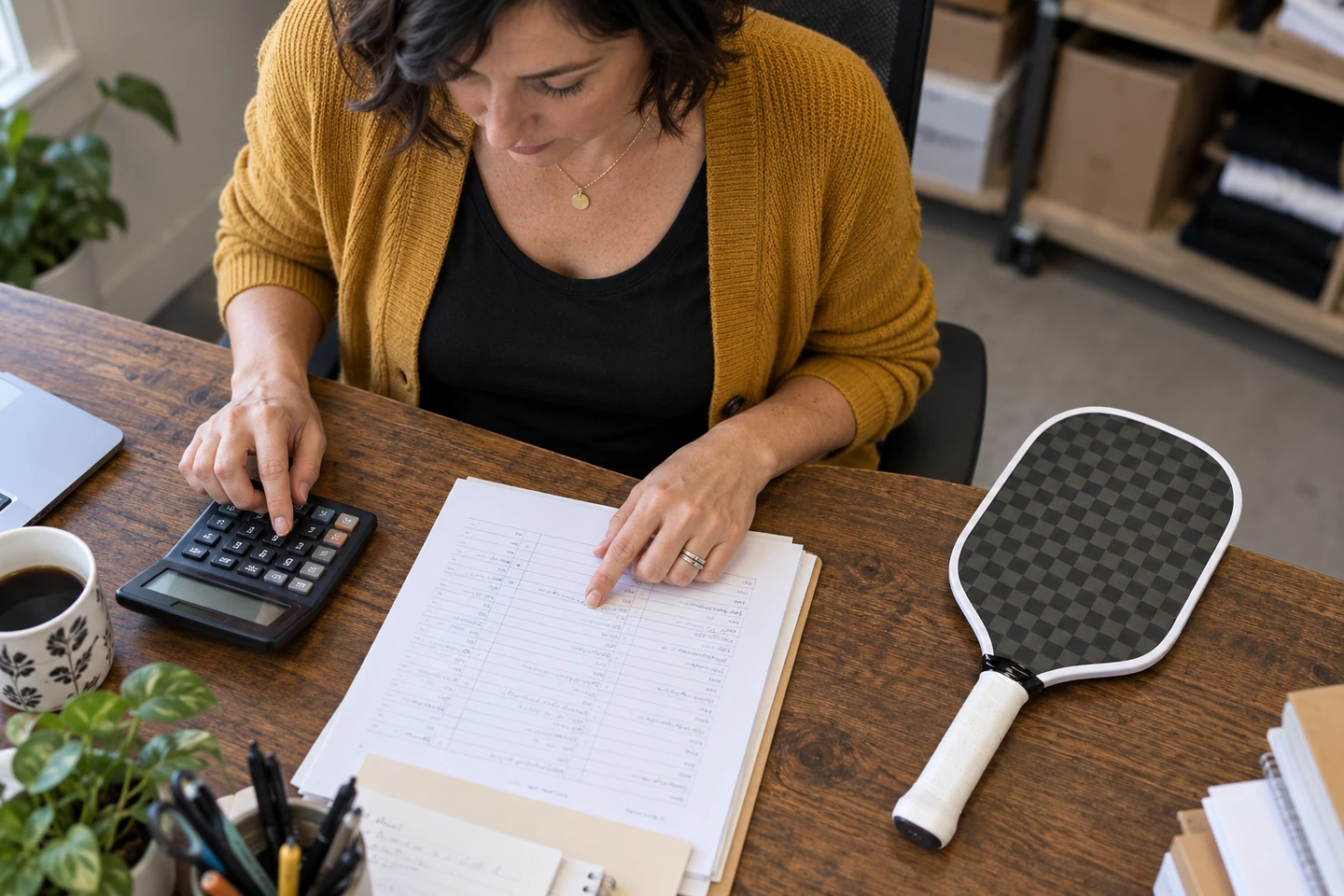
A total becomes unreliable when the same expense appears under two names. I use one line for the product and one for the agreed DDP delivery, then add only genuinely separate items. That makes the arithmetic easy to challenge before payment.
Calculate the product subtotal, add the complete quoted DDP charge once, and add agreed extras only if they are not already included. Divide the resulting total by the ordered quantity for an average delivered cost per paddle.
Put each amount in one place
During a quotation check, I see a buyer's worksheet include both our DDP amount and a separate estimated import-duty line. The buyer is trying to protect the budget, not negotiate the same cost twice. I remove the duplicated allowance from the quoted-order total and retain any unresolved item separately. A contingency is a planning choice, not a second invoice charge, so the buyer can see which amount is confirmed and which is only a reserve.
The calculation below uses simple figures to show the method. It does not price the Canadian inquiry, any particular core or a shipment to any named address. Replace every input with the amounts on your actual quotation and check whether packing or customization is already within the unit price.
Calculation example in USD; these figures are not a supplier quotation.
| Calculation line | Example calculation | Example amount |
|---|---|---|
| Product subtotal | 24 paddles × USD 40 | USD 960 |
| Agreed DDP delivery | One complete quoted delivery amount | USD 180 |
| Separately agreed packaging upgrade | Only if excluded from the product subtotal | USD 48 |
| Complete order total | USD 960 + USD 180 + USD 48 | USD 1,188 |
| Average delivered cost | USD 1,188 ÷ 24 paddles | USD 49.50 per paddle |
If the packaging upgrade is already included in the product price, delete its separate line. The result would be USD 1,140, or USD 47.50 per paddle, under those revised example assumptions. The calculation changes because the scope changes, not because a hidden discount appeared.
Keep currency conversion outside the supplier's arithmetic
Use one currency for the quotation comparison. A Canadian business may receive a USD quotation while budgeting in CAD. State the currency beside every input and identify when you convert it. The Bank of Canada's indicative exchange rates 6 are reference averages, not a promise of the rate your payment provider will apply.
Ask your provider about the amount you will actually pay, including its conversion and transfer charges. Keep those buyer-side payment costs separate from SHUEN's order total unless they are expressly included. For management planning you can combine them into your acquisition budget, but do not send the enlarged figure back as though it were the factory's invoice.
Recheck a quote when its assumptions change
Quantity, packaging, destination and shipping service can all change after the first discussion. Recalculate the affected lines instead of carrying an old delivery amount into a new order. A larger batch may need a different carton plan, while a smaller batch can spread a fixed delivery expense over fewer paddles.
Carrier pricing can also move. FedEx publishes changing fuel surcharges 7, which illustrates why a transport estimate needs a date and a validity check. Do not apply its published percentage to a SHUEN DDP total; that could duplicate a component already included and use the wrong service. Ask whether the delivery amount remains valid for the shipment you now intend to authorize.
How Do I Choose a Sensible Quantity and Close the Budget?
A lower delivered cost per paddle can tempt a buyer to purchase more than the product decision needs. I compare the cash commitment with the reason for ordering. Freight efficiency is useful; excess stock is not a saving simply because division produces a smaller number.
Choose the quantity that serves the next business decision, compare complete totals for the viable options, and reconcile the approved quote with the shipment. Do not increase an untested order just to improve its freight cost per paddle.

Use a small delivery to answer the right question
Our minimum order starts at five paddles. That gives a buyer a manageable starting point when the build still needs evaluation. It does not mean every five-paddle shipment has the same freight charge or that increasing the count always lowers the total spending. Price the real alternative rather than extrapolating from a single unit.
For the Canadian inquiry, the remaining question was whether the chosen build deserved a larger inventory commitment. I kept the initial quantity discussion separate from any future restock and asked her to judge the complete paddle in use before increasing it for freight reasons. She kept 24 as the quantity for the quotation and deferred a larger comparison until after evaluation. An outdoor session with the selected build informs that next decision; it does not establish a freight rate or guarantee demand.
Use the sampling-to-production process to connect the evaluation with the next order. The objective here is not a long testing programme. It is to avoid buying additional stock before you know whether this is the product you want to repeat.
Compare total cash as well as the per-paddle figure
Ask for separate complete totals for the quantities you are genuinely considering, keeping the build, destination and packaging assumptions comparable. Look at three numbers together: total product spend, total delivery spend and average delivered cost. A lower average can coexist with a much larger cash commitment.
If the order contains several configurations, decide how you will allocate shared freight internally. An equal per-paddle allocation is transparent for similar items, but it may not reflect different retail packaging volumes. Whatever method you use, the allocated amounts must add back to the single delivery total. Internal allocation should never create money that is absent from the quotation.
Keep first-order development costs visible as well. A one-time component-tooling charge, if your project requires one, should not be silently treated as the recurring price of every reorder. Obtain a separate project quote rather than inventing a tooling amount to complete the spreadsheet.
Reconcile the approved order with the delivered goods
Before dispatch, I compare the approved quantity with the carton breakdown. The buyer needs to know that the cost per paddle uses the same count as the shipment. I resolve any packing-count difference before treating the calculation as final. A clean spreadsheet is not enough if its denominator describes goods that are not being shipped.
The International Trade Administration distinguishes the commercial invoice and packing list 8: the first describes the sale, while the second explains how the goods are packed. Use matching descriptions and quantities to reconcile them, with destination-specific requirements confirmed for the actual shipment. On arrival, count the paddles by configuration and note any discrepancy promptly.
Retain the quotation, agreed inclusions and shipment references together. If an unexpected payment request arrives, ask what it covers and compare it with the DDP scope before assuming it is payable twice. That closes the loop between the budget you approved and the goods your business receives.
Conclusion
Start with quantity, confirm the packed volume and destination, then combine the product price with the agreed DDP delivery charge. Our DDP quotation includes clearance and applicable import duties; those included costs should not appear a second time in your calculation. Keep separate extras, currency costs and planning reserves clearly identified. The best landed-cost figure is one you can trace back to the same build, quantity and delivery scope you are actually buying.
Get a complete delivered-cost quotation. Start with our custom 12K pickleball paddle and send your quantity, preferred shape, core and thickness, branding requirements, packaging choice and full delivery address with postal code. Tell us if there are multiple destinations or special receiving needs. We can then discuss the product price, packing volume and DDP delivery together.