A sample request can stall before anyone makes a paddle: you ask for a price and a delivery date, but the face and core are still undecided. I want to settle those choices first, so you are paying for a useful sample rather than the quickest answer to an incomplete question.
SHUEN samples start at a minimum of five paddles. The sample fee depends on the face material and core construction, so choose those configurations on our website before we calculate the price. After design confirmation, samples with imported Toray T700 carbon-fiber faces can dispatch in 3–5 working days; special materials such as Titanium Wire, Kevlar, Emery Grit and SiC silicon carbide require 10–15 working days. These are dispatch periods, not arrival promises.
Requesting samples should leave you with four clear answers: what will be made, what the quotation includes, when the factory can send it, and what decision the samples will help you make. Here is how I work through them with a buyer.
What Should I Send When Requesting Paddle Samples?
The first message does not need a finished brand presentation. It does need enough product information for us to identify the sample you want.
Select the face and core on our website, identify the shape and thickness, and request at least five paddles. Tell us what you need to learn and which appearance details are still open; a quotation request and final design approval are different steps.

Start with the question the sample must answer
The buyer wanted a sample price before her designer finished the logo. During our discussion in May 2026, this United States brand developer asked whether she had to wait for the entire artwork package. I separated the material decision from the artwork decision: we needed her face and core choices to calculate the sample fee, while unfinished graphics could remain a clearly identified next step.
She requested five paddles in shape 008, with Silicon Carbide Grit faces, C07 Zoned Molded Full-Foam Cores and 16 mm thickness. Her purpose was to decide whether that complete build suited her first product direction. She sent the selected configuration for pricing and kept the logo marked as unfinished, rather than approving a design she knew would change.
That is a useful first request. It gives us a product to discuss without pretending development is finished. The Silicon Carbide Grit paddle page is the starting point for that face choice; the selected core and shape complete the request. We confirm the proposed combination for the project rather than infer performance from a construction name.
Identify the material instead of describing a look
“Black carbon paddle” is too broad for a meaningful comparison. Name the material you selected and the core ID with its construction. If you are also considering imported Toray T700, identify that alternative separately. Toray's carbon-fiber data sheets 1 distinguish material grades; a generic color description cannot do the same job. Do not substitute a different face simply to obtain a faster sample without deciding whether it still answers your buying question.
| Information to send | A useful request | What it allows us to clarify |
|---|---|---|
| Face and core | Selected face name plus core ID and structure | The build used to calculate the sample fee |
| Shape and thickness | Catalog shape ID and 14 mm or 16 mm selection | The physical direction for the sample |
| Quantity | At least five, with any separate versions identified | How the request is divided between configurations |
| Purpose and appearance | Trial objective, graphics status and component choices | What can be priced now and what still needs agreement |
Separate an inquiry file from production artwork
Send the artwork you have and say what is missing. A rough logo can communicate a direction, but it should not accidentally become the print file. For scalable logos, vector artwork 2 retains its geometry when resized, unlike a low-resolution raster screenshot. We can discuss the intended layout before you treat any file as approved.
A buyer working without finished design drawings can still explain shape, materials and brand direction. The practical distinction is simple: asking us to price a selected build does not start the post-confirmation dispatch clock. Keep your request moving, but make the later approval deliberate.
How Should I Read the Sample Fee and Shipping Quotation?
A low figure is not necessarily a low total. First check which paddle it describes and what must still be added before the package reaches you.
Ask for a configuration-specific sample quotation with quantity, currency, included customization and shipping scope shown clearly. Confirm any separate development or tooling charge, and do not assume that a later bulk order automatically refunds the sample fee.
Put each cost beside the decision that causes it
When a buyer compares a plain sample price with a fully branded request, I separate the requested paddle from optional components and packaging. The concern is not just that the total looks higher; the two offers may cover different work. I keep the face and core unchanged while identifying those differences, because changing the construction to match a budget would also change the sample being evaluated. The buyer can then remove an optional presentation feature or request a second quotation without losing the original product direction.
There is no single sample price I can responsibly apply to every face and core. Ask what the quotation includes for the chosen configuration and what is charged separately. Custom logo rings and butt caps require dedicated tooling quoted for the project. If those details are not necessary for the first buying decision, discuss whether existing components can serve the initial sample; do not assume the later customized parts are included free.
| Quotation line | What to confirm | Common misunderstanding to avoid |
|---|---|---|
| Sample paddles | Face, core, shape, thickness, quantity and currency | Treating a different build as the same offer |
| Graphics and components | Included work and separately quoted options | Assuming every branding detail is included |
| Development or tooling | Exact purpose and charge, if applicable | Reading a one-time item as a per-paddle price |
| Packing and international freight | Package scope, destination and service | Confusing the sample fee with a delivered total |
| Later order treatment | Any expressly agreed credit or discount | Assuming a refund before terms are agreed |
Quote the package, not just five loose paddles
Send the destination and postal code when asking for freight, then confirm the actual receiving details before shipment. Packaging affects the transport calculation as well as protection. DHL's guidance on dimensional weight 3 explains why a light but bulky shipment can be charged by the space it occupies. A presentation box and a compact protective pack should not be assumed to have identical freight costs.
Ask who pays the carrier and which charges the offer includes. The answer should distinguish international freight from any destination charges that are not included. For the handover and commercial sequence, connect the quotation with the agreed payment and delivery arrangements. Do not compare an ex-factory sample figure with another supplier's delivered offer as though they were the same total.
Keep the paperwork and any future credit explicit
Calling the goods samples does not remove the need for a proper description and value. FedEx's goods-description guidance 4 says to identify what the goods are, their materials and purpose, and notes that samples still have value. Supply accurate information and resolve destination-specific questions with the carrier or the appropriate adviser rather than inventing a zero value to reduce the apparent cost.
If a future bulk-order credit matters to your budget, ask whether one is offered and under what conditions before paying for samples. Keep the answer attached to this quotation. A hoped-for order is not a confirmed discount, and a sample fee should not be presented to your team as recoverable unless that treatment has actually been agreed.
When Does the Sample Lead Time Start, and When Will It Arrive?
The word delivery often hides two different clocks: making the sample and moving the finished package to the buyer. A launch schedule needs both.
Count SHUEN's sample dispatch period from design confirmation: 3–5 working days for imported Toray T700 faces, or 10–15 working days for the stated special materials. Confirm transport separately for your destination and service, and revisit the plan when an approved requirement changes.
Use the correct material window
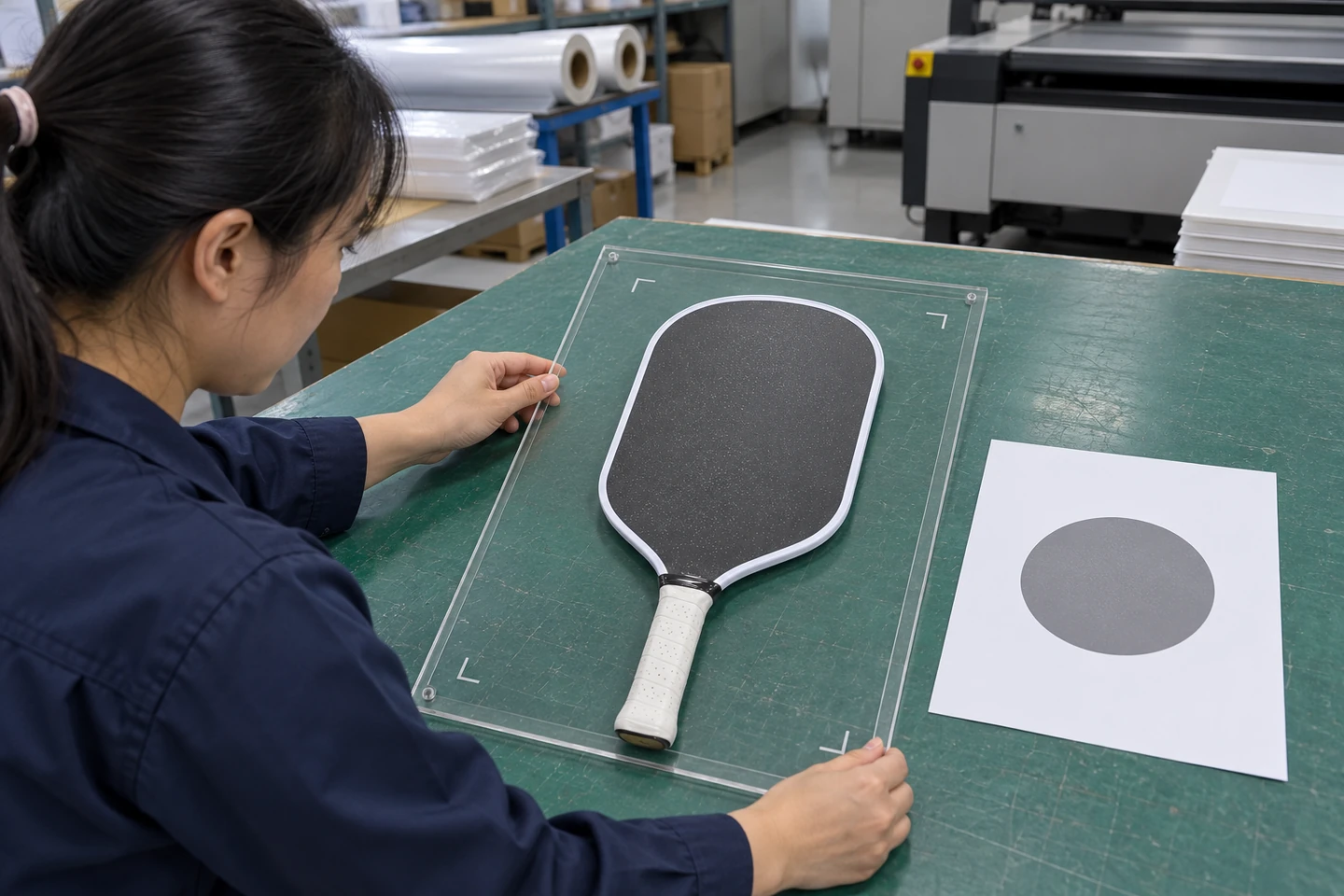
At the sample workbench, I stop a request that carries the special-material choice but still quotes the T700 dispatch window. The buyer wants the selected SiC build, not merely a paddle sent quickly. I keep the material choice and correct the timing discussion, because a shorter window for another face cannot answer the original request. The resulting plan uses 10–15 working days after design confirmation for that SiC sample, with transport considered separately.
| Face selection | Sample dispatch after design confirmation | What the period does not include |
|---|---|---|
| Imported Toray T700 carbon fiber | 3–5 working days | An automatic arrival date at your address |
| Titanium Wire or Kevlar | 10–15 working days | Unfinished design decisions before confirmation |
| Emery Grit or SiC silicon carbide | 10–15 working days | A promise that international transport takes no additional time |
These windows should not be turned into calendar-day promises. Ask how the confirmed date falls around the relevant working calendar, particularly if your evaluation is tied to an event. Avoid counting from the day you first sent a logo, asked for a quotation or discussed an alternative material. Those messages can advance the project without constituting final design confirmation.
Make the approval complete enough to manufacture
Check front and back artwork, orientation, placement and the agreed component colors together before sending approval. A message that approves the logo but leaves the face layout unresolved is still incomplete for the intended sample. Where printed color matters, discuss the reference and review conditions. Print color management 5 depends on output profiles and printing conditions, so a phone screenshot alone should not carry every color expectation.
Once the design is confirmed, avoid sending a replacement file casually with “use this instead.” State what changed and ask whether it affects cost or the dispatch plan. A late revision is a new manufacturing question, not simply an updated attachment. We should resolve that question before both sides continue relying on the earlier date.
Distinguish ready, dispatched and delivered
Ask for an update that names the stage: sample work completed, package ready, handed to the carrier or moving through the network. For example, UPS distinguishes Label Created from Shipped/On the Way 6; a label by itself does not mean the carrier has the goods. Use the relevant carrier's actual tracking events rather than treating a tracking number as proof of arrival timing.
Leave room in your plan for transport, receiving and review before promising a demonstration or production decision. If the need-by date is immovable, tell us at the inquiry stage. We can discuss the selected material and available shipping arrangement, but changing the meaning of dispatch will not make a tight schedule safer.
How Can Five Samples Make the First Purchase Worthwhile?
The sample charge is useful when the set answers a buying question. Five paddles left in their packaging provide little more information than a photograph.
Decide in advance who will inspect and play with the samples, what must be learned, and what would justify another version or a bulk-order discussion. Use the selected build for that decision rather than buying extra variants without a clear purpose.

Give the sample set a practical job
For the United States developer, the next concern was whether five samples meant five different designs. I brought the conversation back to her original question about one product direction. I recommended evaluating the selected SiC and C07 build before spreading the budget across unrelated versions, because a different paddle in every player's hand would make her first decision harder to interpret. She kept the five-paddle request focused on that one build and arranged for playing feedback before deciding whether another configuration was needed.
You can allocate the set among appearance review, product photography and relevant players without making every paddle a separate design project. Confirm how any proposed variants affect the custom-model minimum and quotation before assuming one of each is acceptable. The minimum starts at five paddles; it is not a reason to order additional materials before knowing what uncertainty they will resolve.
Arrange useful feedback before the package arrives
Choose people who represent the intended use and ask for comments tied to the sample's purpose. Let them actually play, including the movements that matter to them, rather than judge only the face finish. An overhead practice shot can reveal a handling preference that a desk inspection cannot, but one exciting hit is not a measured performance result. Keep the first trial focused enough that the buyer can explain the next decision.
Before play, use a short inspection check sheet 7 for the received appearance and agreed details. Then keep observations about handling separate from an artwork mismatch. This is not a full testing tutorial: it is a way to avoid spending on a second sample merely because the first comments were too vague to use.
Decide what you are approving next
Five development paddles are not a statistical guarantee for a future bulk lot. Quality sampling 8 depends on the population, selection method and decision being made. Treat this initial set as a product-development step, then agree the appropriate production and inspection arrangements separately.
Send a short conclusion: keep this configuration, discuss this particular change, or price a named alternative. Preserve the details that already work rather than reopening everything. The sample-to-production sequence then has a clear starting point. You are paying for a decision you can use, not just accumulating more paddles.
Conclusion
Start with the face and core choices on our website, identify the intended shape and thickness, and request at least five samples. Obtain a quotation for that build rather than rely on a generic sample price. After design confirmation, allow 3–5 working days to dispatch imported Toray T700 samples or 10–15 working days for the stated special materials, with transportation planned separately. A clear purpose for the set makes the fee and waiting time easier to justify.
Request Your Selected Sample Build
Start with the custom Silicon Carbide Grit paddle. Send your face and core selections, shape ID, thickness, quantity, artwork status, sample objective, destination and need-by date. We can then calculate the configuration-specific sample price and discuss the dispatch and shipping plan.