A sample can look convincing in its sleeve and still leave the important buying questions unanswered. Is the finish what you approved, does the handle work in your hand, and can you control the ball with it? I separate those questions before a good first impression becomes a production decision.
Inspect appearance first: the edge-guard color, face texture and roughness, and printed colors against the agreed references. Then check the rubber ring, grip size and comfort, and the customized butt-cap logo. Finally, play with the sample to evaluate power, ball speed and spin. Keep those findings separate so you can accept the build, request a specific correction or arrange a focused retest.
You do not need to turn the first sample review into a laboratory project. You do need a sequence that prevents a strong shot from hiding a poor finish, or an attractive logo from deciding whether the paddle suits your players. Here is how I approach that sequence with a buyer.
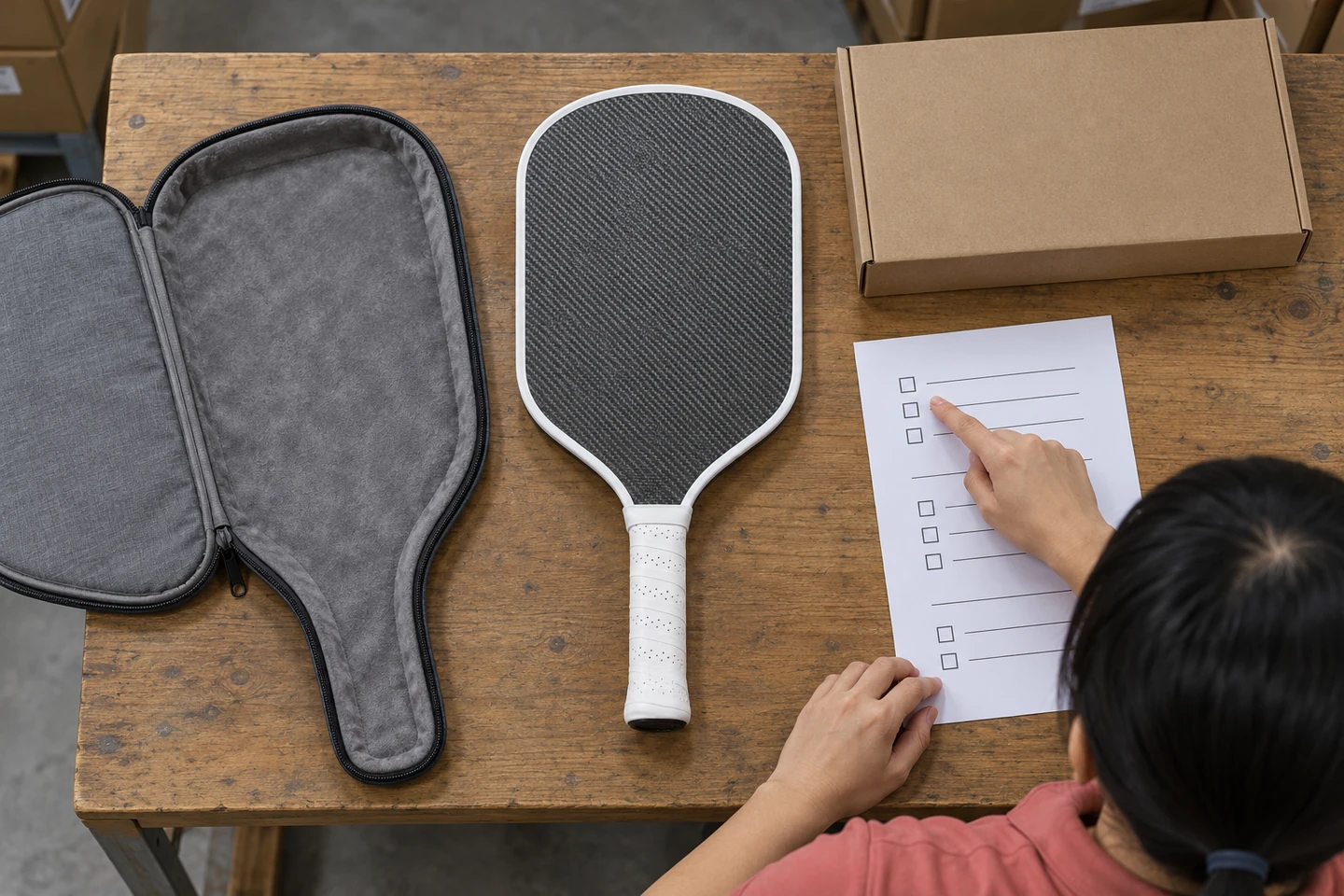
Does the Sample Match the Appearance I Approved?
Start before the paddle goes into a busy club bag. The first inspection should distinguish the condition you received from marks added during play.
Compare the edge guard, face finish and printed design with the agreed physical or artwork references, under consistent viewing conditions. Record a specific mismatch before deciding that the whole sample is wrong.
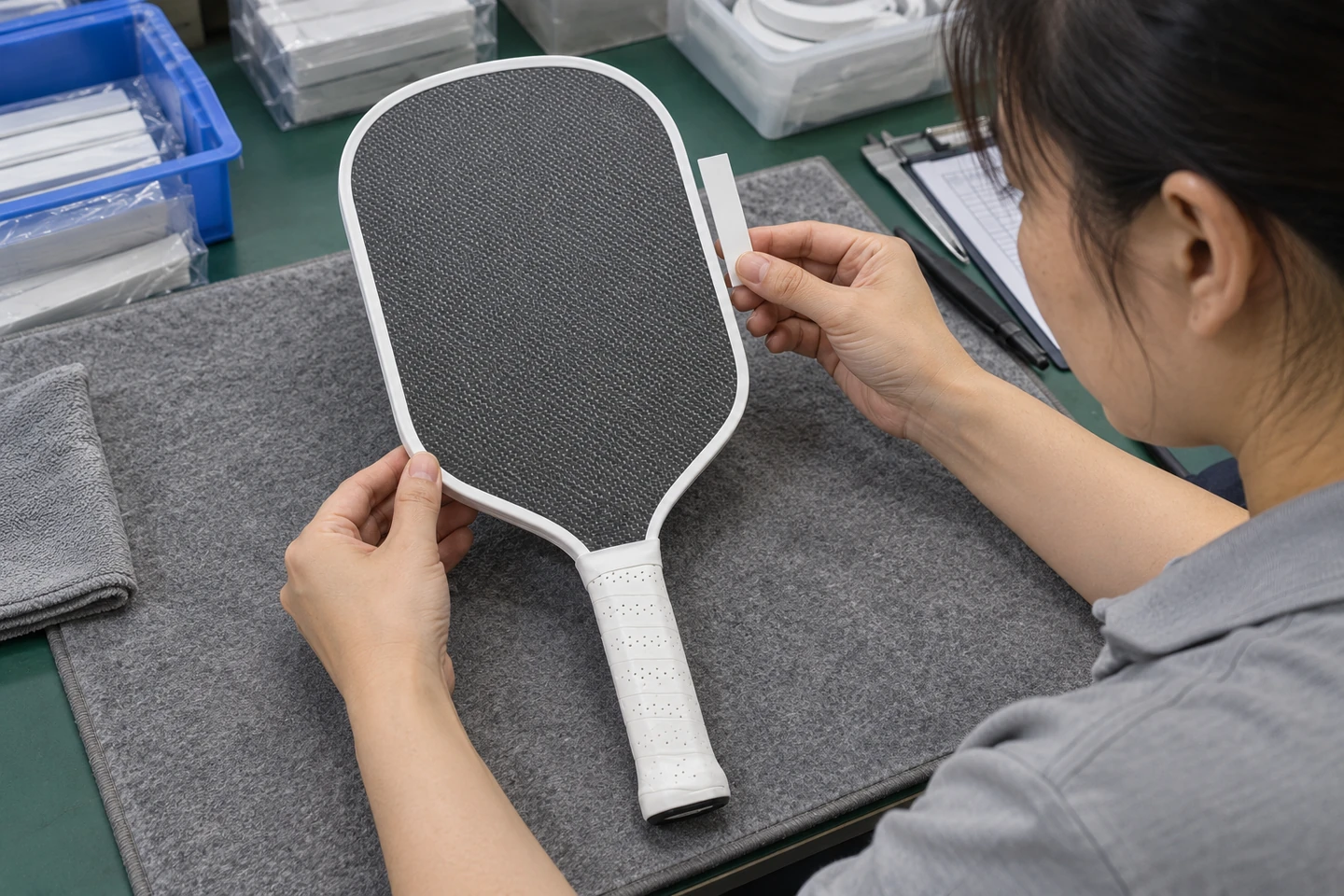
Separate a color concern from a different product
The edge looked darker in the buyer's evening photo, but she did not want to reject a promising sample over the wrong comparison. A retail buyer in Vietnam brought that concern to me in February 2026. I asked her to place the paddle beside the agreed edge-color reference in the same light, rather than compare two photographs taken in different rooms.
Her five samples used shape 002, Titanium Wire faces and the C09 Carbon-Wrapped EPP Core with 20 mm EVA Rim, at 14 mm paddle thickness. The 20 mm description identified the rim in that core, not a thicker paddle. She kept that build under evaluation and agreed to repeat the edge-color comparison before requesting a change. We could then discuss an actual appearance difference without reopening the selected construction.
The Titanium Wire paddle identifies the face direction; it does not establish a performance score. Keep the chosen core, shape and thickness beside it so a request to adjust the edge color does not become an accidental material substitution.
Check color, texture and print as separate items
Place the reference and sample side by side, not on opposite sides of the room. Lighting and viewing direction can affect the apparent match of textured materials; metamerism and viewing geometry 1 explain why an apparent color change deserves a controlled comparison. If color is commercially critical, agree the assessment method with the supplier rather than inventing a tolerance after receipt.
Check the printed front and back against the approved layout: color, orientation, placement and missing details. A phone display is not the final print reference. Print color management 2 depends on the output profile and printing conditions. Use that understanding to ask for a suitable reference, not to excuse a visible mismatch.
| Appearance item | Compare against | Useful feedback |
|---|---|---|
| Edge-guard color | Agreed physical color reference | Which area differs, in the same light |
| Face texture and finish | Agreed sample or finish description | Uneven areas, unexpected gloss or roughness |
| Printed design | Approved front and back artwork | Exact color, placement or orientation concern |
| Edge attachment | Received condition and agreed finish | Location of a visible gap or lifting section |
Do not judge spin with your fingertips
Feel the face gently and look for obvious inconsistency, but do not sand, scrape or modify it to create a preferred texture. A rougher sensation is not automatically better performance. The USA Pickleball equipment standards manual 3 treats surface characteristics through defined requirements and tests. A buyer's touch check is not that testing process or proof of approval.
Photograph concerns with enough of the paddle visible to locate them, then add one close view. Send the sample identifier and say whether the concern appeared before use. This gives our team something specific to review while leaving the undamaged sample available for the next stage.
Do the Grip, Rubber Ring and Butt Cap Work as Intended?
The handle is easy to overlook when the face artwork attracts all the attention. It is also the part your players must live with through every exchange.
Check the installed rubber ring, actual grip size, wrapping comfort and butt-cap logo together. Judge the handle as a finished assembly, then identify whether any concern is dimensional, cosmetic or a playing preference.
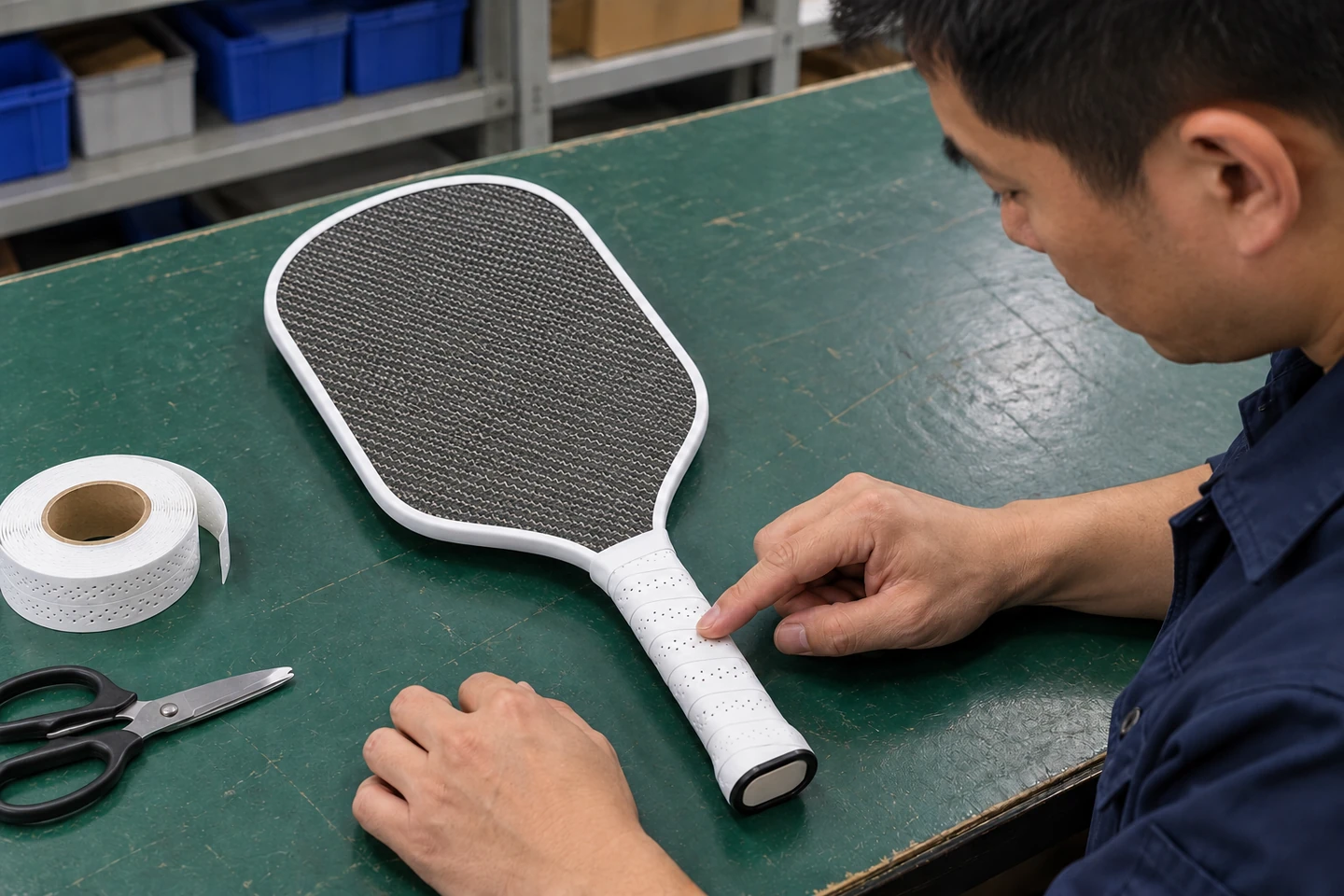
Inspect the finished assembly, not just loose components
At our handle-finishing bench, I separate a buyer's complaint that the grip is uncomfortable from a request for a different grip color. I check the wrap overlap and the transition beside the rubber ring before proposing a larger handle. A local ridge and an unsuitable circumference are different problems. The next sample request should address the cause, not enlarge the entire handle because one seam feels raised.
Look for lifting tape, an uneven transition and any obvious movement of a component during ordinary handling. Check the ring's color and intended logo detail where applicable. Turn the paddle over to inspect the butt cap instead of accepting a photograph that hides the end of the handle. Confirm that the logo is the requested design and orientation, and that it remains legible at its actual size.
The available paddle customization options separate these parts so you can name the exact change. Do not ask for a new face build when the concern is a ring, grip wrap or cap detail.
Check dimensions and comfort without changing the baseline
Measure the grip in the finished condition using the agreed location and method. Note whether an overgrip has been added; otherwise, two testers may be discussing different handle sizes. A manufacturer's grip-sizing guide discusses grip circumference and usable length 4 as separate considerations. Use both in your review rather than treating “small grip” as a complete specification.
Ask intended players to hold the sample naturally and move between their normal hand positions. Is there enough room for the way they actually play? Does the wrap feel even? Those questions are more useful than asking everyone whether they like the paddle. A preference can be valid without being a manufacturing defect.
Decide which change needs another sample
If the agreed logo is missing, identify that discrepancy directly. If the cap is correct but the buyer now prefers another design, describe it as a requested change. That distinction helps us discuss the right work and any associated quotation, rather than mixing a correction with new customization.
Do not remove the grip or disassemble the cap merely to inspect a hidden construction. Start with non-destructive checks. If the issue cannot be understood that way, discuss the next inspection step before altering the only useful sample. Keep one untouched version available when trying an overgrip or a different wrapping arrangement on another paddle.
Comfort must also survive actual use. Carry the initial observations into the court session and check again afterward. A handle that feels pleasant for ten seconds on a desk may not suit the player through a longer practice, but that finding should still name the player, the setup and the situation that caused concern.
How Should I Evaluate Power, Ball Speed and Spin on Court?
A single exciting winner is not enough to approve a product. The useful question is whether the sample gives the intended player a response they can repeat and control.
Use a repeatable set of familiar shots with comparable balls, conditions and players. Evaluate usable power, outgoing ball speed, spin response and control separately, and label observations honestly when no measuring equipment is used.

Keep the comparison conditions steady
The Vietnamese buyer wanted her strongest club player to decide whether the sample had enough power. I asked her to include ordinary controlled exchanges as well as attacking shots, because a paddle chosen only for the hardest swing could miss the needs of her retail customers. She arranged a court session that included gentle forehand dinks after the bounce, drives and controlled returns before drawing a purchasing conclusion.
Use the same ball model and comparable ball condition, and keep the court, session and feed as consistent as practical. Let each player become familiar with the sample before collecting comments. The simple idea behind repeatability 5 is agreement under the same conditions. You are applying that discipline to a buying decision, not claiming a laboratory result from a club session.
| Trial focus | What to observe | What not to confuse it with |
|---|---|---|
| Controlled drives | Usable depth and outgoing pace at familiar effort | One maximum-effort winner |
| Soft forehand dinks | Ability to keep a gentle shot low after the bounce | A direct measurement of spin |
| Spin-focused strokes | Repeatable response with the player's normal technique | Surface roughness judged by touch |
| Returns and off-center contacts | Handling, control and noticeable response changes | A universal performance ranking |
Separate what the player feels from what you measured
“Fast” can mean the paddle feels easy to move, the ball leaves quickly, or the shot travels deep. Ask which meaning the tester intends. If you use a speed-measurement setup, agree its placement and conditions before comparing readings. Without one, describe perceived outgoing pace rather than inventing a speed value.
For spin, ask players to repeat their normal topspin and slice techniques, then record whether the response is useful and controllable for them. Do not turn a phone clip into an unsupported revolutions-per-minute claim. A short check sheet 6 can collect observations by player, sample and shot type without forcing every comment into one misleading overall score.
Look for the trade-off your customers can use
Power matters, but power that regularly sends a controlled return long may not be the response your target player wants. Equally, a player who prefers a quieter response should not determine every attacking player's choice. Ask what the player could do confidently, what required adjustment and what remained difficult after familiarization.
Formal rebound assessment is a separate matter. USA Pickleball's explanation of Paddle/Ball Coefficient of Restitution testing 7 concerns defined equipment-performance evaluation. A satisfying court session does not certify the sample, and a construction name alone does not establish its rebound performance.
Stop using a sample if a component becomes visibly loose or the paddle develops a concerning change. Report what happened rather than continuing until the original condition is lost. The useful outcome is a buying judgment supported by observations, not a dramatic failure test that nobody agreed to perform.
Should I Accept the Sample, Request a Change or Retest It?
The review is unfinished if the only message back to the factory is “good” or “not good.” You need to say what should happen next without discarding the parts that already work.
Separate confirmed mismatches, player preferences and unresolved observations. Accept the parts that meet the brief, request a narrowly defined correction where needed, and retest only the questions the current evidence cannot answer.
Give every concern a clear location and consequence
When feedback combines a dark-looking edge, a raised wrap seam and “not enough spin,” I do not send all three directly into a new build. I separate the visual comparison, the handle-finishing concern and the playing observation, because each needs a different response. We can discuss correcting a seam while keeping the selected face and core, and repeat an unclear court observation before changing the construction. The buyer avoids paying for an unrelated redesign that leaves the original question unanswered.
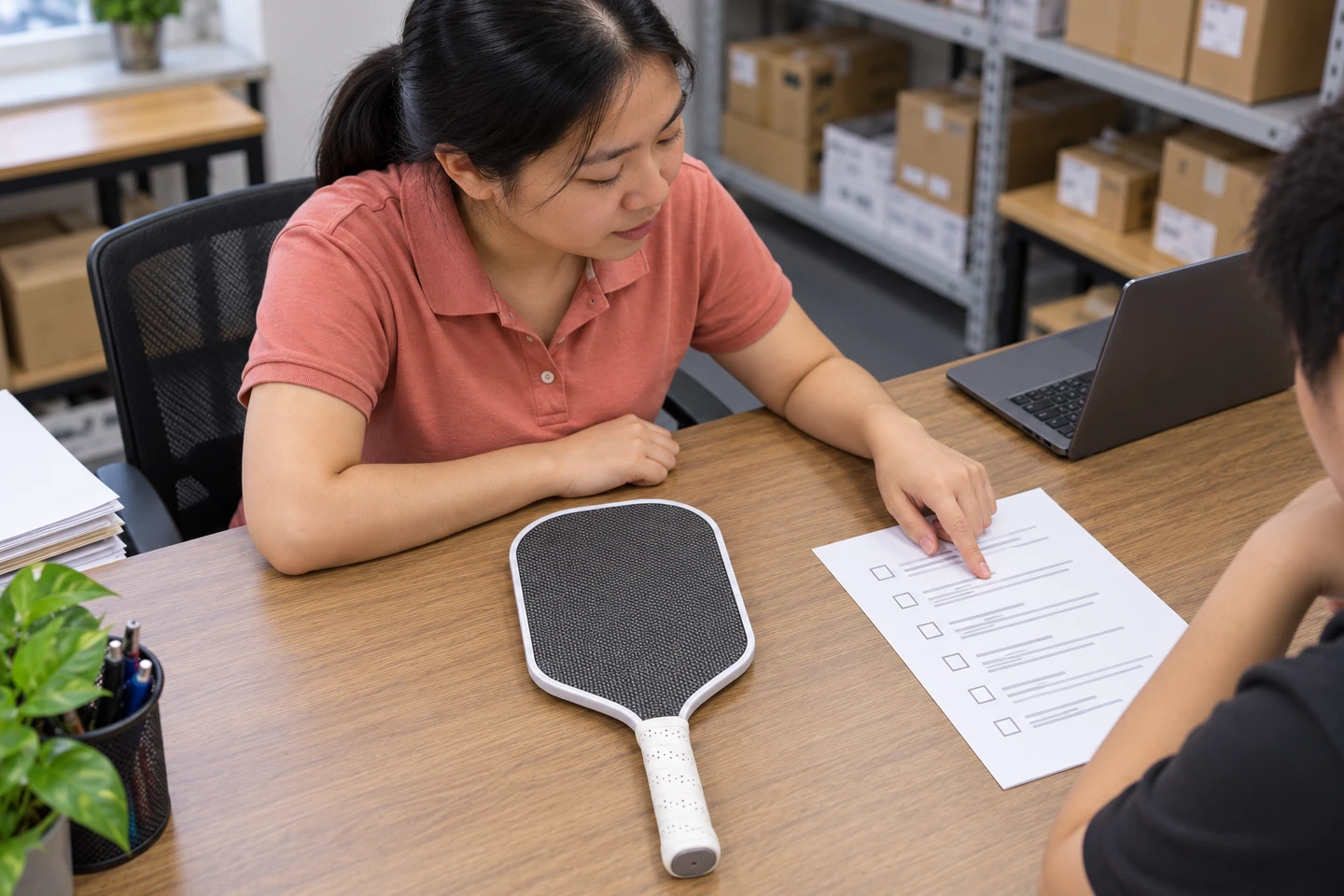
Use the agreed paddle specification checklist to identify what was requested. Add photos for visible concerns and a short account of the trial conditions for playing feedback. Tell us which findings affect acceptance now and which are preferences for a later version.
| Finding | Next decision | Information to send |
|---|---|---|
| Clear mismatch with agreed appearance | Request a specific correction | Reference, sample view and location |
| Grip fits the brief but not the target player | Discuss a defined adjustment | Current setup and intended change |
| Playing comments conflict or lack context | Repeat a focused trial | Player, ball, shot and conditions |
| Agreed checks are satisfactory | Confirm the accepted sample scope | Build details and accepted appearance |
Do not make five samples promise an entire future lot
Development samples help you decide whether the configuration is suitable. They do not automatically establish the quality of goods that have not been made. Quality sampling 8 concerns a defined population or lot and an appropriate selection method. Do not describe a convenient small development set as statistical proof of future production consistency.
Keep the immediate question narrow: is this sample acceptable for the purpose you requested? If the answer is yes, state the accepted configuration and appearance. If only one part remains open, name it. Production inspection and later lot acceptance deserve their own agreement rather than an assumption hidden inside sample approval.
Close the review with a decision, not another pile of comments
Send a short summary that the supplier can act on: retain this build, correct this identified detail, or quote this named alternative. If another sample is needed, state what it must demonstrate. Do not simply ask for something “better,” because that can change several features without resolving your concern.
Keep the inspected sample and its relevant observations available for the next discussion. This article's task is to evaluate the sample in your hands; preserving the approved build through production is the next step. Clear feedback now makes that later conversation possible without turning the first trial into a promise about every future paddle.
Conclusion
Inspect appearance first, including edge color, face roughness and printed colors. Check the rubber ring, grip size, comfort and butt-cap logo next. Then evaluate power, outgoing ball speed and spin through a focused court trial. Keep mismatches, preferences and uncertain observations separate so your next instruction is useful: accept, correct or retest. A sample has done its job when it helps you make that decision clearly.
Discuss Your Sample Evaluation with SHUEN
For a custom Titanium Wire paddle, send the selected shape, core ID, thickness, appearance references and sample quantity. If you already have samples, add the exact concern, clear photographs and the conditions used for playing feedback so we can discuss the next practical step.